|
|
|
 |
| 1 | 2 | 3 | 4 | |
 |
COLUMBIA
FORUM
Rockwell Kent: Art
and Advertising
"Strictly
speaking, there can be no such thing as commercial art. If it is
the one, it cannot be the other," Rockwell Kent (Class of
1904) wrote in 1936. "A man is either an artist or he isn't one,
and the professional in that field of commercial activity had much
better leave the word 'art' out of the title of his
profession."
Kent's
contempt for commercial art was the result of a deep familiarity. A
native of Tarrytown, N.Y., Kent studied architecture at Columbia
but left after his junior year to study painting with William
Merritt Chase at the Shinnecock School on Long Island. In the first
two decades of the century, while he waited for his paintings to
generate a sufficient income, Kent worked as an architectural
renderer in New York, but America's entry into World War I in 1917
drastically curtailed construction and he found himself out of
work. Kent turned to advertising, and despite his claims of regular
conflicts with clients, worked steadily at commercial illustration
until after World War II, even as his more purely artistic
production prospered.
By the 1930s,
Kent was recognized as one of America's preeminent painters and
illustrators, known for his spare, often bleak landscapes and for
his highly stylized, formal figures. Widely known for his wood
engraving and lithography, Kent illustrated classic books such as
Moby Dick, The Canterbury Tales, and Shakespeare's plays,
and became an outstanding bookplate designer. He was also a
successful author, publishing and illustrating N by E and
Wilderness: A Journal of Quiet Adventure in Alaska. In the
1940s, Kent's popularity declined with the rise of modern art.
Although he had vigorously supported America's entry into World War
II, his reputation suffered from his leftist political activism in
the late 1940s and 1950s, which ultimately led to his being brought
before the House Committee on Un-American Activities.
An exhibit,
"Commercialism and Idealism: Rockwell Kent - Bringing Art to
Advertising," at the Plattsburgh State Art Museum, State University
of New York, (www.plattsburgh.edu/
museum) revisits the neglected commercial aspect of Kent's
work. The museum assembled 150 of Kent's commercial works in the
exhibition, which also celebrates the 25th anniversary of the
museum's Rockwell Kent Collection. This exhibit, on display through
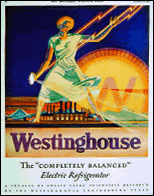
December 2000, features images Kent published in newspapers and
magazines, such as the ad for a Westinghouse refrigerator seen
here. The museum will hold a Rockwell Kent symposium in September
2000.
Plattsburgh's
exhibit is one of three retrospectives in the northeast remembering
Kent. In May 1999, the Adirondack Museum in Blue Mountain Lake,
N.Y., (www.ADKmuseum.org)
opened "The View from Asgaard: Rockwell Kent's Adirondack Legacy,"
an exhibition of Kent's nature paintings along with some of his
commercial art and artifacts from Asgaard, his upstate New York
farm; the exhibit will be on display until October 2000. In
addition, The Norman Rockwell Museum in Stockbridge, Mass.
(www.nrm.org) currently has on
display "Distant Shores," an exhibition focusing on Kent's
depictions of wilderness (until October 2000).
| |
| 1 | 2 | 3 | 4 | |
|
|
|
|