 |
 |
 |
 |
 |
|||
|
COLUMBIA
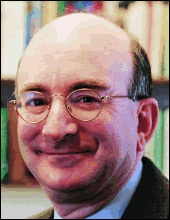
FORUM On October 2, 1999, Alan Brinkley, the Allan Nevins Professor of History, joined art historian David Rosand '59 and political scientist Jack Snyder in the class of 152 new fellows at the American Academy of Arts and Science, an honorary society of members chosen in recognition of distinguished contributions to science, scholarship, public affairs, and the arts. Brinkley is a noted scholar of American history whose most recent books are Culture and Politics in the Great Depression (1999) and Liberalism and Its Discontents (1998). One of only three new members who spoke at the induction ceremony at the House of the Academy in Cambridge, Mass., Brinkley used his remarks to highlight the inequalities that threaten American society.
It is my great privilege this evening to speak on behalf of the newly inducted members from the humanities, and I am sure I will be expressing a view shared by all of them in saying how honored I am to have been elected to this great and venerable Academy. We have been asked tonight to speak about a critical issue facing our nation in the next century, now only 90 days away. In considering what to say, I could not help thinking about how some of our ancestors of a century ago tried to answer the same question and how familiar some of their answers might sound to us now. The challenge of the twentieth century, H.G. Wells and Henry Adams said, was mastering scientific and technological progress and using it for the benefit of mankind. The problem with the twentieth century, W.E.B. DuBois said, was the problem of the color line. The greatest danger facing the twentieth century, Eugene V. Debs warned, was protecting democracy from the great centers of economic power that menaced individual liberty. The great task confronting the nation, Theodore Roosevelt said, was bringing practical efficiency and some measure of social unity to a diverse and fragmented society. But to many other Americans a century ago, the most important problem facing the twentieth century was what, one could argue, is also the most significant problem facing the twenty-first - the problem of inequality. Inequality is a global problem, of course, and its most serious and dangerous manifestation is undoubtedly the vast and growing gulf that separates the modern industrialized world of which we are a part from the poor and wretched societies of much, perhaps most, of the rest of the globe. But our own nation struggles with problems of inequality, too. Almost everyone is aware of the wage stagnation that has affected the majority of Americans over the last 30 years, and the growing economic inequality that this stagnation has produced and which the dramatic prosperity of the last 15 years has barely touched. There are great differences of opinion about whether economic inequality is by itself a social or moral problem. John Rawls, for example, has argued that inequality can, in theory, be compatible with justice if it contributes to the improvement of the lives of all. But whatever one thinks of Rawls's claim, there is a kind of inequality that seems to me inherently incompatible with justice, and incompatible as well with the values that most Americans claim to treasure. And that is inequality of opportunity - a problem that has gone largely unnoticed in the self-congratulatory public world of America today. There can be little doubt, I think, that the United States will enter the twenty-first century with barriers to opportunity considerably higher for many of our citizens than at all but a few moments in our history. There are many reasons for this - job structures, families, housing, heath care, public safety, many others. But the one that should perhaps be of most concern to those of us in this room are the barriers that exclude so many Americans from the world that many of us inhabit, education. There has probably been no era in history in which access to knowledge has been more indispensable to anyone hoping to flourish in the world than our own. And there may also have been no time in our recent history, at least, in which the quality and availability of education has been less equally dispersed. In a world profoundly and increasingly shaped by dramatic advances in science and technology, millions of American children receive virtually no exposure to even the most basic scientific skills or concepts. In a society in which rapid and effective communication has become central to our lives, vast numbers of students struggle and often fail simply to learn to read and write. Many of our supposedly better schools, even some colleges and universities, manifestly fail to prepare their students adequately for the challenges that they will face in the new century. The differences between the best American schools and the worst are now not just differences in degree, but increasingly differences in kind. The promise of America has never been the promise of equality of condition, although some Americans might wish that it were. The promise of America has, rather, been equality of opportunity. It has been an elusive promise throughout our history, but seldom far from the center of our nation's concerns and aspirations. Today, I fear, it may be slipping further than ever from our grasp. The world of the arts and sciences has waged a brave and honorable battle for many generations to defend artistic and intellectual freedom, and that battle is not over. But it seems to me that those of us who treasure and benefit from the unfettered pursuit of knowledge and free expression should be equally committed to insuring that the things we value and fight to defend are available to everyone.
|
|
|||||||||||||||||||||||||||||||||||||||||||||||||||||||