 |
 |
 |
 |
 |
|||
|
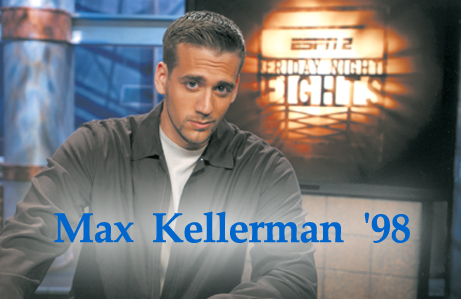
Max On Boxing by Sarah Lorge '95 It was the television equivalent of a first-round knockout. When boxing connoisseur Max Kellerman '98 was approaching his College graduation, he put together a demo tape and a press kit representing the best of the public access show Max on Boxing, which he had started while in high school. He made 25 copies and sent them off to various networks. Evidently, the tape packed some punch, because ESPN came calling. Voilà: gainful employment. And not just any employment. Kellerman, then just 24, went from student to network studio analyst in one quick step - or giant leap. In October 1998, Friday Night Fights debuted on ESPN2. Kellerman and Brian Kenny, a veteran of ESPN staples such as SportsCenter and Baseball Tonight, co-host the 21-2-hour show, which usually features three live fights with studio commentary before, in between and after. "I never planned to go into boxing to make a living," says Kellerman. "But when I was about to graduate, I realized it was either talk about boxing or work. I figured talking about boxing was a better deal." Despite his youth, Kellerman has become a fixture in the televised boxing world. But it's more than his age, spiky hair or gravelly New York accent that define him. His vehemently defended opinions, put forth with machine-gun fire rapidity and liberally peppered with comparisons of present-day fighters to greats of years past that display his knowledge of the sport's rich history, are his signature. "Max is like Scotch - you get used to him," says boxing historian and author Bert Sugar. "Previously, I found anything else to do [rather than watch Friday Night Fights]. But now it's part of my viewing diet because I really want to hear what Max is saying. And if he'd slow down, I could understand him!" Kellerman's passion is undeniable. It constitutes part of his attraction and translates into results: Friday Night Fights is ESPN2's highest-rated year-round series, watched in more than one-half million homes each week. In April, Kellerman was nominated for a Sports Emmy in the Outstanding Sports Personality/Studio Analyst category. The other nominees were sports TV heavyweights Terry Bradshaw, Howie Long, Tom Jackson and Kevin Kennedy. (Bradshaw took home the trophy.) As a youngster, Kellerman was captivated by fights on TV, and in junior high, his father took him to a nearby Police Athletic League club to try the sport for himself. But in 1982, Duk Koo Kim, a Korean boxer, died after a fight against lightweight champion Ray Mancini, prompting a deluge of negative publicity about boxing. Kellerman's mother forbade him to participate in the sport, so he says he "sublimated all that energy into following boxing." The knowledge he acquired, as well as his pure delight in the subject, had to come bubbling out somewhere, so his father helped him launch the public access cable television show. Kellerman did more than 400 segments of Max on Boxing starting when he was 16 and continuing for eight years. For a half-hour each week, he would sit in front of a blue screen and take questions from callers. "I watched it all the time," says Bob Raissman, sports media critic for The New York Daily News. "For his age, he had an incredible knowledge of boxing history. It was impressive because you knew that here was a kid who was probably going to school but had studied up on this, taking a lot of time. It showed a lot of gumption." Kellerman's reputation grew among hard-core boxing fans. Often, public access shows attract callers who will "curse and make idiots out of themselves," Raissman says. "But he [Max] never really got those calls. He got calls from people who were interested in boxing. He provided a good service." Dustin Hoffman was among his regular viewers. One of David Letterman's producers caught the show, and the novelty of it - a 16-year-old talking knowledgably about old-time fighters - won Kellerman an appearance on The Late Show. [ 1 | 2
] |
|
|||||||||||||||||||||||||||||||||||||||||||