|
|
|
COLUMBIA FORUM
Experiments in the Everyday

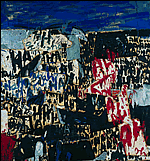
Allan Kaprow,
Hysteria (1956). 79" x 72", oil, aluminum, foil, and canvas on
canvas.
 |
During the
1960s, artistic production in America shifted from abstract
expressionism to a new aesthetic vision that employed everyday,
industrial materials and challenged traditional perceptions of what
was art. "Experiments in the Everyday: Allan Kaprow and Robert
Watts - Events, Objects, Documents," an exhibition on display at
the Miriam and Ira D. Wallach Art Gallery, highlights the work of
two avant-garde artists central to this aesthetic transformation.
The two works presented here - Allan Kaprow's Hysteria (1956) and
Robert Watts's Table for Suicide Event (1961) - are among more than
80 works on display.
Although both
artists began as abstract expressionist painters, each moved beyond
the limits of the painted field. Best known for his collage-like,
collaborative performances known as "Happenings," Kaprow (b. 1927)
worked to move art into everyday spaces. Watts (1923-1988), too,
tried to break down the distinctions between art and the everyday,
becoming a key figure in the quasi-anarchic artists' collective
known as Fluxus and producing unconventional projects and objects.
Both men received master's degrees in art history from Columbia -
Watts in 1951 and Kaprow in 1952 - though they did not become
friends, or collaborate on any projects, until after 1953, when
they were each hired by Rutgers.
The Wallach
Art Gallery is located on the 8th floor of Schermerhorn Hall; the
exhibit runs from 1 to 5 p.m., Wednesday to Saturday, through
December 4 (except Thanksgiving week). A fully illustrated
catalogue will be available from the Wallach Gallery for $30. For
more information, please call (212) 854-2877.
|
|
|