 |
 |
 |

|
 |
|||
|
COLUMBIA
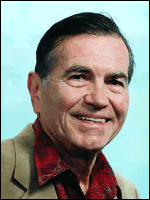
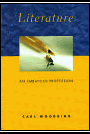
FORUM "Segregated as a graduate teacher, I came late to the core program at Columbia College," admits Carl Woodring, George Edward Woodberry Professor Emeritus of Literature. A specialist in British literature, Woodring, the author of Politics in English Romantic Poetry and co-editor (with James Shapiro '77) of The Columbia Anthology of British Poetry, became an important member of the program and helped organize Columbia's Society of Fellows in the Humanities. In this selection from Literature: An Embattled Profession, his assessment of literary studies in America, Woodring discusses the continuing applicability of the Core Curriculum and the virtues of commonalty.
Issues, ideas, values, and varieties of accomplishment predominate in the Columbia program, but commonalty comes only a step or two behind in significance. Whatever the great books may have been at Chicago under [Robert] Hutchins, they certainly have not preserved an elite ideology at Columbia. The books speak differently not only to different generations but to each teacher and each student. The books contain issues and values; they do not dictate a response. One who experienced the jar and challenge of the books twice as a student has concluded that the Core provides "actually the most radical courses in the undergraduate curriculum." The readings create a commonalty; they stimulate thought but do not control it.... Annual inspection of the canon leads occasionally to substitution for the following year of one or two titles; a Gulliver's Travels may return from banishment a few years later; a Malcolm X tends to fill a revolving slot near the end. Teachers meet at the beginning of each week for discussion of that week's assigned work (normally amounting to an epic, a novel, or three plays) usually with a presentation from a specialist in that corpus. Authority, without a lecturer, resides in the works read, and these are kept open to rational challenge. Most of the teachers are able to maintain a high degree of what is now sometimes condemned as objectivity, enough at least to take the role of devil's advocate against interpretations that seem to be predetermined rather than derived from reading with an open mind. Normally, under urging, a student will have taken Literature Humanities in the first year and Contemporary Civilization in the second. On the campus and in nearby bars, students concur or argue about cruxes in the readings of that week or the previous month. Rather than Great Books easily coaxed into preserving gentlemen's agreements, most of the works read have called readers of each generation into dissatisfaction with self and with unexamined assumptions. Responses to the Core demonstrate the pliancy of tradition; most of the works recommend change explicitly, the others implicitly. Until teachers are superseded by robots, the classes will not imbibe "an idea of Culture that is encapsulated into tokens and affixed to curricular charm bracelets to be taken out at parties for display," as one jealous for "the demotic, folk, vulgar, idiosyncratic, ethnic, erotic, black, 'women's,' and genre poetry" has charged of great great Great Books. Every teacher of a class for upperclassmen at Columbia can expect students to understand allusions to concepts or phrases from the seminal works read in the courses required of all. A Manhattan or Albany lawyer who hears another in the firm allude to idols of the cave with reference simultaneously to Bacon and to Plato recognizes a fellow graduate of Columbia College. Imagine for a moment the value if every sophomore in the United States had read carefully under tutelage the same epics, dramas, satires, and philosophic and political essays - imagine that all had read Montaigne or all had read Alice Walker. Call the required writings masterpieces, great books, important books, good books, or works exerting influence, the requirement brings a common knowledge and shared experience that would be of social value even if the assignments were writings of current interest likely to be ephemeral. In an old Vassar phrase, everything correlates - with a little prodding and shoving. Commonalty and pursuit of open-mindedness could be achieved by an informed selection of recent works chosen for cultural, geographical, and ideological diversity, including the demotic, folk, vulgar; ethnic, and idiosyncratic - but achieved only among those exposed to this selection. One of the values of selecting from among works long considered readable is the greater likelihood of reaching through them toward a commonalty embracing significant numbers. Across the continent more teachers are likely to vote for Don Quixote than for [Saul] Bellow's Herzog. The purposes expressed in George Washington's will are still valid. He there recommended a national university not only to meet the need for education in arts, sciences, and politics but also that future leaders, he said, "(as a matter of infinite Importance in my judgment) by associating with each other, and forming friendships in their Juvenile years, be enabled to free themselves in a proper degree from...local prejudices and habitual jealousies." Not all habitually bickering members of Congress can now be expected to attend the same college, but every step toward a common education (as national prejudices will not be "local prejudices") is a step across the nation toward mental and intellectual freedom. Even Gerald Graff's "teaching the conflicts" can be offered as "a common educational experience" within each institution, but graduates would then need to meet others who have had a similar intellectual experience elsewhere. Commonality in higher education would be a partial remedy for the absence from secondary schools and family influence of what E. D. Hirsch Jr. calls cultural literacy, "a common body of knowledge and associations." Nationalism is a virtue when compared with tribalism. The job is not to create an instant commonalty but to identify the commonality that begins in geography and law. Two noble traditions intersect: to join the search for such truth as knowledge can afford, and to persuade in just causes....
A choice of works in English from Great Britain, Ireland, the United States, Canada, the Caribbean, Australia, New Zealand, India, and many bilingual locations would avoid one objection frequently raised against the Columbia program. As the Literature Humanities course can draw teachers from a dozen departments and includes translations from Greek, Latin, Italian, French, German, Spanish, and from time to time other languages, few teachers of any one work are adept in the original language of that work. The loss is not merely in pinpoints of meaning but in a galaxy of linguistic skills and nuances. Particularly if students are reading in translation it is preferable to have a teacher who knows the original language. Teachers can consult with colleagues better informed, but consultation cannot cure the need for multilingual competence. In employing teachers not polyglot, something is lost that much may be gained. When challenged in faculty meetings - "Do you think useful value results from reading Dante in translation?" - [Professor of Literature John] Erskine [Class of 1900] answered with a question, "Do you think anything of value can come of reading the authorized King James Version of the Bible?" The dedicated teacher seeks knowledge endlessly, but whole continents of knowledge will fail to outperform, in consequences for education, an awareness of the bordering shore where an ocean of unknowing rolls in against the teacher's knowledge. Here, then, is one chance to debate "the conflicts": Could a strong basic course in literature be devised from works all without translation but from the full range of cultures that have produced writing in English? The greatest value of Literature Humanities at Columbia may be its golden reputation. Why do most students in this course climb mountains of reading each week and write about it with personal spark? In most universities the teacher of an institution-wide required course in literature or writing confronts underclassmen who attend grumpily under compulsion. The teacher must ask of every required piece of writing in such courses if any evidence of unexpected superiority results from plagiarism. It is not so in the Columbia Core. I drew breath on my first day in Humanities A when the half-expected question that followed a raised hand was, "Humanities, okay, but why does it have to be required?" From all sides of the small room, from half of the twenty freshmen assembled for their first day, came assurances that this course would be the greatest experience in that guy's life. Everybody said so. On a Dean's Day, when [University Professor] Edward Said was nominated to expound on the folly of teaching from translation works the teacher could not read in the original languages, in a course aspiring to universality, and a Fellow of the Humanities was nominated to defend a course she was encountering for the first time, parents in the room who had taken the course as given in their time rose to offer testimony as born again humanists. Such responses account in good part for the impressive stability of the canon in that course and the continuance of a very expensive educational instrument. Word passes from father to daughter. From Literature: An Embattled Profession by Carl Woodring. Copyright © 1999 Columbia University Press. All rights reserved. Used by arrangement with Columbia University Press.
|
|
||||||||||||||||||||||||||||||||||||||||||||||||||||||