 |
 |
 |

|
 |
|||
|
COLUMBIA
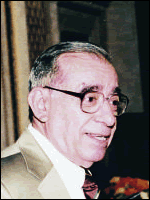
FORUM As countless alumni and students know, Columbia College has few more erudite and articulate spokesmen than James V. Mirollo GSAS '61, the Parr Professor Emeritus of English and Comparative Literature. But even a seasoned veteran such as Mirollo, longtime chair of the Literature Humanities program and now a member of the Society of Senior Scholars, was taken somewhat aback when Columbia's status as heir to the original King's College was challenged. In this excerpt from a talk given at the Class of 1939's 60th reunion dinner on October 22, 1999, Mirollo related a little-known dispute concerning Columbia's history.
In the fall of 1998 I represented Columbia College at a national conference on "Teaching the Humanities" held at Rhodes College in Memphis. I was surprised but pleased to learn once again how influential our Core Curriculum experiment has been and continues to be, to judge from the enthusiastic reception and eager questions I encountered there. A second surprise came from a chance remark I made during my presentation that Columbia was already looking to and preparing for its 250th anniversary in 2004. Soon thereafter I was confronted by another participant, Peggy Heller, a professor from the University of King's College in Halifax, Nova Scotia, who firmly if good naturedly questioned the legitimacy of our King's College (later Columbia College) as opposed to hers! Here are the facts: In 1754, King George II granted a charter to a new King's College here in New York to be built on five acres in lower Manhattan donated by Trinity Church. The first president of this Anglican institution was one Samuel Johnson. While not connected to the Sam Johnson, this first president deserves a footnote in intellectual history for having been an early convert to the philosophy of George Berkeley (1685-1753), with whom he corresponded. According to the Concise Columbia Encyclopedia, which never errs, Bishop Berkeley believed in "subjective idealism," to wit, that material objects do not exist apart from someone perceiving them (except in the mind of God, of course). I digress about this Johnson because it seems to me that existence and perception play a key role in the rest of my story. Also, what this legacy from the first president of Columbia may have portended for the way his successors have handled endowments and budgets intrigues me, though I cannot pin it down! Between 1760 and 1776, the endowment of this new College grew largely from contributions solicited in England by John Jay [Class of 1764] for what was an Anglican institution run by Anglicans. By 1770 its endowment was £15,000, the largest in the soon-to-be USA (and the last time that has happened). After the wars and the secession of 1776, attendance and offerings declined here in New York. But by 1789, the College had been re-established in Nova Scotia, and in 1802 King George III transferred the charter from New York to Halifax. Even though the New York Legislature had sanctioned the re-opening in 1784 of a secular university "heretofore called King's College" now to be called Columbia, the question remained, which is the real King's College? Fast forward to 1978. Undoubtedly hoping to stimulate a flagging fund drive, Dr. John F. Godfrey, the then president of King's in Halifax, loudly announced his school's claims to Columbia's land and endowment. And to the amusement of the national media, which gave him the publicity he sought, he declared that he was prepared to sit in Columbia President William McGill's office to assert his claim. Since, he argued, Columbia had betrayed its Anglican lineage with the selection in 1948 of Dwight D. Eisenhower as University president (Eisenhower was a Presbyterian, unlike all of his predecessors, who were Anglicans), the original endowment belonged to his school - he even estimated the debt as about $460 million (including land and assets). When Godfrey met with McGill in New York in June 1978, he offered to settle for $50 million and a takeover of Columbia. The offer was rejected, as President McGill replied in a letter of September 1978:
It was agreed, however, that the matter should be the subject of a debate between Columbia and King's students at Halifax in the following spring. And sure enough, in May 1979, Columbians Jace Weaver '79 and William Dolan '79 went north to defend the cause. The final vote at the debate was 5712 to 2812 in favor of Canada. (One of their alumnae had received a graduate degree from Columbia and so awarded half of her vote to each side!) During the debate Weaver had suggested, reasonably, a settlement of the original £15,000 raised in England, which, adjusted for inflation and exchange rates, he estimated at $17.54. But after the Canadian debaters pointed out that the two Columbia students had joined in toasting the Queen at dinner, and that both wore crowns on their blazer crests and ties, Dolan conceded that Halifax had a case. He then argued why Halifax would be better off without being saddled with Columbia! But if they insisted, nevertheless, on taking over, he would offer the services of himself and Weaver as administrators of the new university. And so matters stood until 1998, when Peggy Heller and I resumed the debate. In her letter of November 25, 1998, Peggy offered on behalf of her colleagues to settle for yearly installments of $25 million, after wondering whether I thought "Columbia's celebrating a 1754 founding was legitimate?" Not to mention the legitimacy of the American Revolution itself, she added. In my reply of December 4, 1998, I confessed:
Author's note: To be utterly fair, I have relied on materials supplied to me by Professor Heller from the archives of King's College North. Our own archives may tell a different, and less amusing, story, which is why I have shunned them. Editor's note: Despite Professor Heller's protestations, the "official" history of the University of King's College, Halifax, as presented on the school's website (www.ukings.ns.ca/Kings/about/history.html), dates that school's founding to 1789, without making any exaggerated claims against Columbia's lands or assets.
|
|
|||||||||||||||||||||||||||||||||||||||||||||||||||||