 |
 |
 |
 |
 |
|||
|
COVER
STORY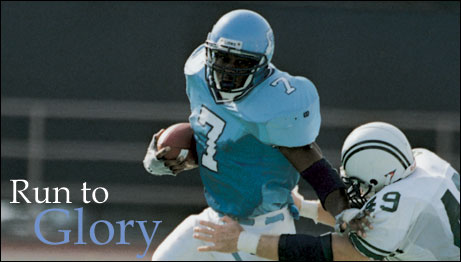 By Jonathan Lemire '01
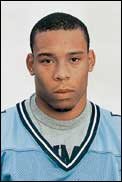
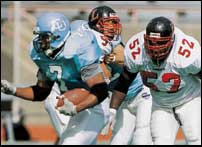
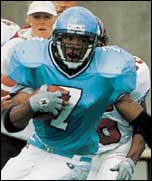
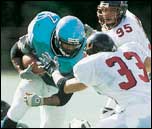
Until that sunny Saturday, Columbia's record for most rushing yards in a single game was held by Jim O'Connor '69 — 225 yards against Brown in 1966. The school record for most rushing yards in a season, 914, was set by Doug Jackson '76 in 1975. And the mark for most rushing yards in a career, 1,992, was compiled by Lou Kusserow '49 in 1945-48. Before a homecoming crowd of 9,289 at Baker Field's Wien Stadium on October 21, 2000, Reese broke two of those records and came within three yards of shattering the third, as the Lions pounded Dartmouth 49-21 in the most one-sided effort by Columbia in the history of the series, which dates back to 1899. Most impressively, the 236-yard, four-touchdown performance — the single greatest day of any Lion running back in school history — took place in just the sixth game of Reese's junior season. It had taken him four fewer games than Jackson to establish the season rushing record — he would finish the 2000 campaign with 1,330 yards on 263 carries, a 5.1 average — and he was just three yards shy of setting the career mark in a season-and-a-half less than it took Kusserow. Reese enters his senior year having gained 2,354 yards for the Light Blue.
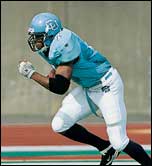
The case easily can be made that while Columbia football has had more than its share of star quarterbacks including Sid Luckman '39, Gene Rossides '49, Archie Roberts '65, Marty Domres '69 and John Witkowski '84, it has never had a running back like Johnathan Reese, nor like former Ivy standouts Ed Marinaro of Cornell or Calvin Hill of Yale. Asked to rank Reese among the Lions' all-time rushers, Bill Steinman, a veteran of more than three decades in the Columbia athletics communications office, says, "It's hard, because on the heels of just one super season he seems to have outdistanced them all. For the most part, the Columbia football record book just says ‘Reese.' Johnathan not only passed Lou Kusserow's records, he overwhelmed them." "The records weren't that big of a deal," Reese says in typically modest fashion, when asked to reflect upon his performance against Dartmouth. "It was more important that we won the game." "But," he allows after some thought, "I guess it was pretty amazing that so many of them came on that same day." Kusserow's career mark fell on Columbia's first offensive play the following week at Yale, but the team could not match the performance of its star running back. While Reese continued to pile up 100-yard rushing efforts, the Lions dropped their final four games of the season to finish at 3-7 including an Ivy mark of 1-6, a major disappointment for a team that had hoped to challenge for the league title. The undisputed bright spot of the season was Reese. The 6-1, 210-pound running back scored 18 touchdowns rushing, another Columbia record. He caught 20 passes for 254 yards and returned 10 kickoffs for 368 yards and another touchdown. His 36.8 yards per kickoff return would have led the nation had he qualified for the NCAA leaders by running back two more kicks. He ranked sixth in the nation in scoring and 14th in rushing, and was selected unanimously to the first-team All-Ivy squad.
So what can Reese possibly do for an encore as a senior? "I started working out earlier this offseason than before, and I'm working harder," he says. "I'm going to be better this year, and most importantly, so is the team." Reese's journey to collegiate stardom began in his native St. Louis. His high school career at St. Louis Country Day School was impressive: he totaled nine varsity letters and excelled at basketball, baseball and track, as well as his first love, football. He was named his league's MVP as a senior and took his team to the 1997 state championship game at the Trans World Dome, home of the NFL Rams. He was also an honor roll student, and that naturally drew the attention of the Ivy League to the streets of the Gateway City. "Most of the schools in the league recruited [Reese]," says Columbia coach Ray Tellier, "but we went after him hard and we were fortunate that he chose us." Tellier benefited from an ace in the hole. Kirby Mack '00 earlier had transferred to Columbia from the University of Virginia to take up residence as the Lions' fullback (he moved to outside linebacker for his senior season). And just as he bolstered the Light Blue's running attack in 1998, Mack also improved it by his actions off the gridiron: He is Reese's cousin, and immediately began recruiting the high school standout. "I wouldn't say I played a huge role in Johnathan's decision," says Mack, "but the fact that I was going to be at Columbia probably helped him feel comfortable going there." Reese also cites the lure of the Big Apple in his decision.
"The appeal of New York City was a major factor for me," he says. "When I stepped off the plane at LaGuardia [for a recruiting visit], "I was just blown away by all of the tall buildings. Growing up in Missouri, you don't see buildings like that so close together." While Reese, a history major, has come to know and love many of Manhattan's attractions during his time at Columbia, his primary focus has been improving the Lions' on-field fortunes. When he arrived on campus, Columbia was looking to bounce back from a disappointing 4-6 season just one year removed from the Marcellus Wiley-led 8-2 1996 campaign. "Like every first-year, I wanted to be the one to change the program around," says Reese, "and I was frustrated by having to sit on the bench so much." His playing time increased as the season went on, however, and Reese finished the year with 417 rushing yards, good enough to earn him Ivy League Rookie of the Year honors. "He played more than first-years do," notes Tellier, "and he made an immediate impact. We always knew he was going to be a real good player, but even we didn't know how good." Though hampered by nagging injuries, Reese showed flashes of brilliance in his sophomore year. He gained 607 yards on the ground and scored four touchdowns, but he was far from satisfied with his performance. "As a sophomore, I was not prepared to take over and become the focal point of the offense," he says. "After that season I knew I wanted to grow both mentally and physically." And grow he did. Reese added almost 20 pounds of muscle that offseason, but Mack believes that the extra bulk was not the most important addition his cousin made before the 2000 season.
"He definitely did get bigger and faster," Mack said, "but he also developed a mental toughness he didn't have before. In high school, he was always used to being the best by just stepping out on the field. He needed to make the mental adjustment that that is not how things work in college." The changes paid off. In the season opener against Fordham, Reese seemed to draw energy from the excitement surrounding the Lions' first night game in the 77-year history of Baker Field by ripping off 172 yards in a 43-26 rout of the Rams. The message was sent: the 2000 Lions were Johnathan Reese's team. "They're going to put the ball in Reese's hands," Fordham coach Dave Clawson told the Columbia Daily Spectator after the game, "and they're going to go as far as he can take them." Reese did his part. He rushed for over 100 yards six times and over 200 twice — the record-setting day against Dartmouth and a 201-yard game against Lafayette. Unfortunately, the Lions' deficiencies were too much for even Reese to overcome. While the offense blossomed under starting quarterback Jeff McCall '02, the defense was porous, giving up over 40 points in six of their 10 games. The Lions also faltered in close games, losing all three contests they played that were decided by four points or less. "It's no secret that our defense struggled last year," says Tellier, looking ahead to the 2001 campaign that begins at Fordham on Sept. 15. "That will need to improve, as well as our ability to win tight games. The offense was good, though, and should only get better, and Johnathan's continued development is a big reason for that." For the upcoming season, Reese's leadership will be officially recognized: He's been picked as one of the Lions' captains by his teammates. Mack believes that Reese, a very quiet and reserved individual, will do an excellent job leading by example.
"He's a great teammate," Mack says, "and everybody likes him. He'll work hard and get the most out of that team." Like most fiercely competitive athletes, Reese's only stated goal for the upcoming year is a team championship. He does, however, have his sights firmly set on where he'd like to be a year from now. "I want to play in the NFL," Reese says. "I believe I have the talent and work ethic to at least get a shot at making it. It's what all football players want, and I'm no exception." He's not eager to leave Columbia just yet, however. "At first, I was a little distant from the school because I was frustrated with how things were going on the football field," says Reese. "But now that the end is almost here, I don't want to leave." Before graduation comes for Johnathan Reese, there will be 10 more football games, 10 more chances to add to his already impressive entry in the Columbia record book. Mack, who as a linebackers coach for Brown will have the challenge of trying to stop Reese this season, believes that more greatness is in store for the most accomplished running back in Columbia history. "I know my cousin," Mack said, "and we've yet to see the best of Johnathan Reese." About the Author: Jonathan Lemire '01 is a former columnist and associate sports editor of Spectator who wrote the cover story on Lerner Hall in the May 2000 issue of CCT.
|
|
|||||||||||||||||||||||||||||||||||||||||||||||||||||||||||||||||||||||||