|
ALUMNI PROFILE
Rosencrans Named to Cable Hall of
Fame
By Alex
Sachare
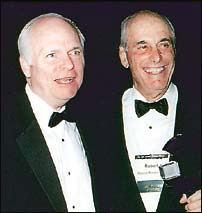
Robert M. Rosencrans ’49, the cable television
pioneer who helped lead the industry to breakthroughs in
programming and technology and was one of the key figures behind
the development of C-SPAN and the USA and MSG Networks, has been
inducted into the Cable Television Hall of Fame.
A
former chairman of the College’s Board of Visitors,
Rosencrans earlier this year received a John Jay Award for
distinguished professional achievement. He was inducted into the
Cable Television Hall of Fame by the Cable Television Museum in
Denver on May 7.
Rosencrans began his career with Box Office Television, which
he formed in 1953 to provide closed circuit telecasts to theaters,
hotels and arenas, and later served as vice president and director
of closed circuit television for TelePrompTer. In 1962 he bought a
small cable television service in Washington state called Columbia
Television Co., which through a series of acquisitions and mergers
became UA-Columbia Cablevision. It constructed and franchised major
cable systems in New Jersey, New York and Texas and installed the
first earth station in the cable industry, to receive HBO
programming. In September 1975 it broadcast the Muhammad Ali-Joe
Frazier heavyweight boxing championship bout — the
“Thrilla in Manila” — to its Florida
subscribers.
That
fight underscored for Rosencrans, an avid sports fan, the
possibilities cable presented for broadcasting sports events. In
1977, UA-Columbia joined with New York’s Madison Square
Garden to create the MSG Sports Network, the nation’s first
satellite-delivered basic cable television service, with Knicks and
Rangers games as its programming cornerstone. Seeking to broaden
the network’s audience, general programming was added to what
was then called the USA Network, which developed into one of
cable’s most successful channels.
“The cable business has always been about risk and about
people with the strength and vision to take those risks. Bob was
one of those,” said Jerry Levin, chairman of Time
Warner.
After leaving UA-Columbia in 1984, Rosencrans formed Columbia
International, a major cable systems operator that sold its cable
systems to TCI, Jones Intercable and Continental Cablevision for an
amount the Wall Street Journal estimated at $600
million.
Rosencrans always believed cable television provided an
opportunity to present positive messages and was one of the
earliest supporters of public service cable broadcasting. In 1977
his initial investment helped create C-SPAN, then he worked hard to
mobilize the cable industry behind the not-for-profit network as
its founding chairman.
“Bob tried to give back to the industry,” said Kay
Koplovitz, longtime head of USA Network. “He was always
interested in bringing programs that would make the industry proud,
that would make us want to stand up and say, ‘We’re
doing something good.’ That’s going to be Bob’s
legacy.”
|