|
FEATURE
Lightweights
Earn Trip to Royal Regatta by Winning Eastern Sprints, Then Bow to
Yale
By Bill Steinman
The
race course at the Henley Royal Regatta, the crown jewel of rowing,
is 2,112 meters long. To reach the starting line, crews begin from
slightly beyond the finish line and row the length of the course to
get into starting position.
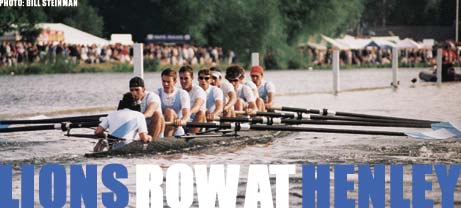
Columbia’s varsity lightweight crew rowed at Henley this
summer, but began much further away than those 2,112 meters. Two
years further.
The
Lion lightweights had made this trip before, in 1998. Coming off a
second-place finish in the national championships at the IRA
Regatta, they were sent, through the generosity of supportive
alumni, to Henley, where they reached the quarterfinals of the
Temple Challenge Cup before losing to Durham University.
Every person who made that trip for Columbia wanted nothing
more than to go right back the next year, in 1999. But it
wouldn’t be easy.
“We were told that the alumni felt finishing second in
the IRA that year [was reason enough] to be sent to Henley,”
James DeFilippi ’00 recalled, “but to go back again, we
had to win something big, like the Eastern Sprints or the
IRA.”
It
was not to be. The lightweights lost their first three races, won
two cup events, then finished second to Princeton at the Eastern
Sprints. Those two crews entered the IRA as co-favorites, and while
Columbia managed to reverse its order of finish with the Tigers,
the two crews crossed the line fifth and sixth, with Harvard
winning the race. There would be no return trip to
Henley.
“It was a strange season. Nothing was predictable,”
said DeFilippi. “We were confused and disappointed by the
fifth place. I was haunted by that all this past year. But now,
looking back, we all took that as fuel to work that much
harder.”
It
worked. The varsity lightweight crew that returned last fall, and
that coaches Tom Terhaar and Dan Lewis ’94 molded through the
fall and winter months, was even more formidable than in
1999.
“We knew from the get-go we had one of the strongest
boats in the league and the nation,” said DeFilippi, now a
senior and co-captain with Ryan Ficorilli ’01. “We just
had to keep working our butts off, and make the extra effort to
learn technique. We had the power and speed, we needed the
technique.”
Columbia lost its first two races, upsets at the hands of
Georgetown and Rutgers. “We were not rowing together very
well,” said DeFilippi. “Things hadn’t come
together yet — we hadn’t jelled. To Tom
[Terhaar]’s credit, he kept our heads up and focused. We
never counted ourselves out.”
But
the Lions needed to halt the pattern that was developing. Could
they do it the next week, in the most grueling test of the regular
season, the Dodge Cup against Yale, ranked first in the nation
among varsity lightweight crews, and Penn.
It
was foggy that April morning on the New York Athletic Club’s
Orchard Beach course, and spectators couldn’t see the crews
until they were almost at the finish line. When they came into
view, Yale was in front, as expected, but Columbia was closing
fast. Very fast. In fact, although Yale held on to win, Columbia
finished just three-tenths of a second behind.
The
race signaled the beginning of collegiate rowing’s most
closely contested rivalry of 2000. It also proved, both to the
rowing world and to the Lions themselves, that Columbia was a force
to be reckoned with. “It confirmed for a lot of us that we
weren’t lying to ourselves,” said DeFilippi. “We
really were fast! We realized that if we worked, we could win.
Through the next two races, we kept our eyes on our
goals.”
Columbia beat Cornell and MIT in the Geiger Cup, then topped an
accomplished Dartmouth eight in the Subin Cup. That set the stage
for the Eastern Sprints, on Lake Quinsigamond in Worcester,
Mass.
The
Eastern coaches had seeded the team fourth, to which the Lions took
exception. “Yale had won the HYP (Harvard-Yale-Princeton)
race, so we knew we were as fast as Harvard, Yale or
Princeton,” DeFilippi said. “We didn’t expect to
win, but none of us thought that we couldn’t do it. We knew
if we were to win, though, we would have to row the race of our
lives.” Even Terhaar, their coach who never goes out on a
limb, said he “thought it was possible to win the
Sprints.”
At
many major regattas, an observer rides along the race on a motor
launch, providing a play-by-play that is broadcast to spectators
near the finish line. But right before the lightweight Grand Final,
the ship-to-shore connection went out. So after the race began,
3,000 spectators were forced to wait on edge until the leaders came
into view.
When
they did, Harvard was in front, followed by Yale. And neck-and neck
with them was Columbia.
“At 500 meters, we were even with Harvard and
Yale,” Ficorilli recalled. “In the last 400 meters, we
started sprinting. We pulled ahead of Harvard and with three
strokes to go, we were tied with Yale. We pulled ahead in the last
three strokes!”

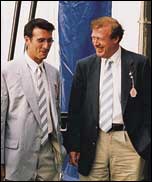
Dean
Austin Quigley (right) enjoys a moment at Henley with Coach Tom
Terhaar.
PHOTO: BILL STEINMAN
 |
The
boats crossed the finish line so close together, no one in the
crowd knew who had won. They milled nervously about, awaiting the
officials’ decision on the photo finish. On the lake, the
crews sat motionless.
“I put my head down and said a prayer,” DeFilippi
said. “We all said prayers and kind of held our breaths. Yale
was doing exactly the same.”
Finally came the announcement: “In third place with a
time of 5:55.63, Harvard.” It was met with a chorus of groans
from the Crimson fans. “In second place with a time of
5:52.59, Yale.” This elicited more groans, and a collective
gasp from the Lion faithful. Then came the cheers, almost drowning
out the announcement that for the first time since the Eastern
Sprints began in 1946, a Columbia varsity stood atop the list.
Columbia won in 5:52.48, a scant eleven-hundredths of a second
better than Yale.
Even
as the Lions were getting their medals and throwing both their
coxswain, Julia Baehr ’02, and their coach in the lake,
thoughts had turned to Henley. “We started thinking of Henley
when we put the boat in the slings after the race,” said
DeFilippi. “We can go, we thought, we’ve won a big
one.” In fact, Tom Sanford ’68 had brought a packet
containing a Henley application with him, and after the race he
slipped it to former lightweight rower Jim Weinstein ’84, who
approached Terhaar.
So
the wheels were already turning when the lightweights left
Worcester, heading directly for Dartmouth and a 10-day pre-IRA
training camp. They talked about the trip when they got to
Dartmouth, and worked on adjusting their schedules, postponing
summer jobs, classes and vacations.
“We were so excited about Henley,” DeFilippi said,
“but we had to get our minds off it and concentrate on the
national lightweight championship at the IRA in two
weeks.”
The
IRA, held on the Cooper River in Camden County, N.J., is a
three-day affair which until recently featured only heavyweight
crews. The lightweight competition takes place only on the final
day, a Saturday. The preliminary heats are the first event, usually
at about 7:30 a.m. The crews then go back to their hotels and rest
until the finals, which takes place at about 3:00 p.m.
On
the strength of its Sprints victory, Columbia entered the IRA as
the top seed. It won its qualifying heat, but got off to a slow
start in the championship race. Harvard took the early lead and
held it until the final 400 meters, when Yale pulled even and then
edged in front, with Columbia and Princeton closing fast. Those
three crews finished just six-tenths of a second apart, but it was
Yale that came in first, with Princeton second and Columbia
third.
Columbia’s rowers were disappointed to have missed the
title by so little, but they also were proud. “We had put
ourselves back into contention [after the slow start]. We
hadn’t given an inch,” DeFilippi said. “We knew
we hadn’t won, but we rowed a very, very good race.”
And Henley beckoned, just a few days later. “We started
thinking of Henley right after our race was over,” DeFilippi
said. “We knew we still could go to Henley and do very
well.”
Some
crews may approach Henley as a week-long holiday, a reward for
their hard work. Terhaar’s crews are not among them.
“It’s a carnival,” the coach said, “with a
really serious race in the middle of it.”
Columbia wasn’t there for the carnival. “We
weren’t over there to go sightseeing,” DeFilippi said.
“There wasn’t a lot of time to do anything. We
practiced twice a day. The rest of the time we watched TV, read, or
walked around the town.”
Columbia rowed in two preparatory races. In the Marlow Regatta,
the varsity eight entered two races, a 1500-meter row and a
500-yard sprint, and won them both, beating Yale in the finals of
each. A week later, Columbia rowed in the Reading Town Regatta,
also on the Thames. This time, Yale won the Elite Eight race, by a
length.
Official racing began at Henley on June 28, a Wednesday.
Columbia had been seeded — “selected” in Henley
lingo — and didn’t have to race until Thursday, against
Imperial College of London. “We were nervous before the
race,” DeFilippi said. “It was our first race at 2000
meters or more since the IRA, and we didn’t know anything
about Imperial College’s team.”
Columbia got off to a lead, Imperial caught up, then the Lions
moved out again. Suddenly Imperial’s boat began to zig-zag
across the course, finally running into a barrier on one side of
the course. By the time Imperial got going again, Columbia was well
in front and stayed there, winning “easily,” which is
rowing parlance for quite a few boat-lengths.
The
next race was on Friday against the University of Glasgow, which
had placed third in Great Britain’s national collegiate
championships. Glasgow’s rowers were larger than
Columbia’s, averaging 174 pounds to the Lions’ 161, but
Columbia had seen Glasgow row and “knew it was a race we
could win,” said DeFilippi.
Lewis, the assistant coach who rode in the umpire’s
launch, described the race as he saw it. “We had a little bit
better start, then we settled,” he said. “We were
already ahead. We put a little move on and established open water
[between us]. That was it.” Columbia crossed the finish line
for the 2112-meter course in 6:37, beating Glasgow by a comfortable
212 lengths.
In
winning its first two races, Columbia had learned not only how to
race over the Thames River course, but how to deal with the huge
crowds drawn to the spectacle that is the Henley Royal Regatta.
Over 100,000 people attended the Friday races, lining the entire
length of the course on both sides.
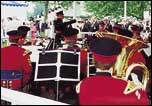
The
Band of the Grenadier Guards plays in the Steward's Enclosure, part
of the pagentry of Henley.
PHOTO: DAN RICHMAN '98
|
“All those people are fun, but extremely
distracting,” DeFilippi noted. “Every time you take a
stroke, there are people watching it. You get accustomed to racing
in the U.S., where the crowds gather at the end of the races. For
the first half or three-quarters of the race, it’s extremely
quiet because nobody’s on the side watching. Here you have an
audience all the way down the course.”
The
victory over Glasgow had moved Columbia into Saturday’s
quarterfinals — and another showdown with Yale. The two
schools had met six times during the season and post-season, and
each had won three times. From the moment they saw the draw, and
realized they could meet each other in the quarters, that match-up
had been on the minds of both schools’ rowers.
The
crowds had swelled, to put it mildly, by Saturday’s races.
More than 500,000 fans crowded into little Henley-on-Thames, lining
the course 50 and 60 deep in its entire length. The two Ivy League
crews, rowing slowly to the starting line, looked at the multitudes
in awe. Then the race began.
Yale
had the better start. “They led after 400 meters, then they
put on a move, which we matched,” DeFilippi said. “We
put on a move to catch them, but they matched it. All the way down
the course, they matched, we matched.”
Columbia had become known for its ability to come from behind,
but that’s very difficult at Henley, especially since heavy
rains the day before had caused a stiff current on the Thames,
flowing against the racers. “In the first 400 meters, Yale
got what they needed,” Terhaar said. “We rowed as hard
as we could. Anything we gave up early, we started to earn back.
They fought the whole way, like they fought the whole season. But
on a day like today, there was no catching up.”
Yale
swept across the finish line the winner in 6:40, with Columbia a
half-length behind. The Bulldogs went on to win its semifinal and
upset Oxford Brooks University in the finals to win the Temple
Challenge Cup.
“I’m disappointed to have lost, but we rowed a
great race, and I’m happy for Yale,” DeFilippi said as
he prepared to leave Henley.
“Yale did a great job,” Terhaar said, “and we
did a great job.”
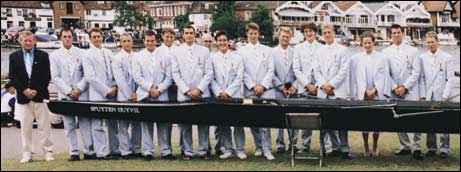
For
the second time in three years, Columbia’s lightweights had
traveled to the crown jewel of rowing, the Henley Royal Regatta,
and had done themselves proud. There was little doubt they’d
be back.
About the
Author: Bill Steinman
is senior associate director of athletic communications, a
fixture in the athletics department for three decades and the
lifeline you want to have left if the topic is Columbia sports
trivia.
|