|
CLASS NOTES
Columbia College Today
475 Riverside Drive, Suite 917
New York, N.Y. 10115
cct@columbia.edu
Louis R. Slattery '29 has retired as the surgical
coordinator at NYU Medical Center. "I am well and in good health,"
he writes. "I live alone, take care of myself, and walk a mile a
day in New York City. I follow the stock market and enjoy my
children and grandchildren."
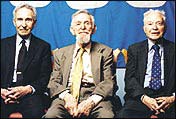
During reunion weekend, held from June 2-4 on campus, the Class
of 1930 was represented by Bernard Friedlander, a resident
of N.Y.C. (left in photo), and Dr. Felix Vann of Durham,
N.C. (right). That's professor Samuel Devons in the middle. The
Class of 1935 (no photo taken) was represented by Norman
MacLeod of Walnut Creek, Calif. and Hunter Meighan of
Mamaroneck, N.Y. Their classmate, Carl Relyea of Cincinnati,
had planned to attend, but had to cancel at the last
minute.
Paul V. Nyden
1202 Kanawha Blvd. East, Apt. 1-C
Charleston, W. Va. 25301
Murray T. Bloom
40 Hemlock Drive
Kings Point, N.Y. 11024
John Kluge, the only multi-billionaire in our class, has
been demoted. In Forbes magazine's annual 400 richest
"People in America," he was No. 12 in 1998 (with some $9.8
billion.) In the magazine's 1999 listing, Kluge fell to 14th. But
no condolence notes, please. His net worth increased to $11
billion.
Barry Commoner, our only classmate who ever ran for the
U.S. Presidency, resigned in March as head of the center for the
biology of natural systems at Queens College in New York. He will
continue working as a member of the center's staff. In 1980, he ran
for President on the Citizens Party ticket and got 23,186 votes in
New York State. Barry has another distinction. He probably has more
doctor of science degrees than anyone in the class.
There were four of us from '37 who went on to the Graduate
School of Journalism: Bob McMillen, John Oudine, Ken Steffan
and myself. Over the years I have seen or talked to Bob and Ken, so
I was curious to know what happened to John Oudine. I wrote
him.
"I
served in the Navy in World War II mostly in the Pacific. Then to
work with UNRRA in China in '46-47. Back in the States, I started
as an editor at the Navy's version of Time magazine, All
Hands. Moved up gradually until I was made editor. I was there
29 years... Met my first wife in Shanghai. She was also with UNRRA.
We had two children - daughter and son - and now I have four
grandchildren. My second wife was the daughter of a Russian sea
captain who escaped from the USSR and came to China to serve as a
harbor pilot out of Shanghai. I met her at a bridge table here in
the U.S. In retirement I bask in the sun on the shores of Lake of
the Woods, Va. and go to Old China Hands gatherings, most recently
in Alexandria, Va., in May."
I
hadn't seen Danny Friedman since our last ping-pong game in
Livingston in 1937 (he had a mighty forehand). I was delighted to
hear from him recently: "I am reasonably healthy. I have been a
Federal judge for 21 years and 10 years ago I took senior status
which means I can work as little or as much as I want... I work
about four hours a day... Last year I wrote 15 opinions, which is a
respectable number for a senior. My personal life hasn't been too
good recently. Two years ago my wife had a major stroke, which left
her unable to walk and with very serious speech problems. It has
been very hard for both of us... I keep in touch with Tom
Jones, who is living in retirement in North
Carolina."
Psychoanalysis, the darling of the "Thinking Classes" in the
'40s and '50s, has fallen on hard times. Critics abound,
particularly the New York Review of Books. One of its
articles, "Freud Under Analysis" in November, 1999, drew a long
rebuttal from Morty Ostow, who has been a psychoanalyst for
decades - as well as a psychiatrist and psychopharmacologist - with
offices in New York and Riverdale.
What
particularly interested me in Morty's letter was the closing, which
he signed as president of the Psychoanalytic Research and
Development Fund. I asked Morty for details. "The Fund has been
around nearly 50 years. We conduct study groups.each focused on a
specific subject and most of them lead to a published paper or
book. The group's work was summarized in a book I published in
1995, Myth and Madness (Transaction Press)."
Dr. A. Leonard Luhby
3333 Henry Hudson Parkway
West Bronx, N.Y. 10463
Ralph Staiger
701 Dallam Road
Newark, Del. 19711
rstaiger@brahms.udel.edu
Trygve H. Tonnessen was elected class vice president at
our 60th reunion. He and President John Alexander will make
a good team.
Edward LeComte has published his 20th book, In and
Out of the University and Adversity, an autobiography. The
Columbia College chapter includes recollections of Mark and Charles
Van Doren, Irwin Edman, Harrison Steeves, Raymond Weaver, Lionel
Trilling and Andrew Chiappe. A later chapter is entitled, "Dinner
with Butler and Eisenhower."
J. Pierre Kolisch reports from Portland, Ore. that he
still goes to his office every day "but is no longer involved in
heavy legal patent law lifting."
Lloyd Taylor reports that Jim Welles' wife shared
with him several of Jim's postmortem honors. The board of directors
of the Burke Rehabilitation Hospital of White Plains, N.Y., is
naming the hospital's ambulatory outpatient building after Jim. He
served on their board for 45 years. This is the first time in its
90-odd year history that the board has named a building after a
director. In addition, the Emma Willard School of Troy, N.Y., is
posthumously awarding its highest honor, The John Willard Award, to
Jim. He was a trustee and a trustee emeritus for 25
years.
Barry Ulanov had many interests and abilities. The
newspaper obituaries cited his writings, editorial and religious
contributions. His marriage to the lovely Barbara Bel Geddes during
the war might not have been known by many of us. Miles Davis wrote
that Barry was the only white critic who ever understood him or
Charlie Parker.
Seth Neugroschl
1349 Lexington Avenue
New York, N.Y. 10028
sn23@columbia.edu
Our
60th year reunion proved, by all reports, as memorable as we had
hoped, and can be precursor for a worthy Class of '40 legacy, if we
choose to make it so by our future actions.
If
you missed the reunion, you can catch up by contacting your friends
among the classmates (and their guests) who did attend: Robert
Ames, Isabel and Hector Dowd, Ruth and Daniel
Edelman, Margaret and Matthew Elbow, Shirley and
Wilfred Feinberg, Justin Feldman and Linda Fairstein,
Laurence Ferris, Irene and Franklin Gould, Joan and
Chester Hall (with a son and a grandson!), Lila and
Melvin Intner, Eva and Victor Jacobson, Herbert
Kayden and Gabrielle Reeni, Pamela and William Knight,
Gertrude and Harry Kosovsky, Eleanor and Donald
Kursch, Albon Man, Barbara and Langdon Mansfield,
Geraldine and Seth Neugroschl, Joyce and Harry
Papertsian, Ruth and Harry Schwartz, Muriel and Boaz
Shattan, Shirley and Nikolai Stevenson, Stanley
Temko and Charles Webster.
I'm
delighted to report that Charlie Webster, distinguished
cardiologist and formerly class v.p. for Northern California, is
our new class president. Speaking for the class as well as
personally, Hector, thanks very, very much, for your five years of
dedicated service as our president. Mel Intner continues as
treasurer, and I've been designated executive v.p. in addition to
continuing as class correspondent.
The
June issue of the new alumni newspaper ccalumni@columbia.edu
highlighted the Class of '40's reunion program and its theme, in
reporting on the class programs of the 800 alums attending the
reunion weekend.
Further, with the able publicity of Donn Coffee '55 to his and
other classes, we had a standing-room-only audience at our
afternoon panel, including, as our guests, a cross section of alums
from all reunion classes.
The
three panel members were Prof. Robert Pollack '61 (biology), Prof.
Andrew Delbanco (English) and historian Dr. Peter Maguire. The
panel was moderated by Professor Emeritus Jim Shenton '49
(history).
They
were responding to our theme's question: "Can We Build a
Sustainable Global Society In The 21st Century, or Are We Doomed to
Repeat the 20th Century, or Worse?" Rather than proving so general
a question to be unanswerable, it resulted in four very different
but dynamic and complementary viewpoints. Further, it stimulated a
very active and involved dialogue with the audience, not the least
with our own classmates.
All
this and the day's other sessions, including Professor Shenton and
my morning introduction, Dean Austin Quigley at lunch, and Dr.
David Hamburger, President Emeritus of the Carnegie Corporation, at
dinner, were captured on videotape. I've just received the tapes,
and we're currently reviewing whether - and how - they might be
made available to you and others.
Another, top-down view of global 21st century realities you
might care to explore: United Nations Secretary General Kofi
Annan's just released Millennium Report (www.un.org/millennium) addressed
to "We the Peoples" and requesting a response from the heads of the
188 member states of the UN, assembling for a Millennium Summit
this month in New York. The report is described as "a comprehensive
account of the challenges facing humanity as we enter the 21st
Century... and a plan of action for dealing with them." Kofi
Annan's interesting justification for the report's scope: "That may
seem absurdly ambitious, but if the UN does not attempt to chart a
course for the world's people in the first decades of the New
Millennium, who will?"
Given all the above, early reactions from classmates suggest a
strong interest in having our future class reunions annually,
rather than on a five-year schedule. I very much welcome your
thoughts on this, and on our continuing theme.
|