JILL SHOMER
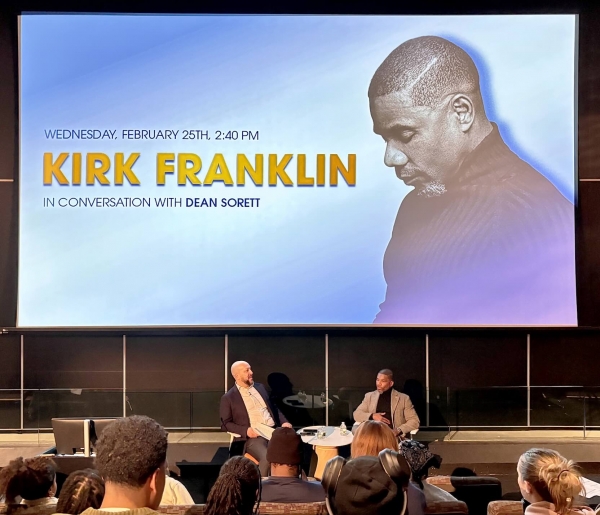
Kirk Franklin, a 20-time Grammy Award-winning singer, composer, writer and producer, was on campus for a special session of Dean Josef Sorett’s course “Religion and the History of Hip Hop.” The event was part of the Undergraduate Community Initiative, which supports shared intellectual engagement and community building across Columbia’s undergraduate population.
Previous special guests of Sorett’s course have included iconic DJ Grandmaster Flash, rapper Lupe Fiasco, MIT professor Joshua Bennet and producer Chris Large.
Over nearly four decades, Franklin’s work has reshaped the landscape of contemporary gospel music; he has written songs that bridge R&B, hip hop and pop, expanding the genre’s reach and cultural impact. In January, he was recognized with a Black Music Icon Award by The Recording Academy.
The Columbia Gospel Choir, led by Josh Black CC’25, opened the event with a stirring performance of “Total Praise” by Richard Smallwood, who died on Dec. 30. (Like Franklin, Smallwood was a major influence on the elevation of gospel music to the mainstream.)
Sorett then introduced the excited crowd to their guest. “Kirk Franklin often describes himself simply as a flawed individual in pursuit of God’s grace,” Sorett said. “His willingness to speak candidly about faith, personal development and human experience has positioned him as an influential voice in conversations that extend well beyond music.”
Sorett went on to acknowledge his personal connection to Franklin’s work. “All of my students have heard me go on about my own coming of age on hip hop — I was a sophomore in college in Oklahoma when your first album came out,” he told Franklin. “To have an artist here today whom I’ve followed since I was their age is really a privilege.”
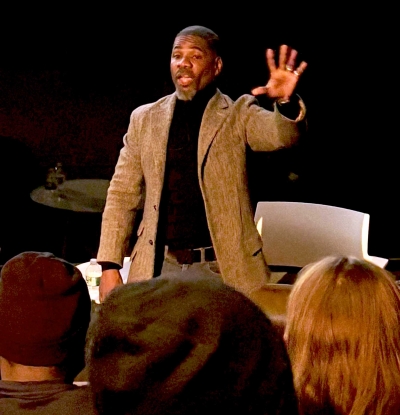
Franklin stood to address students during the audience Q&A session.
JILL SHOMER
His faith deepened in his teens after a close friend was killed; at Oakwood College in Alabama in the 1980s, he began to create music that fused his religious devotion with his passion for the burgeoning genre of hip hop. “My love for God was very real, so my music was really sincere for me,” he said. “I loved talking about Jesus in fresh ways — about my love for him and what I believe to be his love for me.”
In 1993, with a $5,000 loan from a church member, Franklin put out his first album, Kirk Franklin and the Family (Live). The songs were traditional call-and-response, in collaboration with a 17-voice choir. “I was just doing what was part of the tapestry of the Black Sunday morning experience,” Franklin said. But mainstream and hip hop audiences responded, and soon his career was ascendant.
Sorett played five of Franklin’s songs that spanned the decades, including “Why We Sing,” from his debut record, and 1998’s “Revolution,” which inspired the audience to sing out the “whoop whoop!”s of the chorus.
The enthusiasm continued for the remainder of the song play and discussion, leading to a lively Q&A session. Students lined up to ask about everything from Franklin’s struggles with faith and judgment to the role of mentorship, as well as for advice about how to move the needle on their own dreams.
“I always say ‘God loves to hit moving targets’ — we may not know exactly where we’re going, but we’re moving,” Franklin responded. “It’s about the momentum, the momentum of just being. You don’t always have to be thinking ‘I’m going to revolutionize this moment, I’m going to be a game changer.’ Just be. You’d be surprised that as you move, greatness finds you.”
He concluded, “If there is any one little extra ingredient, it’s Never Settle — that’s my mindset. In every room I’m in, I’m a new artist. Every project is my first project; every album is my first album. I’m a student — I’m the guy in the room who wants to learn it all. That’s my posture and it will forever be my posture.
“And I think that as you keep that student mentality and that hunger, greatness and being innovative will just be part of your narrative.”