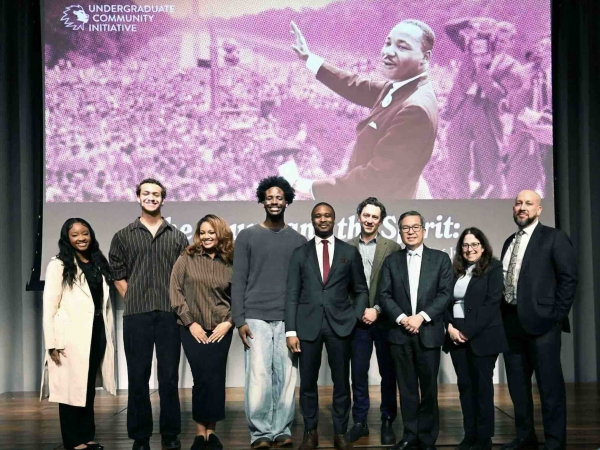
Left to right: Elaine Nomsa Masenda CC’28, Kaiden Currie CC’27, Afomia Giday CC’28, JP Okeke CC’27, keynote speaker Brandon M. Terry, Jonathon Kahn GSAS’03, Engineering Dean Shih-Fu Chang, General Studies Dean Lisa Rosen-Metsch and College Dean Josef Sorett.
EILEEN BARROSO
The annual event was presented by the Undergraduate Community Initiative, a partnership among Columbia College, Columbia Engineering and Columbia General Studies that focuses on deepening students’ understanding of and commitment to their responsibilities as members of a shared community.
The Columbia University Gospel Choir opened the program with a performance of “Lift Every Voice and Sing”; the song, known as the Black National Anthem, became a rallying cry during the civil rights movement.
The event’s first speaker, College dean Josef Sorett, spoke about the evening’s theme, specifically how it invited the audience to consider how community is experienced — not only as an idea, but as something embodied and audible.
“When I consider ‘The Sound and the Spirit,’ I am struck by the richness of sound that characterizes our campus lives, and the range of ways in which we embody the idea of spirit,” Sorett said. “There are the greetings that ring out across College Walk. The laughter and late-night debates that resound in the residence halls. This is the sound and spirit of friendship.
“There is the quieter, but no less powerful, spirit of discovery in laboratories, libraries and lecture halls; of volunteerism that inspires you to give of yourselves on and off campus; and of creativity that animates your artistry in any number of forms.
“All of this, and much, much more, braids together to form the sound and the spirit of this place that we call home,” Sorett said. “And it is this very richness and range — of experiences, identities, interests and aspirations — that make Columbia College so distinct.”
The program also featured remarks from General Studies dean Lisa Rosen-Metsch and Engineering dean Shih-Fu Chang; each introduced a student performance that was inspired by King’s legacy, by tap dancer Kaiden Currie CC’27 and spoken-word poet Elaine Nomsa Masenda CC’28.
“The dream did not end in 1968 — it was passed down unfinished, into our hands,” Masenda recited. “So dream! Dream with audacity, dream with intention, dream so fiercely that injustice feels threatened, dream so loudly that the future has no choice but to listen. And when they ask us, ‘Who gets liberty?’ ‘Who gets justice?’ Let our answer be clear: Not the select few, but all of us who dare to dream.”
Jonathon Kahn GSAS’03, senior associate dean of community and culture, took the podium to speak about the work of the Undergraduate Community Initiative. “At its best, UCI serves as a commons of creativity, of inquiry, of cooperation, of action and tonight, of celebration,” he said. “Consider how much passion, how much talent, how much longing for visions of the good is in this room. If UCI is to mean anything, it must reflect who you are. It must reflect your conversations, your exchanges, your disagreements and your collaborative discoveries. Together, we depend on our capacity to be a community that can hold all of this.”
Kahn then introduced the evening’s keynote speaker, Brandon M. Terry, the John L. Loeb Associate Professor of Social Sciences at Harvard, and spoke about Terry’s recent book, Shattered Dreams, Infinite Hope: A Tragic Vision of the Civil Rights Movement. “Brandon’s book represents nothing less than a paradigm shift in how we make moral sense of the American political project,” Kahn said.
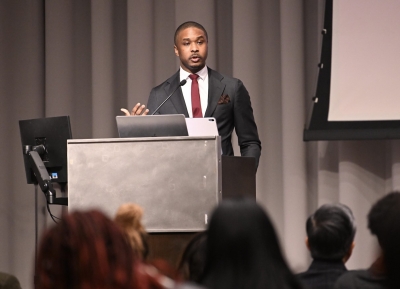
Keynote speaker Brandon M. Terry
EILEEN BARROSO
But when a revolt against injustice becomes embalmed in history and the moral trajectory of the nation is presumed secure, Terry says, the movement becomes static; it casts political adversaries as anachronisms and underestimates the persistence of conflict. The result is what Terry describes as an ironic narrative. “It tells a story of endless repetition of domination,” he says. “‘The more things change, the more they stay the same.’”
Instead, Terry argues, the civil rights movement is best understood as a tragic narrative; that tragedy exemplifies what the civil rights movement has been and can still be. Tragedy, in Terry’s view, is “a way of seeing and feeling that does not deny hope, but refuses easy optimism.”
He emphasized that for the civil rights movement to remain exemplary, it will have to be in this more tragic key. “We do not know what the present struggle between democratic equality and authoritarianism will yield, but we have to act anyway,” Terry concluded. “The collapse of romance is not just disorientation, it’s opportunity.”
Following a spirited Q&A, the last speaker of the evening was Afomia Giday CC’28, a board member of the Black Students Organization. A political science and human rights major, Giday reflected on learning King’s “I Have a Dream” speech as a child, and the way it still resonates.
“It’s a dream rooted in the American dream,” Giday said. “‘I have a dream that one day this nation will rise up and live up to the true meaning of its creed’ … what he meant was equality was not guaranteed by words alone but by how power and institutions choose to act on those words. My education at Columbia has provided me the context I needed to fully grasp this.”
UCI fellow Munachiso Johnpaul “JP” Okeke CC’27 closed the event and expressed gratitude for the Columbia community.
Learn more about UCI and upcoming Initiative events at uci.columbia.edu.