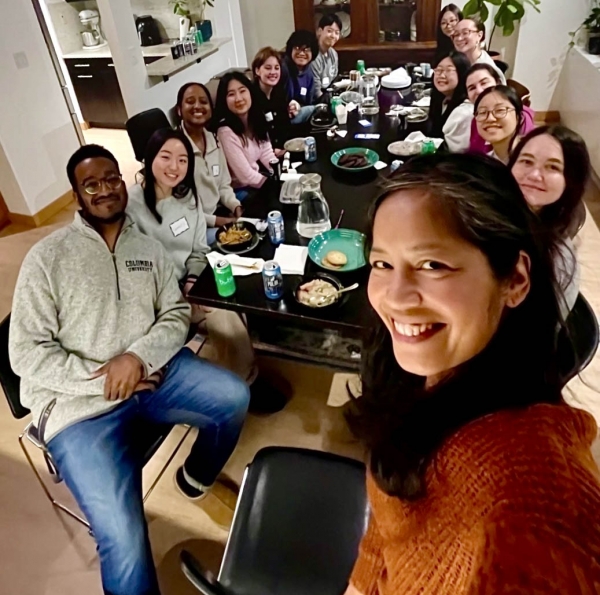
Professor Denise Cruz heads the table at an East Campus Salon dinner
COURTESY DENISE CRUZ
It wasn’t about making the most of the dining room sunlight (which is ample), or arranging her living room furniture (including an elegant old piano) to best effect.
Rather, as the latest Faculty-in-Residence (FIR) — charged with creating programming for the undergraduates who live in campus’ Upperclass Area (UCA) — Cruz saw the apartment as a place where students would be welcomed for a particular type of conversation.
“What I think students really want are more intimate settings to connect with faculty,” says Cruz, a professor of English and comparative literature. “Being able to do that in ways that aren’t attached to a class, that aren’t assignment driven. I wanted to offer an opportunity to speak with a faculty member — or an alum or an artist — in a smaller and more informal setting.”
The FIR program, overseen by Undergraduate Student Life (USL) in close partnership with the Dean’s Office’s Undergraduate Community Initiative, creates an essential bridge between the academic and residential sides of campus life. Faculty members live in community with undergraduates and, working with their respective Residential Life teams, develop opportunities for their student neighbors to engage in both on- and off-campus. There are two other FIRs in addition to Cruz: Ioannis “John” Kymissis, the Kenneth Brayer Professor of Electrical Engineering, residing in the First-Year Area, and Sam Roberts, an associate professor of history and sociomedical sciences, in Schapiro Hall.
“Faculty-in-Residence is a real jewel of our residence halls and the Office of the Dean is devoted to making it even more robust,” says Jonathon Kahn GSAS ’03, senior associate dean of community and culture. “The program reminds us that learning is not confined to our classrooms. Students flourish when they feel known — when faculty and students share meals, talk about ideas, and see each other as real people with histories and cool interests, with both worries and, most importantly, with hopes and dreams.”
Tara Hanna, associate dean of USL, adds: “The FIR program enhances the undergraduate experience by providing a space for faculty and student interaction outside of the classroom. Our FIRs host a variety of enriching programs that aid students in developing competencies for their time at Columbia and beyond.”
As the first FIR in the East Campus residence hall in several years, Cruz is charged with revivifying programming there as well as for the broader UCA, which includes a number of buildings between Amsterdam Avenue and Morningside Drive. The UCA is largely home to upperclassmen, many of them seniors — a consideration that was key to developing a vision for her role.
“I wanted to be really intentional in thinking about what undergraduates in their upper years need at this particular time, what kinds of interactions would be important or interesting,” Cruz says. “I also thought about what knits together every single student at Columbia. I’ve found that while people come here for different reasons, everyone comes for the intellectual community. So I wanted to give them that.”
Residence Hall Director Paul Kehinde Ajayi, who is Cruz’s partner in planning, notes that they also thought holistically about the culture they were helping to cultivate. “Our students are high achieving,” Ajayi says. “So we also want this to be a place to recharge and just have a sense of community.”
Cruz and Ajayi’s strategizing resulted in the launch of three signature UCA series: East Campus Salon, Forks & Detours and Backstage Pass. (Though aimed at UCA residents, all are open to wider participation as space allows.)
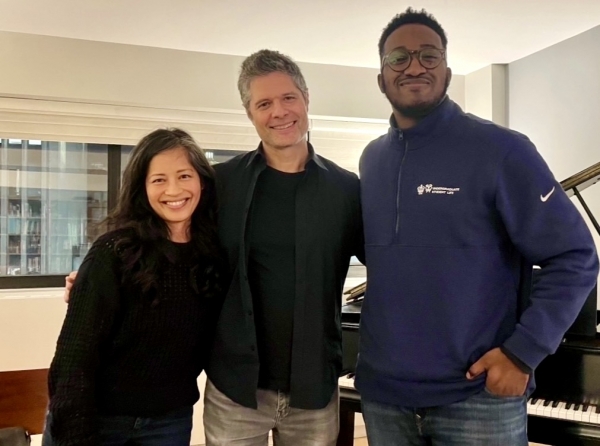
Left to right: Professor Denise Cruz, Tom Kitt CC’96 and Residence Hall Director Paul Kehinde Ajayi.
COURTESY PAUL KEHINDE AJAYI
Andrea Mojsoska CC’28, who attended a salon with Chemistry Department Chair Laura Kaufman CC’97, says she appreciated the personal setting and the chance — unlike in a lecture — for all the students to talk with Kaufman. “I learned that her journey at Columbia, much like my own, was not linear,” Mojsoska says. “The chemistry classes she took were enriched by classes in art, history and English. Her advice gave me the encouragement to couple my interest in biology with my lifelong passion for literature.” On deck for salons this term are senior economics lecturer Sunil Gulati and psychology professor Nim Tottenham BC’96.
Forks & Detours is another small-scale dinner, where featured guests reflect on their careers and the lessons they’ve learned along the way. Backstage Pass goes larger: a gathering for 40 to 60 students where faculty, deans and alumni professionals share insights about different post-graduate pathways and navigating life beyond campus.
“These were inspired in part by my own experience as somebody who thought they were going to medical school, then applied and got waitlisted,” Cruz says. “Students who are getting ready to graduate are facing a tremendous moment of transition. It’s valuable for them to hear that it’s OK to be uncertain, it’s OK for things not to work out — this is actually what’s supposed to happen. It’s rare that you know exactly what you’re going to do when you’re 20 or 21.”
Cruz also has put together a special event this semester, The Senior Reread; College seniors will be invited to revisit a passage from The Odyssey and gather to discuss what it’s like returning to a text they studied as first-years.
“Columbia has so many resources across campus,” Ajayi says. “FIR helps translate that into something students can actually experience through intimate conversations and meaningful access, right where they live.”
Cruz, who shares the residence with her husband and her son, enjoys the day-to-day of living among students. “It’s been delightful, seeing this community on campus 24/7,” she says. “I have a dog, and so we walk around at all hours. To see the students out at night — it’s such a vibrant and dynamic [place]. And that includes all the people who come together to make the community what it is.
“The FIR involves more collaboration and partnership than I’ve seen at any other institution: faculty and students, to be sure, but also incredible teams from Residential Life, Housing, Public Safety, Dining, Advising, the mailroom and Facilities — getting to know all of our community has been incredibly meaningful.”