 |
 |
 |
 |
 |
|||
|
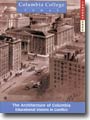
COVER STORY Hilary Ballon is a professor in the Department of Art History and Archaeology and a past recipient of the Great Teacher Award. This is adopted from remarks she delivered when she received the award from the Society of Columbia Graduates in October 2000, and a Dean's Day presentation in April 2001.
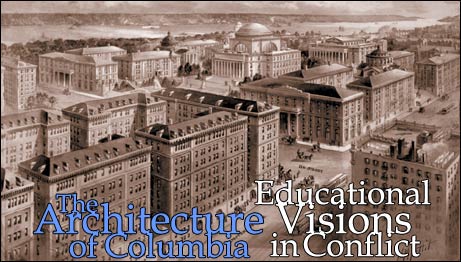
Some may gripe about the facilities and a shortage of space, but in my line of work, architectural history, Columbia's home on Morningside Heights is considered a landmark. A masterpiece of campus planning, it is the fullest translation of City Beautiful ideals into urban form in America. The campus has attained this status not because individual buildings meet a consistently high standard of excellence — actually, the campus has many dreadful buildings. But as an ensemble, the campus is a significant architectural achievement. Given the artistic merits of the design, we tend to read the campus as a well-coordinated whole, a unified entity. I'd like to offer a counter reading. Rather than indicate how the parts fit into a harmonious composition, I want to present the architecture of the campus as a battleground — a battleground of opposing ideas about education, the mission of the University and its relationship to the city. For this we must consider the architectural implications of two educational issues: the first hinges on the relationship of Columbia with New York City, the second on the relationship of the College and the University. While I will focus on the formative era between 1894 and 1910 when the Morningside campus was taking shape, the conflicts at stake a century ago persisted in the ensuing decades, shaped the ongoing development of the campus, and remain relevant to this day. The relocation of Columbia from its cramped quarters on Madison Avenue and 49th Street to Morningside Heights coincided with a formal renaming of the University in 1896: Columbia College was henceforth called Columbia University in the City of New York. The new name broadcast the twin goals of President Seth Low, the visionary leader who championed the move to Morningside. First, he sought to transform a sleepy, relatively undistinguished college into a modern research university along the lines of Johns Hopkins and German research universities. Second, Low was committed to develop Columbia as a major urban institution, integrated in the life of the city — hence the insistence on the University's identification with the City of New York in its clunky new name. The design of the Morningside campus was intertwined with its reorganization. It was the duty of the architecture not only to accommodate the new research program but to communicate the ambitious, reformulated mission of Columbia to the public at large.
Some trustees supported the idea of relocating Columbia to a bucolic patch in Westchester. This suggestion reflected the widespread view in America that the country was a more appropriate environment for higher education. Indeed, the very word campus, which was first used to describe Princeton University, indicated a rural setting. The city was deemed inhospitable to collegiate life because of its dangers and distractions, which gentlemen would do better to avoid. Others considered the commercial ethos of Manhattan as antithetical to the requirements of intellectual pursuit. Admittedly, if you conceive of college as an Ivory Tower, it is better not to locate in the commercial capital of the world. But Low rejected the model of intellectual withdrawal and saw the diversity of urban life as a resource of the University. He considered it an advantage to educate men in an urban setting. "The great city itself," he explained, "gives a view of life which is no slight part of the student's education." The choice in 1893 of an urban site, Morningside Heights, did not in and of itself assure the realization of Low's university ideal. Low came to understand that his vision depended on the way the campus was designed — on the layout of the buildings, on their style, and their relation to the city streets. The trustees entertained different plans, in different architectural styles. In one respect the trustees proceeded cautiously and were indecisive: dissatisfied with the alternatives, they asked the three competing architects to collaborate and produce a compromise plan. Yet this initial hesitation pales beside their boldness in making another decision: unlike virtually every other college in America, Columbia would not be built in the Gothic style. Gothic was the style of the midtown buildings designed by C.C. Haight, and the style of the great English universities, after which so many American schools, including Yale, modeled themselves. Gothic was also the style of the new urban universities — the University of Chicago, City University of New York (designed in 1897), and later our neighbors on the Heights, including Teachers College. There were only two classical precedents: the University of Virginia, which was to some extent a model for Columbia, and Union College in Schenectady, N.Y. The meaning of collegiate Gothic can be understood by considering the University of Chicago, which was established in 1890. At the request of the trustees, architect Henry Ives Cobb designed the master plan in the English Gothic style. The enclosed Gothic quadrangles were intended to protect and seclude the students, and to block out, as one writer put it, "the dark congestion of the mercantile city." In describing the mission of the University of Chicago, the leadership employed ecclesiastical metaphors that the medieval cloisters reinforced, describing the university as "a priest, a keeper of sacred and significant traditions." The cloistered quadrangles in Gothic style perfectly captured the idea of the campus as a place apart.
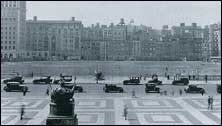
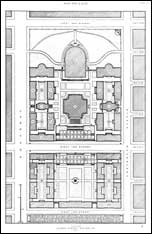
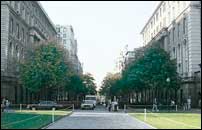
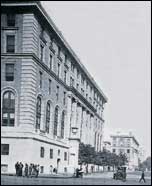
In rejecting the Gothic style and choosing the classicist Charles Follen McKim as architect of Columbia, President Low and the trustees intended to present the University not as a place apart but as a specifically metropolitan institution, bound to New York City. Classicism was the language of the polis, and Low Library, its steps and plaza, called the South Court, were conceived as a civic monument more than a collegiate one. The civic quality of McKim's 1894 plan was reinforced by another feature that has been greatly altered and is difficult to recognize today, namely the considerable openness of the original campus to the city. As originally developed, the campus was far more closely integrated with the urban fabric than it is today. Remember that the original campus did not include South Field, and 116th Street was open to traffic. Low Library and the area in front of it faced a public street from which it was not sharply separated. In fact, Low rejected a proposed gate that would have served to privatize South Court, insisting on public access and the civic nature of the space. McKim's steadfast opposition to planting the South Court with trees emerged as well from his view that the design "must be wholly municipal in character." McKim's references underscored this point: He compared South Court to the Piazza San Marco in Venice, the piazza in front of St. Peter's in Rome, and the steps of the Capitol in Washington, D.C. In addition to the open treatment along 116th Street, other connections were made between city streets and the campus. The Grove at the north end of the campus, along the 120th Street, was at street level, and broad, inviting staircases were located on the cross axis of the composition, behind the chapel where the steps lead to Amsterdam Avenue, and behind Earl Hall where the wide stairs lead to Broadway. Another key feature of McKim's design is that the classroom buildings sit on a granite platform. As the site slopes downward to the north, the height of the granite platform increases, as does the overall height of the buildings. But from within the campus, the buildings appear equally tall. The platform disguises the irregularity arising from the sloping site by establishing a platform, or in architectural terminology, a common datum above which the brick walls rise. The platform creates the appearance of unity among the classroom buildings, which was one of McKim's goals. But the platform also elevates the buildings above street level, and creates what is often described as a "fortress wall" along the street. Indeed, the large blocks of granite and the battered, slightly sloping wall allude to the architecture of fortification, as if the campus needs protection from the surrounding neighborhood.
The sloping topography of the site may well explain the increasing height of the granite base, but topography does not account for the fortress effect. That was McKim's design choice in order to alleviate the openness of the plan and provide more tranquil classroom precincts lifted above the hubbub of city streets. McKim maintained a tension in his plan between permeability and enclosure, although later campus designers used McKim's vocabulary to create a far more enclosed environment. Compare, for example, McKim's scheme in 1899 for dormitories in the Grove with the current situation on 120th Street, where a cliff of granite seals off the campus and entirely disconnects it from the street. Even the classroom quadrangles were not fully enclosed or cloistered spaces. The quadrangles were framed by free-standing buildings which McKim conceived as flexible envelopes for learning. At Chicago, some faculty and critics condemned the Gothic style as an inappropriate expression of modern research, such as took place in the Kent Chemical Laboratory. Thorsten Veblen, for one, belittled "the strange spectacle of modern scientific research taking place behind a medieval dream façade." McKim's pavilions, such as Fayerweather, conveyed a different message. On the inside he tapped the structural advantages of the steel frame so that partitions and uses could be adjusted over time. On the outside, he varied the decoration and use of classical elements to create a hierarchy in relation to Low Library. Because Kent and Dodge framed the long-distance diagonal views of Low, they were designed with a colonnade to echo its columns. (The colonnades became nearly impossible to see once 116th Street was closed off in 1953 and thickly planted in a treatment antithetical to the spirit of McKim's design.) The buildings facing Low and on the same platform were also designed with a colossal order; Avery is the lone example of this type, because the other projected inner buildings were not built. And perimeter buildings like Fayerweather and Mathematics had no classical order.
In order to set Low Library apart and defer to its austere limestone walls, McKim chose brick for the subordinate pavilions — specifically a dark red brick used in American colonial buildings, known as Harvard brick. The combination of brick and limestone trim, to which we are now accustomed, struck architectural critics of the time as discordant. Brick normally calls for a modest, colonial treatment that is at odds with the great massing of the buildings and the large scale of the ornamental décor. Montgomery Schuyler, a leading architectural critic of the day, railed against the hybrid marriage of brick and limestone, classical and colonial, as "a contradiction in terms." The Columbia buildings were a failure in his view. "You can take them for a hospital, for a group of official buildings, for almost anything but what it is. You may admit that [the style] is ‘municipal.' But you cannot possibly maintain that it is ‘collegiate.'" That municipal effect is a key to the design. The second issue concerns the identity of the College within a research University. Low's conception of Columbia privileged the idea of the University as a center of advanced research, with the library at the center of the plan. As alumni unhappily noted, McKim's plan provided no home for the College. But even if one of the original quadrangles had been designated for the College, McKim's design did not allow for the differentiation of those dependent spaces. His architectural system unified the parts and subordinated them to Low Library. Alumni wanted the College to have a distinct identity, which meant a distinct architectural form. The spatial problem reflected a broader educational challenge: how to foster the Collegiate mission in the context of a research-oriented University? McKim's original plan of 1894 crystallized the University ideal. Low believed that campus space should only be allocated for departments and schools, and opposed building dormitories on the campus. He felt that the real estate market would meet the housing needs of students, and that the University should only tend to their intellectual lives. Accordingly, the original plan of the University did not include any dormitories. Low sought donations to build University Hall, which was to play the role of a student center, with a dining hall on the main floor and gymnasium on the lower level. The building was started and a gym installed; you can see its footprint to this day in the Business School Library. But College alumni were not interested in funding a University building, and University Hall was never finished; it remained as it was until 1962, when Uris Hall was built for the Business School. Alumni were, however, willing to fund College buildings and dorms.
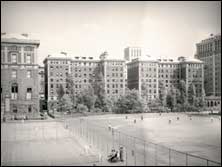
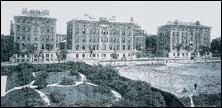
It took a change of leadership and the enlargement of the campus in 1903 to create a home for the College in the southeast quadrant of the expanded site. Hamilton opened in 1907, and two dorms, Hartley and Wallach (originally called Livingston), soon followed. These buildings do not have an architecturally distinct identity from those surrounding Low. Such is the force of McKim's plan and the unified vocabulary of the University that the College does not read as a place apart. This continuity is reinforced by the fact that the inner buildings of the projected quadrangles were never built. In architectural terms, the identity of the College is submerged in that of the University as a whole. Hence, visitors to the campus need to be told where the College is. A sign on a walkway and pennants on flagpoles can hardly counteract the more powerful message of the design: open space flows continuously from the steps of Low Library to the doors of Butler, and binds the surrounding buildings into a whole. The ground inscription is at once necessary and unconvincing because of the unifying framework of McKim's University plan, which makes it difficult to carve out an enclave for the College. Dormitories were an achievement of Nicolas Murray Butler, who had a different view of the University from his predecessor, Low. Butler wanted a self-contained campus, more disconnected from the city. He considered Columbia's "metropolitan condition," as he put it, a "nuisance." Low had wanted the student population to represent the social composition of the city; he had sought to attract the graduates of the city's public high schools, and before the subway opened, he worried that the move to Morningside Heights would make the school less accessible. Butler, on the other hand, favored the traditional model of a boarding college for which dormitories were essential. It is especially interesting how dormitory construction advanced a particular social project and a new concept of selectivity, which Butler helped to define. Butler wanted to reduce the number of New Yorkers who attended Columbia College, because New York City students were disproportionately from immigrant families and Jewish. In order to attract larger numbers of young Episcopalian gentlemen, the future leaders of the country, Butler made an effort to nationalize the College, that is, to draw students from outside New York City. Whereas before 1910 the prevailing view in higher education had been that qualified students should not be turned away, Butler helped to develop the notion of "selective admission," whereby a college conveyed its distinction and prestige by turning away qualified students. Application forms were modified in 1919 to inquire about family history; the forms asked not only for the candidate's place of birth, but his religion, his father's place of birth and his father's occupation. The application also required a photograph of the applicant and an interview.
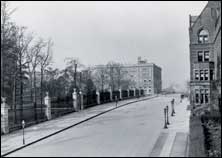
This change in admissions policies produced the desired effect. From 1920 to 1930, that is the first decade of the new admissions policy, the percentage of Columbia students coming from New York City dropped from 54 percent to 23 percent, and what one administrator called "the invasion of the Jewish student" was contained. Dean of the College Herbert E. Hawkes informed Yale's director of admissions in 1930 that "the proportion of Jews in Columbia has been reduced from about 40 percent to 20 percent." But the issue of selectivity, of who should be admitted to Columbia, persisted. In 1933 President Butler instructed Dean Hawkes: "I don't know whether it is at all practicable, but it would be highly judicious if...some way could be found to see to it that individuals of the undesirable type did not get in Columbia College, no matter what their record in the very important matter of As and Bs." Dormitories enabled Butler to promote his elitist and more homogenous vision of the student body. New Yorkers did not need dormitories or could not afford them; local boys commuted from home. Dormitories were needed for out-of-town students. The creation of a residential College separated the wealthier, often Episcopalian students whom Butler valued more highly from the day students who commuted from the Lower East Side, Brooklyn and places farther removed. Dorms also fostered student interaction and placed more emphasis on social activities. This communal social life tended to focus the undivided loyalty of residential students on the College, unlike commuting students who retained competing urban attachments. It is strikingly consistent with Butler's anti-urban vision that Butler Library bears his name. This site, on the south side of the campus, had presented difficulties for McKim and others wedded to a more open, permeable campus. Originally, Low towered over an open site to the south, but as the neighborhood became urbanized and the campus was enlarged, it became desirable to close the south edge of the campus. McKim had proposed locating the president's house on the far side of 114th Street in a gesture toward integrating the University buildings with the city. But the site stood empty as the dormitory building program took precedence, until Butler Library, which was completed in 1934, sealed off that edge. (It was not named after President Butler until 1949, a year after his retirement.)
The tensions between urban integration and campus enclosure, and between the residential college and the research university, are not an undesirable condition. On the contrary, they are essential to the vitality and identity of Columbia. It is not just that teaching and scholarship enrich one another, or that the city presents us with a wealth of educational resources. These educational frictions, which assume architectural form on our campus, are a productive stimulus and heighten the learning process. In the late 19th century, at a time when other colleges were accepting women, Columbia would not allow women to enroll but offered in 1883 a "Collegiate Course for Women." Women could meet with professors at the beginning of the term to get reading assignments, and were to reappear at the end of term to take exams. They could not attend classes, but if successful on the exams, they got a Columbia degree. The course for women was the 19th-century equivalent of an online course, and the Columbia librarian, Melvil Dewey, considered the program absurd. "Obviously," he declared, "if women could get from a few examinations all that men got from daily intercourse with faculty and with students, and from hundreds of lectures and work in the laboratories, then either women were miraculously gifted, or else — and this was an alternative pretty serious to contemplate — all the millions and millions [of dollars] in college endowments, in laboratories and lecture halls, were just so much sheer waste." In the past decade, much energy has been focused on the educational possibilities of the computer and of long-distance, online learning which supposedly reduces the advantage of location. This exploration at the technological frontier and the changes it has produced in the delivery of information should also drive us to clarify our educational mission on this campus. Why, it's fair to ask, does it make a difference to study here, in these buildings, on Morningside Heights? My answer relates to the productive tensions between city, University and College, which are expressed in the architecture and which distinguish the educational mission of this great institution. Columbia University in the City of New York embraces the pursuit of knowledge and unconstrained intellectual inquiry not in spite of but in conjunction with the responsibilities of civic engagement and urban citizenship. This combination gives the project of humanistic education a sense of urgency and an enduring value.
|
|
|||||||||||||||||||||||||||||||||||||||||||||||||||||||||||||||||||||||||||||||||||||||||