 |
 |
 |
 |
 |
|||
|
ALUMNI PROFILE
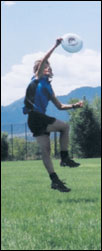
Ultimate Frisbee has come a long way as a competitive sport in the past decade, and so has Heidi Pomfret '92. Pomfret was one of five women selected to the United States team that earned a silver medal at the World Games in Akita, Japan, in August — the first time Frisbee players were invited to a multi-sport, international competition. Pomfret and her teammates lost to Canada in the finals of the seven-nation competition. Members of the International Olympic Committee attended the games to assess whether to include the sport in future Olympics. Ultimate Frisbee is a growing sport that is now played by an estimated 150,000 people in 42 countries. Pomfret is a former soccer player whose interest in the sport was sparked during her first year at Columbia, when she saw a flier recruiting for the club team. She ended up devoting most of her non-academic time to Ultimate Frisbee, traveling out of town to competitions on many weekends. When Pomfret moved to Colorado after graduation, she joined a club in Boulder that has won its regional tournament for the past four years. In addition to playing with the club, she coaches the University of Colorado women's team while attending her second year of pre-med studies. She decided to go to medical school after working for several years as a victim's advocate at an anti-violent crime organization and at the district attorney's office. Ultimate Frisbee is played by seven-member teams on a
football-sized field. Frisbees are passed among teammates, who
score a goal by catching the Frisbee in the end zone. It's a
combination of soccer and basketball and requires similar skills as
those sports and lacrosse. "It's non-contact in the same way that
basketball is non-contact," Pomfret says. "It's physical, but you
don't tackle." Like tennis, the games are not timed but end when
one team reaches 15 points and beats the other team by at least two
points.
"It works amazingly well, especially in the women's game," Pomfret says. "In the men's game, it has had some problems. Men are a little harsher with each other, and for a few years there was less value put on sportsmanship. That has been changing back to the Spirit of the Game." Recently, the game has added optional observers who will call whether a player is in or out of bounds. Ultimate Frisbee players don't play with Frisbees. Frisbee is a registered trademark of the Wham-o Company, and that's not who the Ultimate players buy from anymore. They now buy from a company called Discraft, and what they play with are called flying discs. Regulation discs look like regular Frisbees but are slightly heavier. To put together the U.S. team for the World Games, the Ultimate Players Association, the sport's governing body in the United States, solicited nominations from clubs around the country. The nominees were required to submit lengthy applications that included essay questions about strategy and how the players have helped their team and the sport. "It was like a college application," Pomfret says. "It was astonishing and awesome to be chosen." After considerable fund raising and three training camps during long weekends around the country, the U.S. team traveled to Japan for the opening ceremonies and competition. "It was amazing," Pomfret says. "It was like being — it was being — a world-class athlete."
|
|
||||||||||||||||||||||||||||||||||||||||||||||||||||||