 |
 |
 |
 |
 |
|||
|
COLUMBIA
FORUM Class Act: The Invention of Tradition By Dina Epstein '01 Although alumni remember Class Day and Commencement, Columbia doesn't always mark other rites of passage for students. This past fall, the Columbia College/SEAS New Student Orientation Program instituted a ceremonial entry into the College for members of the Class of 2004. Dina Epstein, a history major who was a vice president on the Columbia College Student Council and served as coordinator for New Student Orientation 2000, describes the thinking behind "Class Act."
The members of the Class of 2004 may not have known it upon their arrival at Columbia, but within a few hours they would not only be witnesses but players in the making of history. They were to play the lead role in the invention of a new tradition. New tradition? An oxymoron, perhaps. True, it would seem difficult to establish in the present what will go down in history, but here at Columbia, we believe we can create our own history. After all, as Marie de Vichy-Chamrond said of Voltaire, "He has invented history." So a group of Columbia students, well versed in Voltaire from the Core Curriculum, set out to do the same. As we reflect upon the graduation season before us, it is easy to understand the protocol for our grand exit from Columbia. Clothed in cap and gown, graduates of the College proceed across the stage, receive handshakes, a diploma and a class pin. The next day, we are given the honor of flipping our tassels and then tossing our caps into the air. Our roles are defined, our parts scripted. We are reminded of the oft-quoted line from Shakespeare: "All the world's a stage, and all the men and women merely players: They have their exits and their entrances." We do in fact know our grand exits, but how many Columbia students know of their entrance? What is it that marks our debut at Columbia? Where is the pomp and circumstance? Where are the processionals, the ceremonies, the grand displays? Somehow, dragging boxes across College Walk, waiting in the elevator line for hours, or kissing one's parents goodbye is not an induction that is sufficient for beginning a new endeavor such as a Columbia education and all that involves.
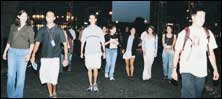
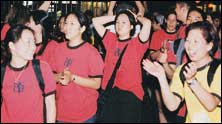
With this in mind, a group of students set out to effect change. The New Student Orientation Committee for 2000 saw this dearth of memorable first moments and began plotting. Over the course of a summer, ideas were hatched and a plan was laid. On August 27, 2000, the new first years, members of the Class of '04, descended upon campus. This time they were greeted with a welcome that was worthy of Columbia. It was in the form of a program called Class Act, in which first years were regaled with the greatest spirit Columbia has to offer. This introduction came to the students in their first few hours as independent, urban, college students. Within minutes of saying goodbye to family and friends, the students were welcomed into the Roone Arledge Auditorium of Alfred Lerner Hall by enthusiastic Columbia cheerleaders and an energetic Lion mascot. Almost immediately, the brand new students were clapping, cheering and hooting, showing their excitement to be at Columbia. Soon the curtain opened and the show began. The students were entertained with a series of performances and brief welcomes. In an effort to link the students with the concept of a lifelong connection to the College, Rita Pietropinto '93, president of Columbia College Young Alumni, addressed the students and then joined the cast for a Varsity Show revue filled with Columbia humor. What better way to introduce the students to the world of the College than to bring them together to celebrate the upcoming 107th annual Varsity Show? The welcome continued with a parodied history of Columbia, marking key moments from the founding of the school to the demonstrations of 1968 and on to the move to coeducation in 1983, each in a different dramatic style. In the final scene the actors remained wordless, performing an intricate, perfectly choreographed dance set to Gershwin's "Rhapsody in (Columbia) Blue." The grand finale and capstone to the program was the recessional. Rather than taking the usual anti-climactic exeunt, the doors at the rear of Roone Arledge Auditorium were opened to Broadway. Hundreds of students then filed out of the auditorium, flanked by the 200 Orientation volunteers who lined either side of the sidewalk on the east side of Broadway. The students walked up this aisle from 115th to 116th Street, surrounded by singing, cheering, clapping students. The end of the line brought them to the main gates of Columbia at 116th and Broadway, and their official and commemorative entrance to four years of academic, social and intellectual pursuits here at Columbia.
Not only are students now ceremoniously entering Columbia, but a tide of change seems to be sweeping through the 116th Street gates. For years, Columbia has been lacking in traditions, especially when compared with peer institutions. But there seems to be a sense that many current students are not satisfied by this status quo. And rather than waiting for traditions to arise, students have taken the job into their own hands, reinventing and revitalizing old Columbia. Now we have created the opportunity to officially mark our entrance to Columbia with proper pomp and circumstance; students have at least one opportunity to elevate the mundane. In one's tenure at Columbia it is easy to pass through the gates hundreds of times, but from now on first years will have the opportunity to reflect upon their first and most noted entrance. By creating a tradition we have created a moment, a memory, and made a daily, mundane passage into an event that is truly remarkable. This processional is already planned again for September, and is in its beginning stages of attaining canonization in the practices of Columbia. The only hope now is that the tradition becomes so ingrained that we forget that it was ever invented or created. For, as Friedrich Nietzsche said, "Every tradition grows ever more venerable - the more remote is its origin, the more confused that origin is. The reverence due to it increases from generation to generation. The tradition finally becomes holy and inspires awe." I
can only hope that the origins are completely confused and muddled
when my grandchildren commence their education at Columbia with a
memorable and ceremonial walk through the wrought-iron gates at
116th and Broadway.
|
|
||||||||||||||||||||||||||||||||||||||||||||||||||||||||||||||||||||||||||||||