Columbia College | Columbia University in the City of New York
Art Hum Was “A Revelation” for Na Eng ’98
Friday, February 13, 2026
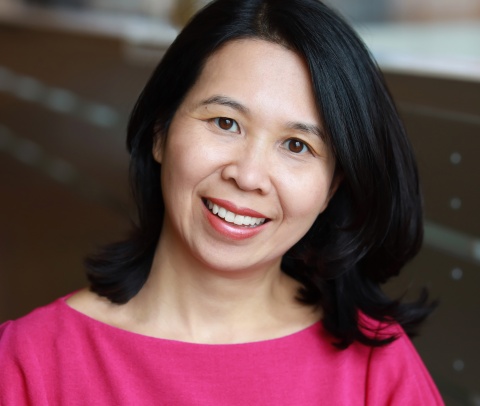
Prior to becoming a social impact executive, Eng traveled the globe as a television producer, reporting on social and economic issues for PBS and CNBC. She has received numerous national journalism honors, including an Emmy Award and an Edward R. Murrow Award for Best Documentary. Eng lived in Zimbabwe as a Fulbright Scholar and received a Paul and Daisy Soros Fellowship for New Americans in 1998. She lives in St. Paul, Minn., with her husband and her son.
What were you like when you arrived at Columbia?
I was like a 5-year-old at Disneyland — my eyes wide open in wonderment. I came from modest beginnings, the youngest of seven children raised by a single mother. We were refugees from war-torn Cambodia growing up in the Midwest. I was the first in my family to attend an Ivy League university. I arrived incredibly curious and open to every new experience, with an insatiable appetite to discover everything Columbia could offer. I wanted to join every club, taste every new dish, apply for every internship, stretch myself academically, and meet anyone from a different country or background than mine.
I had never met Sikhs or Orthodox Jews before coming to campus. I had never tasted Ethiopian doro wat or Indian dosas. I seized every opportunity to hear a speech by a visiting head of state or a Nobel Prize winner. I explored independent films, moody coffeeshops and Broadway musicals. I hunted down every student discount possible to see shows for dirt cheap, including my first opera at The Met, where I stood in the back row for hours.
What do you remember about your first-year living situation?
I lived on the all-women’s floor of Carman Hall, and my floormates became dear friends. I remember fondly a colorful mural of Butler Library, modified with the names of women philosophers and thinkers, and the overall supportive environment. I also remember fun group outings off campus — trips to Little Italy or a midnight showing of Little Shop of Horrors.
The only unpleasant memory is of a suitemate who frequently ate canned tuna. While I absolutely adored her, I still scrunch my nose at the memory of that smell wafting into our shared bathroom and bedroom!
What Core class or experience do you most remember, and why?
Art Humanities because I had never really gone to museums before and knew little about art history. I enjoyed learning how to see and interpret deeper meaning in images that had previously been little more than background décor to me. It was a revelation to understand how historical and cultural context, an artist’s background and stylistic choices intersect to shape a work.
I remember doing a report on Bruegel’s The Harvesters — being able to see the original painting for myself at The Met as part of the research was special.
This past year, while working on The Art of Saving Democracy, which features works by world-renowned contemporary artists such as Shepard Fairey, Carrie Mae Weems, Edward Ruscha, Roy Lichtenstein and Vincent Valdez, I’ve been channeling my Art Hum experience to tap into the deeper meaning of their contributions.
Did you have a favorite spot on campus, and what did you like about it?
The Morningside campus is so beautiful that it’s hard to pick just one spot. In every season, I always felt like I was living inside a dreamy postcard and never took my good fortune for granted. I loved walking down the cinematic Low Steps. I loved picnicking on the patch of grass beneath the replica of Rodin’s The Thinker near the Maison Française.
If I had to choose just one place, it would probably be the land bridge over Amsterdam Avenue connecting the College campus with SIPA. I was in an accelerated dual-degree program, taking graduate classes during my senior year, and beyond being a romantic spot with sculptures overlooking Harlem, it held significance for me —a literal bridge between my undergraduate and graduate school experiences.
What, if anything, about your College experience would you do over?
I was extraordinarily lucky. My days at the College and SIPA were some of the most stimulating and joyful years of my life. I certainly made plenty of embarrassing mistakes — like bombing miserably in a global human rights fellowship interview because I had been completely unprepared. I didn’t realize candidates were supposed to arrive armed with a comprehensive plan and confirmed acceptance from an overseas sponsor even before getting the fellowship. And in my first entry-level jobs, I felt like an idiot because I struggled to make a pot of coffee or serve wine. Oh, well!
Honestly, as a refugee kid with limited resources and connections, I’m proud to have figured out a lot on my own — mostly by asking a lot of questions. There’s not much I would do over again. Things turned out all right for me. I am grateful.
More “Take Five”
Wednesday, October 4, 2023
Friday, August 18, 2023
Friday, August 11, 2023
Thursday, July 20, 2023
Friday, June 2, 2023
Friday, May 19, 2023
Friday, April 14, 2023
Friday, March 24, 2023

Published three times a year by Columbia College for alumni, students, faculty, parents and friends.
Columbia Alumni Center
622 W. 113th St., MC 4530, 6th Fl.
New York, NY 10025
212-851-7852
cct@columbia.edu

Columbia Alumni Center
622 W. 113th St., MC 4530, 4th Fl.
New York, NY 10025
212-851-7488
ccalumni@columbia.edu