 |
 |
 |
 |
 |
|||
|
AROUND THE QUADS
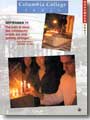
Columbia's continuing response to the tragedy of September 11 has ranged from memorials to volunteer work to academic forums. The University service of remembrance, held November 15 and presided over by University Chaplain Jewelnel Davis, honored those lost in the terrorist attacks. Members of the campus community, including faculty, administrators, students, alumni, staff and family members, gathered in Roone Arledge Auditorium to hear President George Rupp read the names of the 39 University alumni victims and 64 other family members and friends of current students, faculty, staff and alumni who were lost. Representatives from myriad campus and religious groups offered songs, prayers, words of assurance and meditations. As day-to-day campus life continues, one concern has been the ongoing anthrax threat. Although a report of white powder closed Lerner Hall for several hours on November 1, the New York Police Department found no evidence of anthrax and concluded that none of more than 40 suspicious packages reported posed a threat. As a preventative measure, mail delivery was temporarily suspended on October 26 while the mailroom implemented safety measures and obtained protective equipment for staff in order to meet Centers for Disease Control guidelines. Although there has been no evidence of contamination at any Columbia campus facility, the community was asked to exercise caution in handling mail. In addition, campus security was enhanced during the last few months with increased patrols and spot checks in University parking garages. Vehicular access to College Walk remains restricted, and a campus information line (212-854-4636) was established to provide daily updates about campus reports. The local police precinct also has increased its presence in the neighborhood. Recovery efforts continue to get a boost via volunteer groups. Columbia Ongoing Volunteer Emergency Relief, which comprises administrators, students and rescue organizers, works to support long-term relief efforts. For example, operators answered an 800-number for displaced businesses for NYC Partnership, while others reached out to businesses above 96th Street by walking door-to-door to assist Upper West Side, Harlem and Washington Heights businesses in applying for federal emergency disaster relief. COVER also assisted small- and medium-sized businesses by seeking students with professional experience to serve as business advocates, financial mentors, project managers for assessment of business needs, and donor team members. For many organizations, basic as well as high-tech office equipment was needed to restart their businesses in the months following the disaster. And, in a more low-tech approach that gave a nod to the healing power of nature, students were invited in November and December to join in planting a living memory of September 11 in city parks. Holland's gift of one million yellow flower bulbs will beautify the city's parks and greenspaces when they bloom in March. Relief efforts require monetary support, and fund raising by student and staff-led groups has raised more than $27,000 for the rescue effort and for the families of victims. The College Democrats and Republicans, for example, raised $6,000 at an October 4 dinner where the speakers included SIPA Dean Lisa Anderson, former New York City Mayor David Dinkins, Deputy Fire Chief Ed Dennehy and New York City Red Cross team leader John McGee. Other fund raising included more than $3,300 raised through the ongoing donation center at Lerner Hall and $4,700 donated by employees in the central administration building. In addition, students and faculty participated in a Rally for Recovery in Washington Square Park on November 17, which was sponsored in part by the School of Public Health. CCT has learned of several more funds created to honor lost alumni (please see the November 2001 issue of CCT, page 25, for information of the funds that honor John Benedict Fiorito '82, Brian P. Williams '94, Brooke Jackman '00 and Tyler Ugolyn '01). Solomon Gayle '85 has offered $50,000 to establish a College scholarship in memory of his fiancée, Seilai Khoo '86. Donations in memory of Robert Murach '78 may be sent to the Madison and Hayley Murach Education Fund, 41 Watchung Plaza No. 109, Montclair, NJ 07042. And donations in memory of Joseph Della Pietra '99 may be sent to his high school: Poly Prep, September 11 Memorial Fund, c/o Development Office, 9216 Seventh Ave., Brooklyn, NY 11228-3698. To facilitate discussion and understanding of the tragic events, Columbia faculty, including several from the College as well as graduate schools, have hosted discussions and groups. Karen Barkey and Anthony Marx, co-directors of the Center for the Historical Social Sciences, moderated a roundtable with Alan Brinkley, Eric Foner '63 and Ira Katznelson '66 that discussed September 11 as a historical turning point. And when Ellen DeVoe, assistant professor at the School of Social Work, noticed new responses to television in her 18-month-old son, she realized her study of trauma in children was suddenly even more necessary. With other volunteer professors from the school, DeVoe held response groups for parents and their children to discuss their reactions and concerns. Teachers College's Center for Educational and Psychological Services also has offered parent support group sessions to help adults and their children work through feelings of insecurity, disorientation and anxiety linked to the WTC trauma. SEAS hosted a day-long forum with top engineers of the WTC, Ground Zero structural assessment team members and leaders of the emergency response to gather information that could lead to improvements in building design and operations. SIPA sponsored an ongoing series of lectures and panels under the heading "SIPA Responds," with professors examining such varied topics as what may have caused the attacks, Afghanistan's future, the war's effect on international relations with other countries and the U.S.'s new defense priorities. Law School forums have focused on domestic legal implications of the war on terrorism, raising questions about racial profiling, current and proposed laws governing electronic surveillance, and protection of constitutional principles. And the Business School held a joint conference with the London School of Business to explore the impact of September 11 on financial communications and information systems and future development. David Westin, president of ABC News, lectured on the media's responsibility to keep Americans informed of developments in the war against terrorism. Sponsored by the Poliak Center for the Study of First Amendment Issues at the School of Journalism, the event was taped for broadcast on C-SPAN. The Journalism School's "Wonderful Town: The Future of Theater in New York" conference hosted critics, scholars, artists, and representatives from arts groups, government agencies and theater companies on- and off-Broadway for a two-day discussion of the economic, political, real estate and cultural issues facing New York's performing arts groups. While the effects of the attacks will be felt for years to come, the Columbia community continues to reach into its hearts, wallets and academic resources to help the recovery effort.
|
|
||||||||||||||||||||||||||||||||||||||||||||||||||||||||