 |
 |
 |
 |
 |
|||
|
LETTERS TO THE EDITOR Architecture of Columbia
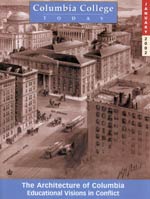
We read with interest the article, "The Architecture of Columbia, Educational Visions in Conflict," in the January 2002 issue of CCT. Whether the University's architecture ever was planned to be open to the city is arguable, as all building entrances were designed to be interior to the campus and access to the campus is and was from a limited number of points as well. In these days of heightened security, openness works against the need to provide a safe environment. The College at its Morningside inception would have benefited from a separate architectural identity within the larger University campus by completing the enclosure of the Hamilton/John Jay quadrangle as in the original plan. It might have fostered a greater sense of identity and pride among undergraduates, elements the College has often been accused of lacking. But more importantly, as the University expanded its dormitory facilities for undergraduates, it should have instituted a house system within the dormitories with separate dining and study facilities. The other Ivies, from their origins, realized the fundamental human need for community in their house systems, which foster subsidiary groupings within the larger university community and the surrounding urban area; a comforting refuge from the anonymous larger environment. In my day, the fraternities and student organizations offered opportunities for fostering community not available to the same degree in the dormitories. Fecundity without solidarity can be barren and empty. The University also egregiously failed to meet the needs of the undergraduate community by not acquiring adjacent properties for undergraduate athletics when it located to Morningside Heights. Having to travel half an hour to get to the University's athletic facilities is an onerous burden that has been placed upon generations of Columbia undergraduates. If at the time it could not afford the property acquisitions, or if the land was already developed, it should have opted for the leafy greenswards of Westchester for its undergraduate campus. It created an admirable architectural legacy for generations of students, but it fell short in providing for many of their fundamental human needs. As the University expanded its facilities in the second half of the last century, it betrayed its architectural legacy by building some truly mediocre, dissonant buildings and by violating the symmetry of the original plan. First among them was Carman, truly atrocious and utilitarian. It should have been designed in architectural harmony and in symmetry with John Jay — John Jay II, if you like. This was followed by the similarly uninspired Mudd Engineering building and a further succession of bland additions. Uris Hall at least echoes the limestone used in Low Library and does not violate the campus symmetry. The University should have expanded within McKim's symmetrical architectural plan, and should have echoed his style and materials in its additions rather than encumbering its campus with discordant elements. Lerner succeeds at that (except for the metal shed on the roof). How grand and elegant the fulfillment of the original plan would have been! Architecture, beyond providing shelter and space for activities, functions to inspire feelings of transcendence and solidarity. Columbia's campus does that well, better than most, but it suffers from missing pieces and unfortunate carbuncular accretions. Arthur E. Lavis
‘61 I enjoyed the piece on Columbia University's architecture and how it balances various tensions (University vs. College and campus vs. city, for example). All of these tensions pale in comparison to the tensions between south and west, specifically, or money and vision. The trustees had another choice when they authorized the move uptown in the 19th century. It was whether to face the campus south, so as to embrace the city, which is what the architects pushed for, or to face the campus west. At that time, all the land from the hilltop where Low stands, to the riverside where Riverside Park and the highway were later built, could have been Columbia property. Our football stadium and athletics fields were to be on the waterfront, much like they are now, but 100 blocks closer, keeping major student activities and intercollegiate athletics accessible. Imagine the views, the increased light, the ability to play a spontaneous game of frisbee or hoops, and the magnificent sunsets. This would have made our campus perhaps the most impressive in the world, and probably would have resulted in even greater renown and endowment than Alma Mater enjoys today. I think we would have surpassed Harvard in the 20th century. We would have avoided some of the painful town and gown tensions we experienced in the late 1960s. Unfortunately, the Trustees' decision was not driven by McKim, Mead and White's vision of an urban university embracing the city, but by dollars. The extra land would have cost about $1 million more, which was quite a lot then. The entire move to Morningside Heights cost about $11 million, including $7 million for the central campus's real estate. An additional 14 percent on real estate and we really could have seemed like we owned New York. So the tension between having it and not having it continues. The lesson being, if you can get waterfront real estate, especially in NYC, then go for it, even if you must finance! Jared Goldstein
'89 I commend Hilary Ballon on her fascinating, cerebrally satisfying exposition, "The Architecture of Columbia: Educational Visions in Conflict – A battleground of ideas, mission, relationship to city" (the title almost, but not quite, says it all) that appeared in the January issue of Columbia College Today. Her elaborations about Seth Low's vision of the College as a classic extension or enhancement of the municipal, about McKim's granite high-rise table that lifted law students above the hustle and bustle of the city crowds and exhaust pipes into the rarefied atmosphere of legal debates and case studies, and finally about Butler's vision of the College as a Gothic withdrawal away from municipal involvement to a more gentrified campus gives her presentation coherence as she itemizes and describes interesting physical features of the campus, both classic and Gothic. By the article's conclusion, she has convinced the reader of her thesis: [The campus is] "an ensemble ... a significant architectural achievement." Most compelling is her conclusion that these productive tensions of Gothic and classic, reflected in the campus architecture, give "the project of humanistic education a sense of urgency and an enduring value." Whenever anyone now asks, "How did the College get elitist?" we can say, with assurance, "The Butler did it." Byron Noone '66 Professor Wallace Gray I was truly saddened to learn about the death of Professor Wallace Gray, English professor since 1953. Professor Gray was one of those great teachers who had a formative role in my intellectual and moral development. His dedication to learning, sense of humor and unconventionality made him unique among faculty. In addition to the Elliot, Joyce and Pound courses that made him famous, he was a great supporter of theater, and together with Professor Bernard Beckerman, also deceased, encouraged students to study drama and stage plays on campus. (He was responsible for an award I received for Distinguished Achievement in the Arts, mainly for directing plays for Columbia Players.) Professor Gray also provided a great deal of support to gay and "questioning" students at a time that this was not common at Columbia. Although I do not recall him "coming out" per se in the 1970s, he communicated the type of understanding and camaraderie to gay students that was not generally available to us, even in the Stonewall Era. This may have been his greatest legacy and I will always be grateful to him for it. Spence Halperin
'77 Professor Gray inspired many students, myself included. Although I was closed out of his Lit Hum class as a freshman (didn't get in line early enough!), I was fortunate to take his EJ&P class and his Senior Seminar. I kept only a handful of books from College, but my copies of Ulysses and all the other books from EJ&P are among them. Wally was able to take impenetrable texts (or was it our impregnable minds?) and open them to us. He was always funny, always open to ideas and suggestions from students, and never dull. He required us to be prepared and to actively participate in class discussions, but never made anyone feel belittled or uncomfortable if they had trouble with the material. He was a model for all teachers, and he set the bar very high. In my post-Columbia career, I've done some teaching, both formal and informal. I've always tried to emulate Wally Gray as much as possible. There have been many great instructors at Columbia, but certainly none better. If there is an afterlife, I'm betting that Wally is teaching the Finnegan's Wake seminar there. Kevin G. Chapman
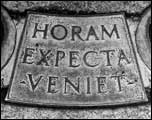
'83 Horam Expecta Veniet
In the January issue of CCT, Steve Pulimood '03 refers to the inscription on the base of the Sundial, Horam Expecta Veniet. The translation he provides is "Await the Hour Will Come." The translation provided to the Class of 1973 when we arrived on campus in 1969 was "Await the hour. It is coming." I have always wondered, however, whether the original intent was a religious one: "Await the hour. He is coming." Whichever translation is correct, I have chosen to add Horam Expecta Veniet to collections of graffiti in various odd locations where I hoped a fellow Columbian might recognize them. Henry Rosenberg
'73 War Memorial What a pleasant surprise to receive a brochure informing me of plans to build a war memorial on campus. A request for a contribution was included and I returned it with a donation. The memorial, honoring alumni who made the ultimate sacrifice, will be called War Remembrance. The project gave rise to memories of my own, such as when I cleaned out my desk at school in preparation for summer vacation in June 1944 as troops were going ashore and dying on the beaches of Normandy. In June 1950, I was enjoying sun and surf when war broke out in Korea. Other dates and other places came to mind, such as Midway, Tarawa, the Schweinfurt-Regensburg raid and the Da Nang Valley. I don't remember exactly what I was doing at the time of each, but I wasn't in harm's way while others were. Now, in the wake of 9-11 and the deaths of several thousand civilians, including Columbia alumni, military forces are putting their lives on the line again. The memorial is long overdue, but it couldn't be more timely. Howard J. Loeb
'55
|
|
||||||||||||||||||||||||||||||||||||||||||||||||||