 |
 |
 |
 |
 |
|||
|
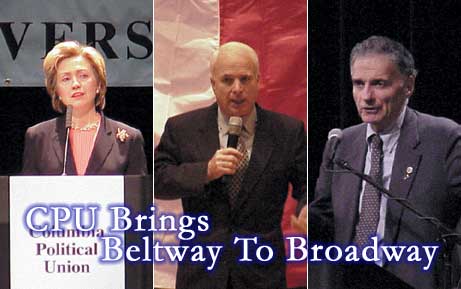
COVER STORY Hillary Clinton. Al Gore. John McCain. Bill Bradley. Ralph
Nader. Such a set of political heavyweights can usually only be
found power-lunching in a Washington, D.C., steakhouse (at separate
tables, of course), or perhaps appearing on a particularly
ambitious Meet the Press episode. However, in the span of one
calendar year, they all journeyed to a college campus far from the
Beltway. More noteworthy still is that the campus that they chose —
a political hotbed in the 1960s — has re-emerged as an
important political stage, and one student group has led the
charge. “We felt that there was a political void at
Columbia,” says Yoni Applebaum ’03, general manager of
the Columbia Political Union. “There was a feeling on campus
that political events were dangerous and only led to polarization
and controversy. The purpose of the CPU is to restore political
dialogue.”
Judging from the impressive roster of speakers that the CPU has
helped bring to campus since its founding in January 2000, it has
done just that, though the organization is far more than simply a
platform for the politically powerful to share their views with
undergraduates. The CPU also publishes pamphlets (40,000 last year
alone) that highlighted the debate over hot-button topics that
included Social Security and the budget; hosts frequent panel
discussions with political and faculty representatives, engaging
students in topics such as the death penalty and campaign finance
reform; and even publishes a magazine, Columbia Political Review,
which is available for download at the group’s Web site
(www.columbia.edu/cu/cpu). The CPU has come a long way from its birth (or rebirth) on a
crowded bus on the way to wintry New Hampshire. “Our first
formal activity was to sponsor a group of about 50 students to
travel to New Hampshire for the initial 2000 presidential primary
to support their chosen candidate,” Applebaum, a history
major from Newton, Mass., recalls. “Its success encouraged us
to think bigger.” The re-emergence of the CPU (a group with that name has existed
since the 1950s, according to Applebaum, but has been dormant) on
campus as a political player was the brainchild of Marc Dunkelman
’01, the organization’s founder and original general
manager. The thinking was simple: make the concept of unification
more important than party lines, and get inherently opposing
student groups (such as the College Democrats and Republicans) to
co-sponsor events and have their leaders sit on the CPU’s
executive board. Working on the assumption that political extremism only further
alienated and ostracized students, the CPU aimed to be a venue for
all students to have a voice and feel as though they belonged in
the political world. “If you’re going to excite
politically interested folks, and certainly if you hope to inspire
apathetic corners of the campus, you’re going to need to
bring people with differing viewpoints together and let the sparks
fly,” Dunkelman says. “Possibly the CPU’s most
important contribution is that it provides a safe forum for
political debate, allowing students to appreciate the nuances of
different arguments and form their own opinions.” After conquering the snow in New Hampshire, the CPU was faced
with a more difficult task if it wanted to remain relevant in the
2000 election year — energizing a politically apathetic
student body. “For almost 30 years, no group on campus tried to forge an
arena for real political debate and interaction,” says
Dunkelman, who now works for the Senate Judiciary Committee under
Senator Joseph Biden (D-Del.). “Once the CPU did, the
response was overwhelming.” Buoyed by the natural interest in a presidential election, even
the CPU’s initial events were well-attended: speeches by
presidential candidate Bill Bradley on the nation’s economy
and Senator Paul Wellstone (D-Minn.) on welfare reform drew large
crowds to the Roone Arledge Auditorium in Lerner Hall. A March 2000
editorial in Spectator lauded the CPU for “bringing
much-needed political discourse to Columbia after years of
absence.” A CPU-sponsored voter registration drive was
similarly applauded. The list of nationally-known speakers to descend the ramps at
Lerner for speeches that spring began to look like the guest list
for Larry King Live. After columnist Arianna Huffington spoke on
campaign finance reform in March, presidential candidate and
Senator John McCain (R-Ariz.) arrived a few weeks later to touch
upon the same subject.
But while the student body continued to pack the Roone to get a
glimpse of figures usually only visible on C-SPAN or the Sunday
political talk shows, the CPU encountered some resistance in trying
to bring other speakers to campus. “The CPU’s emergence
was met with a certain degree of hesitancy by the
administration,” Dunkelman contends. “They were
initially reluctant to permit political candidates to appear on
campus, not only for concerns about nonprofit regulations, but also
possibly — and justifiably, considering the 1960s — for
fear that the school’s reputation would be damaged by an
embarrassing incident.” In a spirit of what could be deemed bipartisanship, however, the
CPU and Low Library quickly worked to form a new policy regarding
candidate appearances on campus, and soon the administration was,
according to Applebaum, “tremendously
supportive.” “I never noticed any resistance; we’ve all been very
happy with the CPU,” says University Chaplain Jewelnel Davis,
a member of the organization’s advisory board and whose
office oversees all Student Government Board groups, including the
CPU. “I think it’s simply fabulous that students have a
chance to interact with political leaders and each other about
issues, and that our school, the most prestigious college in the
nation’s most important city, is a political center
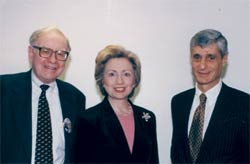
again.” When classes reconvened in fall 2000, and with election fever
running high, the CPU trotted out its biggest guns yet: then-First
Lady Hillary Clinton (now a New York Senator), former Treasury
Secretary Robert Rubin and billionaire Warren Buffet spoke in
September about fiscal responsibility, followed by a speech by
former Israeli Prime Minister Shimon Peres that drew sizeable, yet
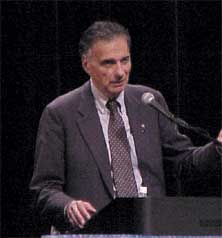
peaceful protests. In October, two more men vying for the Oval Office made stops on
the Heights: first, Green Party candidate Ralph Nader, and then, in
the CPU’s biggest “get” of its brief history,
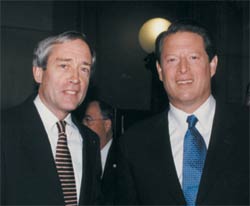
then-Vice President Al Gore. The Gore event — which took CPU
board members nearly two weeks of nonstop work to arrange —
attracted national attention, and a sizeable portion of
Gore’s speech graced the pages of The New York Times the next
day, complete with a photo of him speaking under Low
Library’s soaring rotunda. It was official: Columbia was back
on the political map. ‘‘The CPU has had a very positive role in bringing
political debates, leaders and issues to campus,” says
Anthony Marx, associate professor of political science. “It
has contributed to a deepening engagement in difficult issues of
the day. As such, the CPU has contributed to a refreshing trend to
get beyond the frivolities of the ’90s and to become more
serious about the difficulties that we face as a society
today.” As the election year of 2000 eventually ended with a storm of
confusion, butterfly ballots and hanging chads, the CPU rededicated
itself to fostering political dialogue on campus. Its allotted
annual budget of $4,000 long since gone, the CPU — which
hopes to soon solicit alumni support for an endowment —
raised money “wherever we could find it,” according to
Applebaum, and continued with its impressive roster of events. In
2001, it hosted speeches by New York City mayoral candidates Mark
Green, Fernando Ferrer and Herman Badillo, as well as a talk by
civil rights leader Reverend Al Sharpton.
The group also took center stage as a resource for students in
the traumatic days following September 11. Following the terrorist
attacks on the World Trade Center and Pentagon, the CPU hosted
panel discussions about Homeland Security and the evolution of
George W. Bush’s presidency. And in an event covered by CNN,
it organized a gathering of students to watch the president’s
stirring speech to the House of Representatives on September
20. “The [mayoral] election and September 11 might have
spurred activity by their own force, but having an organization
ready to organize forums and events in a nonpartisan and open way
provides great added value,” says Professor Robert Shapiro,
chair of the Political Science Department and moderator of the Bush
panel. “The CPU’s founders and current leaders deserve
a lot of credit for assisting in Columbia’s political
revival.” The new politically friendly environment at Columbia stretches
beyond even the CPU’s reach, as Morningside Heights has
become a mecca for pols-turned-profs. In addition to Gore teaching
a Journalism School class last spring, former Bill Clinton aide and
current ABC News commentator George Stephanopoulos ’82 and
former New York City Mayor David Dinkins have taught recently for
the School of International and Public Affairs. And former U.S.
Senator George Mitchell (D-Maine) gave an address on international
conflict resolution at SIPA in January and will be joining Columbia
in July as a senior fellow, conducting lectures and issue briefings
for faculty as part of SIPA’s newly formed Center for
International Conflict Resolution. As for the CPU, its mission statement remains constant: provide
a platform for Columbia to re-establish itself as a premier stage
on the American political circuit. While it has gotten off to an
undeniably fast start, the CPU has no plans to rest on its laurels.
“We’re focusing now on the new magazine, creating a new
roster of speakers and keeping student interest high even though it
is not a presidential election year,” says Applebaum.
“We think the CPU exemplifies what is good about Columbia
— open intellectual and political debate — and
we’re going to try to keep it going.” Jonathan Lemire ’01 is a contributing writer
for Columbia |
|
||||||||||||||||||||||||||||||||||||||||||||||||||||||