|
|
|
Student Spotlight

Alisa Weilerstein ’04
By Beth Satkin
Don’t call Alisa Weilerstein ’04 a prodigy.
“Don’t ever use that word again!” she admonishes.
“People say that all the time, and it drives me crazy. I just
have a visceral aversion to that word.” She prefers
‘precocious.’
The College sophomore, known to her friends as Ali, already has
distinguished herself as a rising cello star in the classical music
world. Her resume of solo performances includes many of the
world’s most prestigious performing groups and venues: her
Cleveland Orchestra debut at age 13, Carnegie Hall two years later,
recent tours of Japan, Europe and Australia. Her debut CD was
released in 1998 by EMI Records, and last year she received a
prestigious Avery Fisher Career Grant. “I used 90 percent of
my grant for Columbia tuition,” she says, smiling. “I
am saving the other 10 percent for further study down the
road.”
Adolescence can be a perilous time for talented young
performers. Stories of early burnouts and breakdowns abound, and
only the toughest of wunderkinds emerge from their teenage years
unscathed. Weilerstein, however, appears to have remained grounded.
“I love performing; it’s my favorite thing to
do,” she says. “I know there are some jaded views about
young people playing a lot, but I ignore that and continue what
I’m doing.”
 |
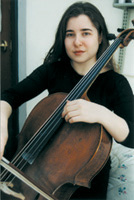
Weilerstein believes
that having to carve out practice time within her busy class
schedule will make her a better musician by teaching her to
practice more efficiently.
PHOTO: EILEEN
BARROSO |
 |
Weilerstein, a Cleveland native, was perhaps destined for a
concert career. Her mother and her father, pianist Vivian Hornik
Weilerstein and violinist Donald Weilerstein, are accomplished
musicians and teachers. But it was her grandmother who gave
Weilerstein her first cello when she was just 2 1/2 years old: a
painted Rice Krispies box with a toothbrush for the end pin.
Weilerstein played her toy cello day and night, even accompanying
her parents at rehearsals. At 4, she roped her parents into buying
her first real cello, a diminutive one sixteenth-sized instrument.
She held her first public recital just six months later. These
days, Weilerstein plays a 1696 Matteo Goffriller cello, on loan
from the Stradivari Society of Chicago.
Weilerstein’s talent was evident from an early age, her
mother recalls. “When Ali was 3 years old, I was practicing
at the piano,” she recalls. “I got up to answer the
doorbell, and when I came back, she was sitting at the piano
playing the whole opening theme of a Chopin piece that I had been
practicing. She had never taken a piano lesson. She just picked out
the tune by ear.”
Music was a family affair throughout Weilerstein’s teenage
years, culminating in the family’s debut recording of the
Ives Piano Trio as The Weilerstein Trio in 1998. “We’ve
been playing together for such a long time. It’s such a
natural thing, like the way you have a conversation,” says
Vivian Weilerstein. But at times, says the younger Weilerstein, it
can be difficult to put aside the parent-daughter relationship and
work as colleagues. “We’re a very close family, but of
course we have our ups and downs,” she says. “We just
try to focus on the music. My parents take my musical ideas quite
seriously.” (Weilerstein has a 14-year-old brother, Josh, who
is a talented violinist, but she stresses, “He has made it
very clear that he doesn’t want to play
professionally.”)
Weilerstein concedes that her college experience has been somewhat
out of the ordinary, even for a Columbia student. As a first-year,
for example, she performed 42 concerts in the United States and
Europe on top of a full academic schedule, often writing papers on
airplanes and e-mailing them to professors. On campus, Weilerstein
may be spotted lugging her enormous white cello case across South
Field or the steps of Low Library. But more often, you can find her
in her dorm room, sawing away at etudes and concertos for hours
each day, which she says isn’t a problem with her neighbors.
“It’s easier to practice in the dorm because everyone
stays up until about 4 a.m., so I never have to worry about
practicing at late hours,” she says. “I’ve
practiced until 3 a.m. several times. And if somebody does want to
go to sleep, they just knock on my door and say, ‘Sorry, you
sound great, but I just can’t sleep!’ And then
I’ll go to some other place.”
Sometimes, a concert tour comes as a much-needed break from life as
a student. “Living in New York, you’re around people
all the time, so sometimes it’s nice to get away and have a
bit of time to myself, where I can read and practice and learn
other languages,” she says. Being on the road, however, has
its down side. “The hardest thing is when you’re
traveling alone, and you come back after a concerto performance
into a hotel room, and there’s no one there to celebrate
with,” she reflects. “Usually I wind up jumping up and
down on my bed and being totally crazy, or watching bad movies
until 3 a.m. You find ways to cope.”
During the past year, Weilerstein has traveled extensively,
performing as a soloist with the San Francisco Symphony under noted
conductor Michael Tilson Thomas and in Japan with the Tokyo and
Hiroshima Symphonies, as well as in several recitals in Europe. A
highlight of the year came on September 15, when she performed with
the National Symphony at the Kennedy Center.
“The concert was almost canceled because of the terrorist
attacks,” she recalls, “but in the end, everyone
decided that ‘the show must go on.’ It was the most
memorable concert experience I’ve had. The hall was quite
full considering what had happened only four days before, and we
all got the feeling that music was something that was desperately
wanted and needed as solace for the terrible wounds inflicted on
the country.”
Despite the challenges of her dual life, Weilerstein doesn’t
regret having chosen a rigorous academic school such as Columbia
over a full-time music conservatory. “I grew up in a
conservatory atmosphere, and I decided that when I went to college,
it would be time for something new,” she says. “I want
to read. I don’t want to be stuck in a practice room for four
years. There’s so much more to learn, so many great books and
great people to meet outside my field.”
|
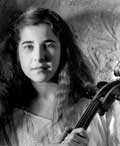
Weilerstein says the
cello "is my passion; always was, and I think always will
be."
PHOTO: EILEEN BARROSO |
|
Columbia’s location in New York City, she says, is a
perfect combination that allows her to further her cello studies
with Joel Krosnick at The Juilliard School while pursuing her
undergraduate degree in 20th-century European history. Despite her
demanding schedule, Weilerstein makes sure that she has some time
left to explore the city, and when she talks about this, she sounds
like many other College students. “I love New York City,
there’s so much excitement around it,” she says.
“I just love walking around. One of my favorite things to do
is sit at outdoor cafés and people-watch.”
Weilerstein aims for three hours of practice on school days and
four hours on weekends, “but I only achieve that about 80
percent of the time,” she admits. Trying to balance practice
and schoolwork can be tricky sometimes, especially around exam
periods. “But most of the time,” she says, “I
appreciate the balance that I have something else to think about
aside from what concerto I’m going to play next.”
In the long run, Weilerstein believes that having to carve out
every hour of practice time will make her a better musician.
“It teaches me to practice more efficiently,” she says.
“I’m hungry for the instrument when I get to it.”
Given the number of hours she spends practicing, touring and
performing during the school year, Weilerstein’s time at
Columbia isn’t exactly a break from music. “But I
wouldn’t want it any other way,” she says. “I
can’t ever totally get away from it, and I don’t want
to.”
As a first-year, Weilerstein’s neighbor across the hall was
one who could relate to the unique stresses of balancing a
performing career with the rigors of Ivy League academics: Julia
Stiles ’04, whose starring roles in films like State and
Main, Save the Last Dance, O and The Business of Strangers have
catapulted her to the top of the ranks of young film actresses.
“She said she liked hearing me practice while she was
studying,” says Weilerstein, “but I don’t know
whether she was just saying that to be nice.”
What do Weilerstein’s non-musician friends think of her
career? “They’re really fascinated by it,” she
says. “One time I played a concert at the Chamber Music
Society of Lincoln Center, and half of my dorm floor showed up,
which was really sweet. They’re very supportive and very
interested.”
Weilerstein attributes her perseverance to her love of the
instrument, and also to her parents, who she says never pushed her,
yet were “100 percent supportive” of her musical
career. “My parents were never the type to lock me in a
cubicle and make me practice 10 hours a day,” she says.
Vivian Weilerstein echoed her daughter’s sentiments. “I
just want her to be happy,” she says. “I want her to
feel that she can be fulfilled doing what she wants to do, whatever
that may be.”
Weilerstein, meanwhile, would rather enjoy the moment. “As
tempting as it is to think about the future, I’d rather live
in the present,” she says. And despite the daily grind of
practicing and the stresses of maintaining a concert career on top
of everything else, Weilerstein says she has never considered
giving up the cello, and doesn’t regret being so focused so
early. “The cello is something I never questioned,” she
says. “Cello is my passion. Always was, and I think always
will be.”
Beth Satkin is completing her junior year at Brown
University. Her writing has appeared in The New York
Observer, Classical New Jersey Magazine and the Brown
Daily Herald.
|
|
|