 |
 |
 |
 |
 |
|||
|
AROUND THE QUADS
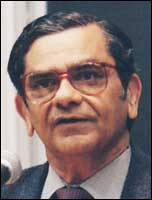
The University's Board of Trustees, meeting in March, promoted three Columbia faculty members - biochemistry professor Wayne Hendrickson and economics professors Jagdish Bhagwati and Robert Mundell - to the rank of University Professor, Columbia's highest faculty honor. University Professors are named in recognition of exceptional scholarly merit as well as distinguished service to Columbia, and are permitted to teach in any department of the University. Bhagwati is the Arthur Lehman Professor of Economics and professor of political science. He is widely regarded as one of the world's preeminent international trade theorists and has made significant contributions to public finance, immigration and the new theory of political economy. One of his early books, India: Planning for Industrialization (1970), which he co-authored with professor of economics Padma Desai, is credited with providing the intellectual case for the economic reforms now under way in India. He has served as an adviser to India's finance minister. A native of India, Bhagwati attended Cambridge University, MIT and Oxford University. He taught at the India Statistical Institute and the Delhi School of Economics in India before returning to MIT, where he became the Ford International Professor of Economics. He joined the Columbia faculty in 1980. Bhagwati is a prolific researcher who has published more than 200 articles and 40 volumes. His works include A Stream of Windows: Unsettling Reflections on Trade, Immigration and Democracy (1998), a collection of his writings on public policy, and Protectionism (1988). He also contributes frequently to The New York Times, The Wall Street Journal, and The Financial Times, and writes reviews for The New Republic.
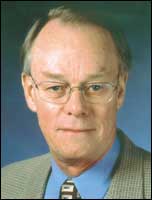
Hendrickson, a member of the College of Physicians and Surgeons faculty since 1984, teaches in the department of biochemistry and molecular biophysics. One of the world's preeminent structural biologists, Hendrickson has invented a method to speed the determination of atomic structures for biological molecules from the X-ray diffraction of crystals. Hendrickson is known for his crystallographic techniques for structure determination of biological macromolecules. He has set universal standards for high-resolution refinement and for the application of multiple wavelength anomalous dispersion. He has also developed software programs widely used in interpreting X-ray data. In his research into immune response interactions, Hendrickson and his co-workers determined the structure of a key molecule that the AIDS virus uses to attach onto a human immune cell during infection. He and his colleagues also have determined the structures of many other biological molecules, including other AIDS-related molecules and several proteins that function at the surfaces of living cells. Hendrickson, who is also an investigator at the Howard Hughes Medical Institute, is the author of more than 200 scholarly articles. He is a member of the National Academy of Sciences and the National Advisory General Medical Sciences Council.
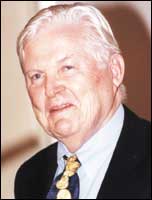
Mundell, the C. Lowell Harriss Professor of Economics, became Columbia's 60th Nobel laureate in 1999 (see CCT, November 1999). Mundell has written extensively on the international monetary system, arguing for the advantages of a common currency, and is credited with laying the intellectual foundations for the Euro. He was a pioneer in monetary and fiscal policy theory, reformulated the theory of inflation and interest, co-developed the monetary approach to the balance of payments and was an originator of supply-side economics. A Canadian native, Mundell studied at the University of British Columbia and the London School of Economics before receiving his Ph.D. from MIT. He has taught at Stanford, the Bologna Center of the School of Advanced International Studies and the University of Chicago, worked at the International Monetary Fund, and edited the Journal of Political Economy. He joined the Columbia faculty in 1974. His books include Monetary Theory: Interest, Inflation and Growth in the World Economy (1971), International Economics (1968) and The International Monetary System (1965), and he has co-edited several others, including Monetary Agenda for the World Economy with Jack Kemp (1983), Inflation and Growth in China (1996) and The Euro as a Stabilizer in the International Monetary System (2000). In 1997, he co-founded the Zagreb Journal of Economics. In
making these appointments, the Board of Trustees increased the
number of University Professors from nine to 12.
|
|
|||||||||||||||||||||||||||||||||||||||||||||||||||||||||||||||||||||||||||||||