|
|
|
CAMPUS BULLETINS
 |
| Related
Stories |
 |
|
|
 THE BEAT
GOES ON: Applications are up, selectivity is up, SAT scores are up
- in other words, it was just another year for the College
Admissions Office. THE BEAT
GOES ON: Applications are up, selectivity is up, SAT scores are up
- in other words, it was just another year for the College
Admissions Office.
A
record 14,094 applications were received for places in the Class of
2005, an increase of 4.7 percent over a year ago. The College
accepted 1,720 students, producing a selectivity or admittance rate
of 12.2 percent, the lowest in College history and the third-lowest
in the Ivy League behind Harvard (10.7) and Princeton (11.7). With
the College's target enrollment at 1,007, that would make the yield
58.5 percent.
The
average SAT scores of the students accepted was 1,425, another
record, and 88 percent of those students who submitted a class rank
were among the top 10 percent of their class. Students were
accepted from all 50 states and 35 countries.
Early decision applications reached 1,501, up 12.9 percent, an
indication that Columbia continues to be a school of choice among
leading students.

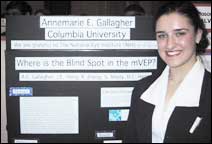
Annmarie Gallagher '03 with her poster at the
Capitol.
PHOTO: DONALD HOOD
 |
POSTER: A
poster designed by Annemarie Gallagher '03 was one of 64
selected for presentation on March 29 in the U.S. Capitol.
Gallagher, the youngest of the 64 presenters, assembled the poster,
"Detecting Optic Nerve Disease with the Multifocal Visual Evoke
Potential (mVEP): Lessons from the Blind Spot" as part of the fifth
annual research poster competition organized by the Washington,
D.C.-based Council on Undergraduate Research, which promotes
undergraduate student research in science, mathematics and
engineering. Donald Hood, the James F. Bender Professor in
Psychology, sponsored Gallagher in the competition. Nile Kurashige
'01 Barnard was also selected to present a poster in the
competition.
PRINCETON'S PLAN: With an endowment that has surpassed $8 billion
plus a strong annual giving program, Princeton has announced plans
to provide grants instead of loans for all of its undergraduate
financial aid beginning with the fall 2001 semester as part of a
$57 million increase in endowment-income spending. The no-loan
program for undergraduates is expected to cost more than $5 million
next year, while improved support for graduate students will cost
more than $6 million.
Columbia will be studying the effects of the changes in
Princeton's financial aid policies, the second time in three years
the school has moved to makes its package more attractive to
prospective undergraduates, as well as the responses of other Ivy
and peer institutions. However, Dean Austin Quigley noted that the
College's prospective student pool differs significantly from
Princeton's, so there is not expected to be any immediate effect of
the move on Columbia's ability to attract top students.
VAN
DOREN/TRILLING: The annual Van Doren and Trilling awards were
scheduled to be presented on April 23, after press time, so look
for coverage in the September issue of CCT. The awards are
presented by students to faculty members, the Van Doren award for
outstanding teaching and the Trilling award in recognition of an
outstanding book written by a faculty member.
BANQUETED:
Colleagues and students honored University Professor Ronald
Breslow in word and music at a banquet-symposium on Saturday,
March 24. The evening, which marked the esteemed chemist's 70th
birthday, featured the world premiere of a celebratory piano solo,
Liberating Chemistry from the Tyranny of Functional Groups,
composed by Bruce Saylor specifically for the evening and performed
by pianist Michael Boriskin. (The title of the piece refers to
Breslow's pioneering research on artificial enzymes.) The 200
invited guests at the Low Library event included leading chemists
from across the United States, some of whom were Breslow's
students, as well as colleagues and students from Columbia and
other institutions.
Breslow, who has been a Columbia faculty member for more than
four decades, was recently named one of the top 75 contributors to
the field of chemistry in the last 75 years by Chemical and
Engineering News. His research has focused on the design and
synthesis of new molecules with interesting properties, and the
study of these properties. He has received many of the top prizes
in his field, including the U.S. National Medal of Science and the
Priestley Medal of the American Chemical Society, its highest
honor.
ADVISING:
Robert Glenn Hubbard, R.L. Carson Professor of Finance in
the Business School, was named chairman of the President's Council
of Economic Advisors in February. A tax-cut advocate, the Columbia
economist served as a deputy assistant secretary in the Treasury
Department during the administration of President Bush's father. He
joined the younger Bush's campaign in 1999 to help develop economic
policies.
The
Council of Economic Advisors focuses primarily on research but also
assists in formulating policy. While the council chairman used to
be the president's chief economic adviser, that position has been
transferred to the head of the National Economic Council, currently
Lawrence Lindsey, a friend of Hubbard's since graduate school at
Harvard. "You have to see how these things evolve," Hubbard said in
The New York Times on February 27, "but my hope for the
Council of Economic Advisers is that it plays a very strong
participatory role in developing economic policy."
A
tax law specialist and prolific researcher, Hubbard has argued that
high marginal tax rates discourage work effort and also
entrepreneurial activity, which he suggests is mostly taken on by
the wealthy. He has also studied family savings, reasons creditors
are reluctant to lend to farmers, and obstacles corporations face
obtaining loans. A Florida native, Hubbard attended the University
of Central Florida and received his doctorate from Harvard in 1983.
He taught at Northwestern for several years before moving to
Columbia, where he has held a joint appointment as an economics
professor in Columbia's Faculty of Arts and Sciences since
1997.
COMMUNITY:
More than 1,000 volunteers from the Columbia community led by
President George Rupp joined their neighbors from the
surrounding communities on a cold, rainy March Saturday to clean
parks, renovate buildings, repaint school classrooms and work at
other projects during the fourth annual Columbia Community
Outreach, a student-organized event. U.S. Representative Charles
Rangel gave opening remarks, followed by keynote speaker
Evan Davis, president of the Association of the Bar of the
City of New York and clerk of the Trustees at Columbia.
HELP
WANTED: The Center for Career Services has launched its first-ever,
online Alumni Resource Network, where Columbia students and alumni
can search for career advice. Created through an expanded
partnership with JOBTRAK, this database holds occupational
information of Columbia graduates in virtually all career fields
including current positions, career paths and resources they wish
to offer. It contains a searchable feature where students and other
alumni can view this information and contact those they wish for
advice and guidance, as well as a tracking method for alumni to
select the amount of times they wish to be contacted per
month.
If
you are interested in sharing your professional knowledge and
expertise and would like to become a resource, go to: www.columbia.edu/cu/ccs. By
clicking on the Alumni link, you will find instructions to register
with the online Alumni Resource Database. When prompted for a
password, enter LION as a default password until you make the
change. For additional information, call CCS at (212)
854-5609.
SOCIAL
WORK: Columbia has announced plans to construct a new building for
the School of Social Work at 121st Street and Amsterdam Ave. on
land that has been empty for many years and is often called the
"Pharmacy site," after the defunct School of Pharmacy. A second
building also will be built on that site, to provide housing for
Law School students.
Community protests had led the University to halt construction
last winter at the original Social Work site, on 113th Street
between Broadway and Riverside Drive.
110th
STREET: At a lengthy and spirited public hearing on March 6,
Community Board 7 approved Columbia's request for building
variances at 110th Street and Broadway that would allow the
construction of a shorter, wider building to house the proposed
faculty residence and K-8 school. Though Columbia can build a
structure as tall as 18 stories, the variances will allow a
12-story building with architectural features contextual to
Morningside Heights and better space for residential living, retail
stores and the elementary school. The planned building would
include 27 apartments for faculty with children, space for an
innovative K-8 school on the first through sixth floors and ground
floor retail to contain a grocery market and Chase Manhattan Bank,
a current tenant on the site. As part of the project, two adjacent
historic buildings will be renovated at no cost to tenants and
dedicated entirely as housing for non-Columbia
affiliates.
CALLING
ALL PHILOS: The Philolexian Society, which lays claim to being the
oldest student organization on campus, is beginning plans to
celebrate its 200th anniversary in 2002. The organization, whose
mission is to improve the rhetorical skills and literary awareness
of students, was founded in 1802, continued uninterrupted until
1962, and was reestablished in 1985. In preparation for the
anniversary celebration, the current Philolexian leadership would
like to get in touch with former Philos, from any point in the
Society's history. Alumni can contact Rachel Kahn-Troster '01
Barnard, censor of the Society, at rdk23@columbia.edu for
information.
|
| Related
Stories |
|
|
|
|
|
|