As The Retrologist, Rolando Pujol ’95 travels coast to coast to share his love of roadside attractions.
Columbia College | Columbia University in the City of New York
As The Retrologist, Rolando Pujol ’95 travels coast to coast to share his love of roadside attractions.
JÖRG MEYER
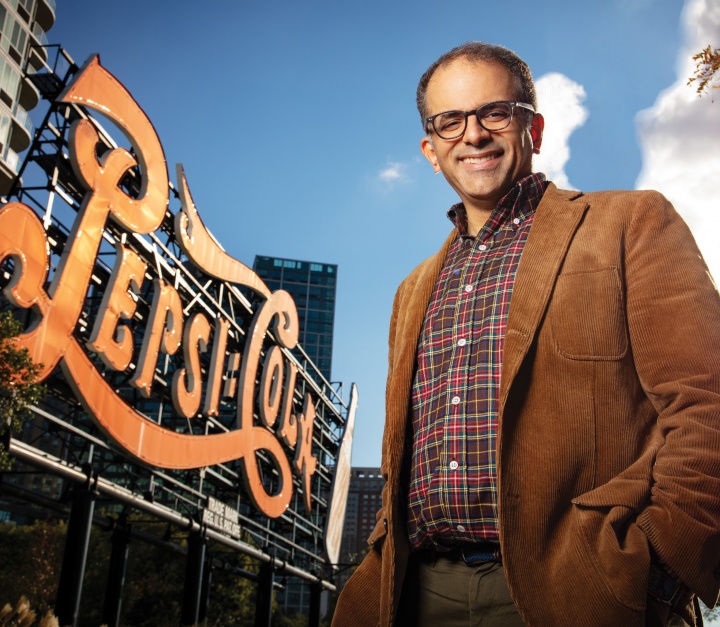
Standing on a walkway tiled with pavers, Pujol is looking up at a vintage advertisement for Pepsi-Cola — and it’s enormous. The swooping, old-timey characters sit on a frame that rises six or seven stories; the “P” and “C” are each about 50 feet tall. Unmissable in daylight, the display pops even more at night, when the letters are outlined in red neon. A bottle of cola punctuates the right side.
Relocated from its original location nearby, the massive fixture once stood atop a Pepsi bottling plant that was built in the 1930s and only closed in 2001. As an exemplar of commercial design that doubles as an urban icon, it is, Pujol says, “absolutely stunning.”

Pujol with “Paul Bunyon” and his hot dog in Atlanta, Ill.
Pujol launched his project on Tumblr in 2012, and it has both evolved and expanded since. The combination of images and commentary proved to be a good fit for Instagram, where he currently enjoys almost 94,000 followers. About a year ago Pujol moved from Tumblr to Substack; the newer platform provides a more flexible template and an easy way for some of his 6,500 or so subscribers to provide financial support. All told, he typically shares new material every few days, whenever he has a new photo to post or link to highlight.
Pujol’s roots in journalism stretch back to the College, where he wrote for Spectator and worked at The New York Times on weekends. After graduating he climbed the ladder from the Allentown, Pa., Morning Call to Long Island’s Newsday and then AM New York, where he helped build up a website and other digital platforms. He gained additional multimedia experience at WNBC-TV and Daily News America before joining the television station WPIX-TV, Channel 11, as director of digital and social strategy. In 2019, he moved to WABC-TV, New York’s Channel 7, where he oversees social media and other online content as an executive producer, among other responsibilities.
Pujol’s fascination with roadside wonders is embedded even deeper, predating both his career and his time at the College; he traces the line back to his early childhood. Born in 1973 to parents who emigrated from Cuba in the late 1960s, Pujol grew up in New York’s northern suburbs, in North Tarrytown (since renamed Sleepy Hollow).
He reminisces about riding along local roads, taking in the view from the back seat of the family car. The plethora of businesses, especially those with distinct buildings and memorable signs — a Smiling Bear Auto Center in Hartsdale and the Red Fox Diner in Elmsford are two that stick in his mind — were an ongoing source of fascination.
“They just intrigued me,” Pujol says. To a child who spoke Spanish at home and learned English from television programs like Sesame Street, he says, “these places were almost like a passport, an invitation to be an American. And going to these places and being welcomed at these places was sort of a step in my own process of Americanization.
“I just grew to admire them and like them, and was always curious about them. ‘Who runs this place, and why is it still here?’”
It’s a long highway that leads from 1970s Westchester to The Retrologist circa 2025, with unpredictable stops along the way. Pujol cites a family road trip down I-95 in the 1970s, recalling the singular kitsch of the South of the Border complex near Dillon, S.C., and a sense of being “overwhelmed” by the art deco sights and signs of Miami Beach.
He talks about taking his first major road trip by himself — more or less on a whim — when he decided at age 25 to visit Mount Rushmore.
“That was a great trip that reignited all of this,” he says. “I was completely hooked once I began to actually experience the independence of hitting the road for myself and seeing America.”
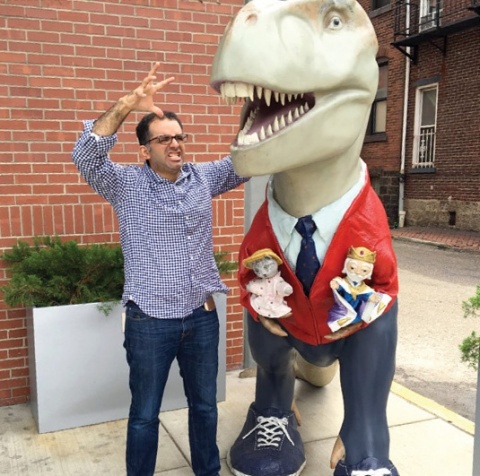
With “Fredosaurus Rex Friday XIII” in Pittsburgh.
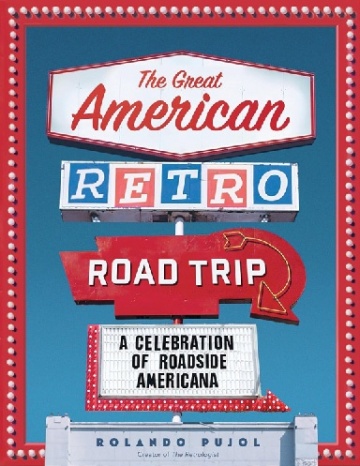
In writing The Great American Retro Road Trip, Pujol says he felt a responsibility to cover as much ground as he could, and took steps to include swaths of the United States he hadn’t visited previously.
That’s how the author found himself on a loop through the country’s midsection that took him from Dallas-Fort Worth International Airport to North Dakota and back. Upon returning the rental car, Pujol says, the agency representative was flummoxed when he calculated that his customer had put nearly 8,000 miles on the car in 10 days. (Pujol took that trip, at least in part, so he could include a photo of Big Tex — the 55-foot-tall cowboy mascot displayed for just 24 days each year, the duration of the Texas State Fair.)
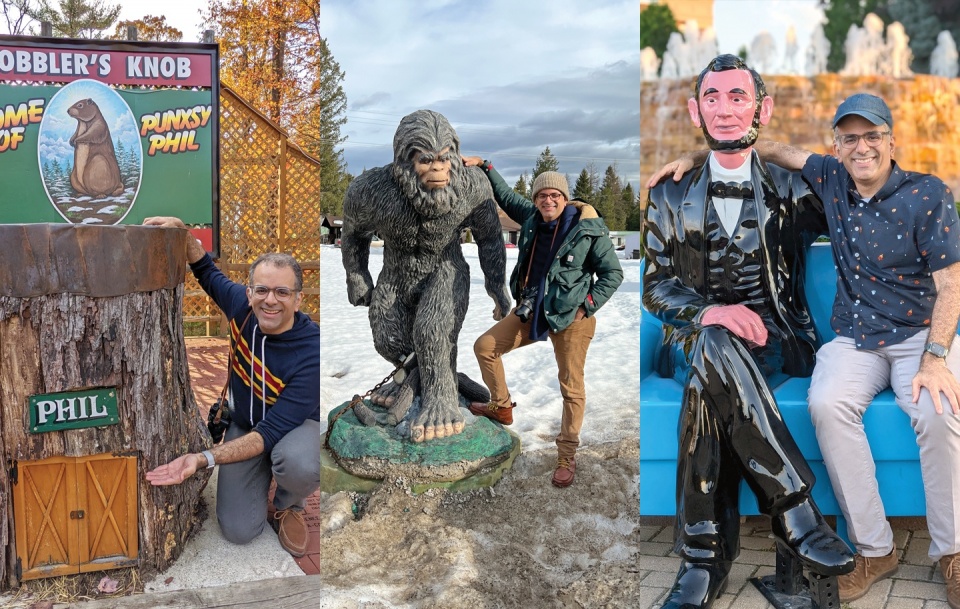
Left to right: At the Gobbler’s Knob Visitor Center in Punxsutawney, Pa.; measuring up to Bigfoot in Hungry Horse, Mont.; and sitting with Lincoln in Niles, Ill.
“I had a hard deadline for the book, so there was a lot of crazy,” he adds. “Basically, every weekend from August through early December [2024] was focused on the book, whether it was writing or photographing.”
The end product is comprehensive in spirit, even if Pujol missed a few corners of the nation here and there, and had to omit some material for lack of space. Whether flipping through the book or scrolling through Pujol’s Instagram feed, the reader experience ranges from pleasant diversion to the thrill of recognition.
So what, exactly, does The Retrologist see as his mission? He provides a view from America’s highways, to be sure — except he sets it alongside content from central cities, including famed eateries like Katz’s Delicatessen in Lower Manhattan and Dan Tana’s in Los Angeles. We encounter a wonderland of neon, yet there’s also plenty of plastic, and plaster. Commercial architecture gets its due, as Pujol traces the physical evolution of Taco Bell restaurants and gleefully muses on “classic” Pizza Huts, with their peaked red roofs. But just as often, interesting signs grace unremarkable buildings.
Asked to define his work, Pujol says, “It’s almost like retail archaeology — retail in the built environment and its evolution primarily in the 20th century. But ‘roadside Americana’ becomes an easy catch-all phrase, you know?”
Pujol talks about one more bit of Americana, recalling a visit to New Bern, N.C., that took place after he finished work on the book. “I went to the birthplace of Pepsi, the actual pharmacy where Pepsi was said to be formulated by Caleb Bradham. ... It was neat to be there, and to have a Pepsi straight from the fountain — probably my first one in a while. I must say, it was quite refreshing.”
Marcus Tonti lives in Long Island City, about a 15-minute walk from the Pepsi-Cola sign. He has also written for SIPA Magazine and Columbia magazine.

Published three times a year by Columbia College for alumni, students, faculty, parents and friends.
Columbia Alumni Center
622 W. 113th St., MC 4530, 6th Fl.
New York, NY 10025
212-851-7852
cct@columbia.edu

Columbia Alumni Center
622 W. 113th St., MC 4530, 4th Fl.
New York, NY 10025
212-851-7488
ccalumni@columbia.edu