Columbia College | Columbia University in the City of New York
In Memoriam: Ellin S. Feld GSAS’84, Professor of German Language and Literature
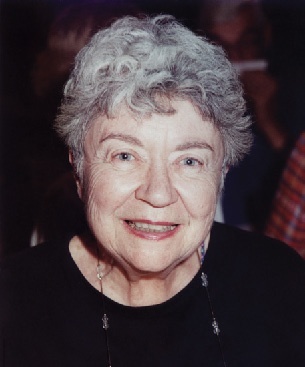
PHOTOS COURTESY PETER FELD ’81
Born Ellin Silverman in Brooklyn, N.Y., in 1927, she graduated from Brooklyn College. There, at the height of WWII, she was drawn to study German because of her friendships with newly arrived Jewish refugees who often chose that major.
Feld earned her master’s from Boston University and taught for two years at the University of Idaho before coming to Columbia in 1950 for graduate study in the Department of Germanic Languages. She formed strong connections with legendary literature scholar Helen M. Mustard GSAS’46, who became her mentor, and fellow student and then colleague Inge Halpert GSAS’57, who later chaired the department and was a lifelong friend. With support from a Fulbright Scholarship and an Ottendorfer Fellowship, Feld went to Tübingen in 1953–54 to research her planned dissertation on the image of Italy in 18th-century German novels. She married Milton Feld GS’52 in 1955.
Like many women in academia at the time, Feld was dissuaded from completing her Ph.D., and directed toward teaching — a setback that inspired her feminism. In 1984, five years before her retirement, she was delighted to be awarded the newly introduced M.Phil. for her graduate work done 30 years prior.
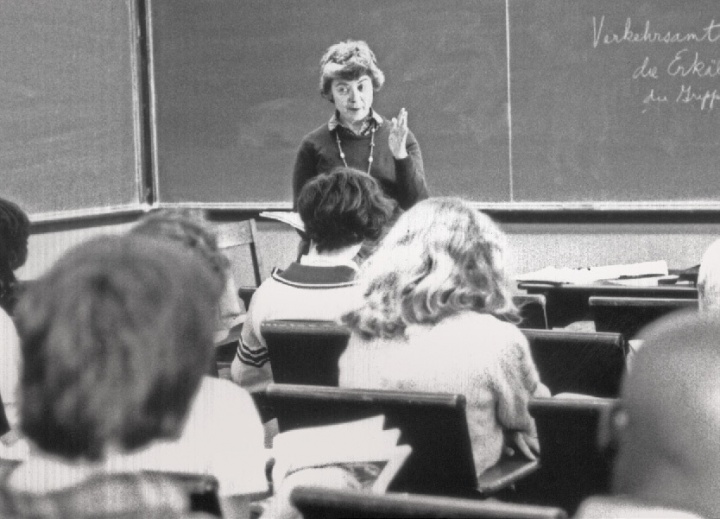
Feld teaching an undergraduate German class in Hamilton Hall in the 1980s.
“This friendly, intelligent teacher seems determined that all should learn the language and have a good time in the process, according to comments by her happy followers,” wrote a similarly laudatory Course Guide reviewer in the Fall 1976 edition. “With ‘the attitude that everyone can and will learn German,’ [Ms. Feld] is the sort of person who ‘gives plenty of work but somehow is an absolute pleasure’ ... ‘I always leave feeling better than when I came in.’ ‘Lectures on syntax, oral drills, dialogues and reading of additional materials are coupled with the sharing of a few German jokes.’” In 1980, Feld was honored with the Faculty Award for Distinguished Teaching.
She also co-authored two widely used first-year German textbooks: Anfang und Fortschritt: An Introduction to German (1968, 1973) and Zielsprache: Deutsch (1981). The latter was praised in Women’s Studies Quarterly in 1984 for its “absence of sexism,” “well-balanced” dialogues featuring women in nontraditional occupations, and grammar exercises that “give equal stress to sentences with women and feminine pronouns.”
Feld’s love of helping undergraduates went beyond the classroom. When her colleague Patricia Geisler BC’55, GSAS’79 became dean of preprofessional advising, Feld signed on as a pre-med adviser. “Ellin was surprised when I asked her to work with pre-med students,” Geisler recalls. “She wasn’t a scientist, and knew nothing about medical school expectations. But she realized that most of all she needed to be supportive for kids under a lot of stress. Her advisees loved her, and I valued her enormously. Not only did she write compelling letters of recommendation, but she also was absolutely reliable. Wise and honest and kind, and very down to earth, Ellin could laugh at life’s absurdities. Long a good friend, she became an admirable colleague.”
Feld maintained her passion for literature and was a mainstay at Columbia’s Deutsches Haus, the German cultural center whose weekly coffee hours were overseen by its revered secretary, Gusti Neugroschel, who took a motherly interest in the German faculty and students. Feld also attended conferences, traveled to Germany, and painstakingly prepared a lecture on fairy tales for Orientation.
Throughout her life, Feld was devoted to political causes, including the civil rights and antiwar movements. In her graduate school days she signed a campus letter in support of her idol, Adlai Stevenson — an act some thought risky in 1952, when Stevenson’s opponent for president was Columbia President Dwight D. Eisenhower. And she was sympathetic to students who protested, though less so to those who occupied her office building in Spring 1972.
Feld retired from teaching in 1989, devoting herself to gardening, political activism and her beloved antiques. She is survived by her sons, Peter ’81 and Michael.

Published three times a year by Columbia College for alumni, students, faculty, parents and friends.
Columbia Alumni Center
622 W. 113th St., MC 4530, 6th Fl.
New York, NY 10025
212-851-7852
cct@columbia.edu

Columbia Alumni Center
622 W. 113th St., MC 4530, 4th Fl.
New York, NY 10025
212-851-7488
ccalumni@columbia.edu