Columbia College | Columbia University in the City of New York
The Football Team Helped Out Manhattan Project Scientists
I
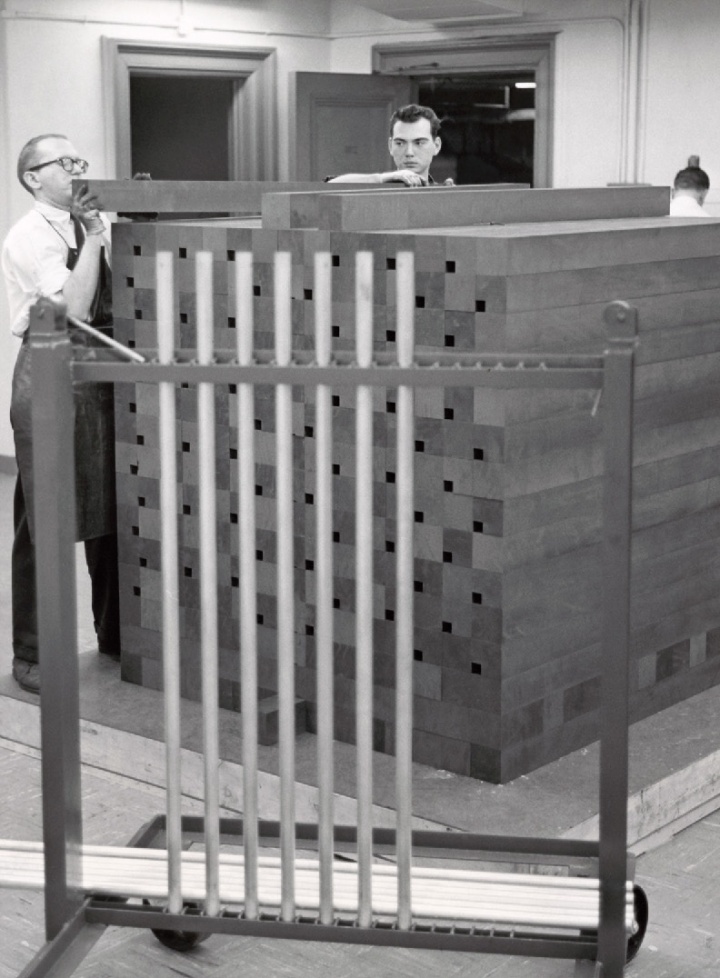
Graduate students set up a nuclear reactor using graphite blocks similar to those carried across campus by the football team.
COURTESY COLUMBIA UNIVERSITY ARCHIVES
From 1941 to 1942, the Lions played a crucial role in helping physicist Enrico Fermi carry out his early experiments on nuclear fission. The federal government had awarded the University $6,000 to use for nuclear research, which Fermi and others in the department used to purchase materials like graphite and uranium. Transporting giant metal blocks would have been quite the challenge; enter the brawny Lions, who spent months carrying materials from Pupin to Schermerhorn, where Fermi was building proto-nuclear reactors called “piles.”
“It really was a pleasure to direct the work of these husky boys, canning uranium, just shoving it in — handling packs of 50 or 100 pounds with the same ease as another person would have handled three or four pounds,” Fermi said in a 1954 address at his retirement as president of the American Physical Society.
Fermi’s experiments were designed to show how plutonium could be produced in a lab setting. Although they were not as successful as he had hoped, the results contributed to later research at the University of Chicago and UC Berkeley before the world-changing explosion in New Mexico in 1945. The Lions never knew what exactly they were carrying across campus, or that they were playing a part in one of the 20th century’s most significant developments.
Graduate students set up a nuclear reactor using graphite blocks similar to those carried across campus by the football team.

Published three times a year by Columbia College for alumni, students, faculty, parents and friends.
Columbia Alumni Center
622 W. 113th St., MC 4530, 6th Fl.
New York, NY 10025
212-851-7852
cct@columbia.edu

Columbia Alumni Center
622 W. 113th St., MC 4530, 4th Fl.
New York, NY 10025
212-851-7488
ccalumni@columbia.edu