Columbia College | Columbia University in the City of New York
Dima Amso
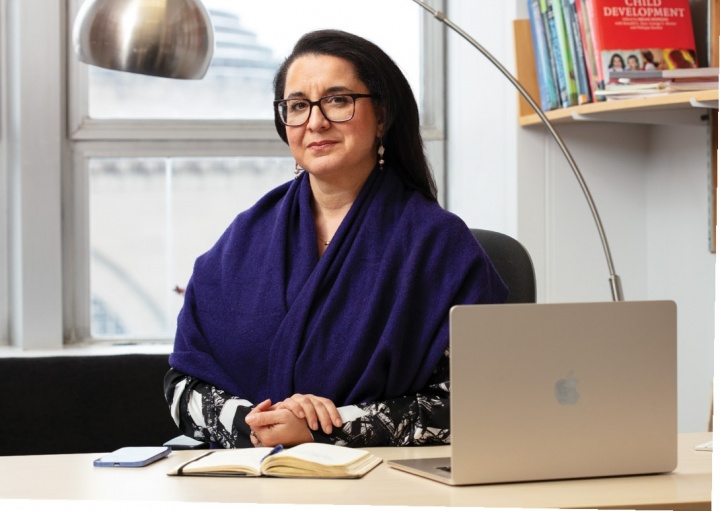
JÖRG MEYER
“Can you imagine if I told you that you’d have to learn how to walk on your hands and elbows in the next few months, and also learn how to speak?” Amso says. “Within the first year and a half, babies undertake more learning than they will ever have again in their lifetime. Early brain development sets the stage for a lifelong trajectory, and we have so much to learn about this formative time in our lifespan.
“If you are in any way interested in the brain as a frontier, infancy is very easy to get excited about,” she adds.
Amso has been exciting undergraduates at the College for the last five years, both in the classroom and as director of the Developmental Cognitive Neuroscience Laboratory (DCNL). There she has a front-row seat to the benefits of immersing students in the work of neurobehavioral research. “It’s transformative for them,” she says, especially when they can spend an entire summer working in the lab. “To actually feel lab culture, to live lab culture. They do the science; they’re not just reading about it. And for us, if you are a scientist, it’s a form of teaching — you teach by doing. It’s something I feel strongly about as an opportunity for elevating excellence in education.”
Amso notes that she didn’t have lab experience as a psychology major at Tufts. In fact, after graduating she nearly pursued her minor, art history — she dreamed of getting a Fulbright to study museology. When that didn’t pan out, Amso shifted gears. Her college adviser recommended she work with neuroscientist Adele Diamond at the Eunice Kennedy Shriver Center in Waltham, Mass. “I didn’t know it at the time, but Adele was one of the founders of cognitive developmental neuroscience,” Amso says. “I may have landed there purely by accident, but it introduced me to the field, and I fell in love with it.”
She followed that passion to a Ph.D., studying first at Cornell and later at NYU, where she earned her degree in 2005. She taught at Brown for 10 years before coming to Columbia in 2020.
Broadly speaking, Amso and her DCNL team examine how the developing brain attends, learns and remembers early in postnatal life. Often that involves how an infant’s biology and environment — which significantly, includes the caregivers — help to influence their growth. The lab also does a lot of work globally, carrying out the same studies in different places to remove location bias. “The brain is so uniquely affected by culture and language and context and nutrition that to study it one way does not tell you what’s true for all,” she explains. “The idea is: How are we shaped by our environments, and what is it that we can abstract as a universal about the human condition?”
In the classroom, Amso rotates through teaching a seminar in theories of developmental change and a lecture in developmental cognitive neuroscience. What often becomes fascinating for students, she says, is the idea that “uniqueness actually is built over time, and it’s rooted early. They start to look at their own behaviors and think, ‘Where did that trajectory come from?’ Like, ‘Oh, I have multiple siblings and tend to be really great with roommates.’ That type of thing.”
She also notes that undergraduates love understanding the brain through the lens of a child. “Our brains have different parts that seem really specialized if you look at them in an adult, but they’re not that specialized in babies,” she explains. “It’s experience that forces the brain to adapt to its environment and allows for a specialization. Students get excited about the possibility of plasticity and flexibility.”
Last summer, Amso became vice provost for faculty advancement; she is tasked with enhancing academic community building and cultivating an environment where all faculty can thrive. “The role is still new,” she says. “Right now the big push is figuring out how to be supportive of early-career faculty. How do we ensure scholarly engagement? How do we make sure people have what they need to do the best scholarship they can with the changing headwinds?”
When she’s not on campus, Amso can often be found in the garden of her Connecticut home. Her 17-year-old has first dibs on her free time, “but he’s pretty busy,” she says with a laugh. “So I do a ton of gardening on the weekends. No food, all flowers. I’m big on roses, and I recently discovered a flower called lantana — I’m obsessed with it. It helps to be away from screens, get my hands in the dirt.”

Published three times a year by Columbia College for alumni, students, faculty, parents and friends.
Columbia Alumni Center
622 W. 113th St., MC 4530, 6th Fl.
New York, NY 10025
212-851-7852
cct@columbia.edu

Columbia Alumni Center
622 W. 113th St., MC 4530, 4th Fl.
New York, NY 10025
212-851-7488
ccalumni@columbia.edu