Columbia College | Columbia University in the City of New York
Dr. Demetre Daskalakis ’95 Charts a New Path
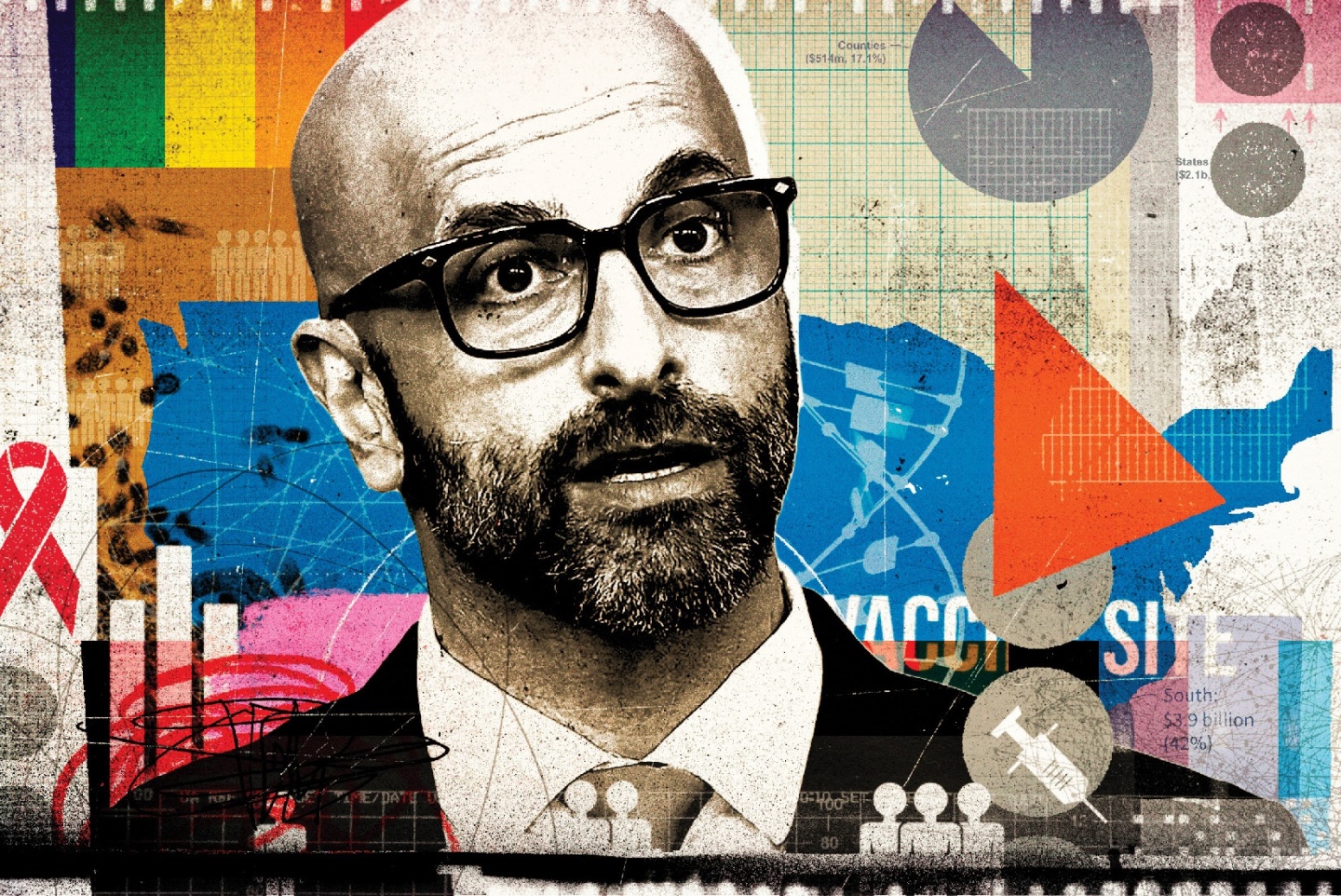
ALEX WILLIAMSON
The core tenet of being a physician is to do no harm. Every medical student takes their Hippocratic Oath when they graduate, committing to a professional life that upholds the highest standards of care.
Dr. Demetre Daskalakis ’95 took his oath at graduation from NYU School of Medicine in 1999 and has lived out those values every day since. He’s gone from being an attending physician, to preventing disease at the New York City Department of Health and Mental Hygiene, to serving as one of the nation’s top infectious disease experts at the Centers for Disease Control and Prevention.
Upholding that oath also was one of his guiding principles last August, when he resigned from his post to protest the firing of CDC director Susan Monarez by the White House.
“I felt like I was going to do harm to the people I promised to serve, as well as my oath to the Constitution as a civil servant,” Daskalakis says. “When it became impossible to mitigate the damage, I knew it was time to leave.”
Following his resignation, he went on a monthslong media blitz, becoming a source for news outlets as they sought comment on the increasingly alarming messaging from the CDC. Daskalakis has spoken out about recent guidance regarding Tylenol use during pregnancy, changes to the CDC’s webpage about vaccines and autism, and the overhaul of its childhood vaccine schedule recommendations. His media appearances and advocacy are a natural continuation of his work as a public health official, with added weight given his firsthand experience inside the offices in Atlanta.
In February, Daskalakis will start a new chapter in his public health career. He is returning to his roots to be the chief medical officer of Callen-Lorde Community Health Center, which provides healthcare for LGBTQ+ New Yorkers. After witnessing the radical remaking of a federal health agency in real time, the job offers Daskalakis the opportunity to make a tangible difference in the everyday lives of patients at the local level, as public health infrastructure responds to the instability at the CDC.
“We’re at an interesting moment where there is no strategy at the top,” he says. “So rather than a top-down view, the future of public health is going to come from the people and rise to the top, which I think is very exciting.”
Even before becoming a physician, Daskalakis understood the critical role of public health in the larger medical system. At the College, he became involved in HIV prevention efforts as the virus continued to devastate the LGBTQ+ community. He taught high school students in the Bronx about HIV, and committed himself to a career fighting infectious disease after he lost friends to AIDS.
After medical school, he worked at Bellevue Hospital, spearheading its HIV testing and prevention programs before completing his master’s in public health at Harvard. Daskalakis then returned to NYC and took on leadership roles within the city’s public health system — including as Deputy Commissioner of the Department of Health. One of his hallmark efforts was a “status neutral” approach to HIV testing and treatment, which included testing at commercial sex venues like bathhouses, and an aggressive communications campaign to fight the stigma associated with seeking care. Daskalakis’ efforts are credited with bringing HIV incidence rates to historic lows in NYC.
“One of the important things about public health is that it’s not just about the science — it’s also how science, politics and communication come together to help you do your best to protect the health of the people you serve,” he says.
After leading NYC through the first months of the pandemic, Daskalakis joined the CDC in November 2020, becoming a national authority as the director of the Division of HIV Prevention. He was deployed to the White House to combat the mpox epidemic in 2022 before stepping into his most recent position, in 2023, as director of the National Center for Immunization and Respiratory Diseases. With more than a decade of experience public health, he knew what to expect from working within the political system.
“It’s not unusual to work with your elected officials to figure out how to blend their vision of the government with the best science,” Daskalakis says. “You try to crawl into the mind of the people you’re working for and see how you can blend what they’re doing with good public health.”
As he watched Health and Human Services Secretary Robert F. Kennedy Jr.’s confirmation hearings last January, he wondered how to do exactly that without compromising the integrity of the CDC. Daskalakis says he and his team were trying to integrate established science into Kennedy’s “Make America Healthy Again” campaign, which is known for its skepticism of vaccines and pharmaceuticals. Daskalakis’ ideas included issuing clearer communication about vaccine safety and the resumes of members of the Advisory Committee on Immunization Practices (ACIP). But, unlike Daskalakis’ previous government collaborators, Kennedy did not meet with him. Over the course of 2025, Daskalakis says he was not consulted about major changes to vaccine policy that were made without scientific guidance — instead, he found out on X. Additionally, Kennedy fired 17 members of the ACIP last June, replacing them with known vaccine skeptics.
“The experience I’ve had in the last few months puts me in a place where I can really be an essential messenger and help people understand what’s going on and what it means for their everyday lives,” Daskalakis says.
That marked a turning point for Daskalakis. Former CDC chief medical officer Dr. Deb Houry, with whom he worked closely, advised him to draft a resignation letter, just in case. The moment Monarez was ousted for refusing to comply with Kennedy’s directives, Daskalakis says he knew the time had come. He published his resignation letter on social media and began making news appearances to warn the public about the anti-science efforts underlying the messages being put out by the CDC.
“You have people using the CDC, the premier public health agency in the country — debatably the world — to spout mis- and disinformation with a stamp of approval,” he says. “You just cannot trust that agency anymore.”
Daskalakis’ media tour wasn’t the only action he took after resigning. Along with Houry and Dr. Daniel Jernigan, former director of the National Center for Emerging and Zoonotic Infectious Diseases, he visited members of Congress to share their concerns and to advocate for decisive action to prevent further change to evidence-based CDC guidelines and recommendations.
“This is a public health emergency on the order of a pandemic,” he says.
Daskalakis is also considering what public health infrastructure might look like in the wake of the erosion of science at the federal level. He observes that regional health alliances have sprung up on the West Coast and in the Northeast, while acknowledging these coalitions leave out states in the middle of the country. But, he says, it could be a start for modeling a new public health system with more localized governance.
“I think there could be regional leadership that would, I hope, create resilience,” Daskalakis says. “But I am worried about the South and the Midwest; I think that there’s a need for some [resources] to land there.”
He’ll also work to build that local resilience himself. Callen-Lorde announced Daskalakis as its new chief medical officer in December, and his return to New York City was celebrated across the LGBTQ+ and medical communities. Executive actions have hit LGBTQ+ health efforts particularly hard. Population data about sexual orientation and gender identity were removed from the CDC’s website last year, and resources for HIV prevention were taken offline. Although reinstated through a court order, those webpages now include messaging saying the information is inaccurate and rejected by the administration. Daskalakis’ new role will allow him to be a resource in the face of these attacks on science and the queer community.
“The experience I’ve had in the last few months — compounded with more than a decade of experience that I have in public health — puts me in a place where I can really be an essential messenger and help people understand what’s going on and what it means for their everyday lives,” he says.
Daskalakis is also urging the public to contact their representatives. He says sharing individual stories of how healthcare access has been impacted is essential to keeping this conversation at the forefront of lawmakers’ minds.
“Call your members of Congress. Make their phone ring over and over again,” he says. “What’s going on today is going to mean that vaccines are going to be harder to get in the future.”

Published three times a year by Columbia College for alumni, students, faculty, parents and friends.
Columbia Alumni Center
622 W. 113th St., MC 4530, 6th Fl.
New York, NY 10025
212-851-7852
cct@columbia.edu

Columbia Alumni Center
622 W. 113th St., MC 4530, 4th Fl.
New York, NY 10025
212-851-7488
ccalumni@columbia.edu