Columbia College | Columbia University in the City of New York
Norman Podhoretz ’50, Longtime Magazine Editor and Lion of Neoconservatism
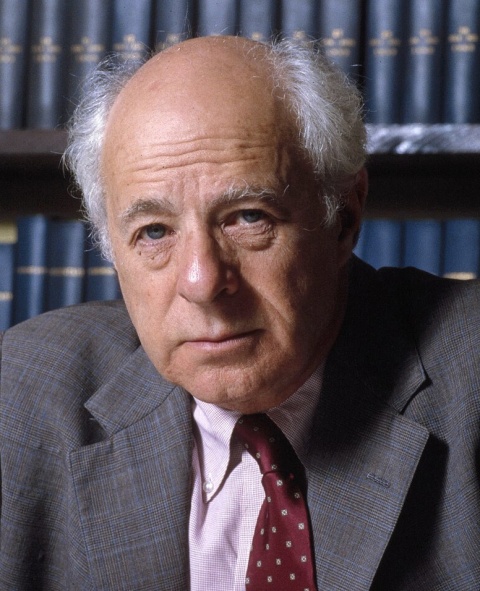
“What you really need to know is that what mattered most to him was writing,” John Podhoretz wrote in his father’s obituary. “Great writing. Good writing. Clear writing. Honest writing. … He often quipped that he would forgive any insult if the person delivering it also said he was a good writer. He was a man of great wit and a man of deep wisdom and he lived an astonishing and uniquely American life. … He made the life of the mind a joyous sport.”
Podhoretz helmed Commentary for 35 years, from 1960 to 1995. In that time he transformed the magazine, a publication of the American Jewish Committee, from a distinguished journal of social and political criticism to a more controversial and influential voice. According to his obituary in The New York Times, Podhoretz relished being a provocateur, “brandishing erudite opinions that ran against the popular grain and became the talk of salons on the Upper West Side of Manhattan and beyond.”
Along the way he won conservative admirers, including Ronald Reagan, Henry A. Kissinger and U.N. ambassador Jeane Kirkpatrick. From 1981 to 1987, Podhoretz was an adviser to the United States Information Agency; from 1995 to 2003, he was a senior fellow at the Hudson Institute, a neoconservative think tank in Washington, D.C.
Podhoretz’s influence reached its peak during the administration of President George W. Bush. Admirers of Podhoretz who were shapers of policy successfully pushed for an invasion of Iraq in 2003, for which initial justifications turned out to be faulty. In 2004, Podhoretz received a Presidential Medal of Freedom — the United States’ highest civilian honor — from Bush in recognition of his influence on public discourse. (Three years later, he urged Bush to bomb Iran’s nuclear facilities, which the President did not do.)
Podhoretz was also a foreign policy adviser to Rudolph W. Giuliani’s aborted campaign for the 2008 Republican presidential nomination.
The son of Jewish immigrants, Podhoretz grew up in Brooklyn’s Brownsville neighborhood. After graduating from Boys H.S. in Bedford-Stuyvesant, he earned a degree in English literature at the College, where he was a prized pupil of Lionel Trilling CC 1925, GSAS 1938. Podhoretz also studied at the Jewish Theological Seminary and earned a degree from Clare College, University of Cambridge.
After serving in the Army, Podhoretz began his career as a literary critic in the early 1950s. By age 30, he was named editor-in-chief of Commentary. He authored numerous books, most notably his 1967 memoir, Making It, which candidly recounted his rise from Brownsville to the center of American intellectual life. The book’s blunt message that intellectuals were as interested in fame and success as any Hollywood starlet was widely received as brazen and overconfident. In other memoirs he recorded what he regarded as vindications, such as the collapse of the Soviet Union, which he considered an ideological enemy.
When Podhoretz gave up Commentary’s helm in 1995, he declared with characteristic brashness that he was proud of the magazine’s tough criticism of the civil rights movement, the New Left and those who would accommodate Soviet totalitarianism.
“We were right — morally right and intellectually right — throughout that period,” he told the Times that year.
In addition to his son, Podhoretz is survived by his daughter, Ruthie Blum; stepdaughter Naomi Decter Munson; 13 grandchildren; and 16 great-grandchildren. He was predeceased by his wife of 66 years, Midge Decter, a fellow conservative writer and editor who died in 2022, and stepdaughter Rachel Decter Abrams, who died in 2013.

Published three times a year by Columbia College for alumni, students, faculty, parents and friends.
Columbia Alumni Center
622 W. 113th St., MC 4530, 6th Fl.
New York, NY 10025
212-851-7852
cct@columbia.edu

Columbia Alumni Center
622 W. 113th St., MC 4530, 4th Fl.
New York, NY 10025
212-851-7488
ccalumni@columbia.edu