Columbia College | Columbia University in the City of New York
Meet the College’s Newest Deans
Two new deans joined the College community in Fall 2025: Kamala C. Kiem, dean of Undergraduate Student Life, and Jonathon Kahn GSAS’03, senior associate dean of community and culture. We spoke to each of them about the paths that led them to the College, what they love about working with undergraduates and their priorities for the year.
Kamala C. Kiem
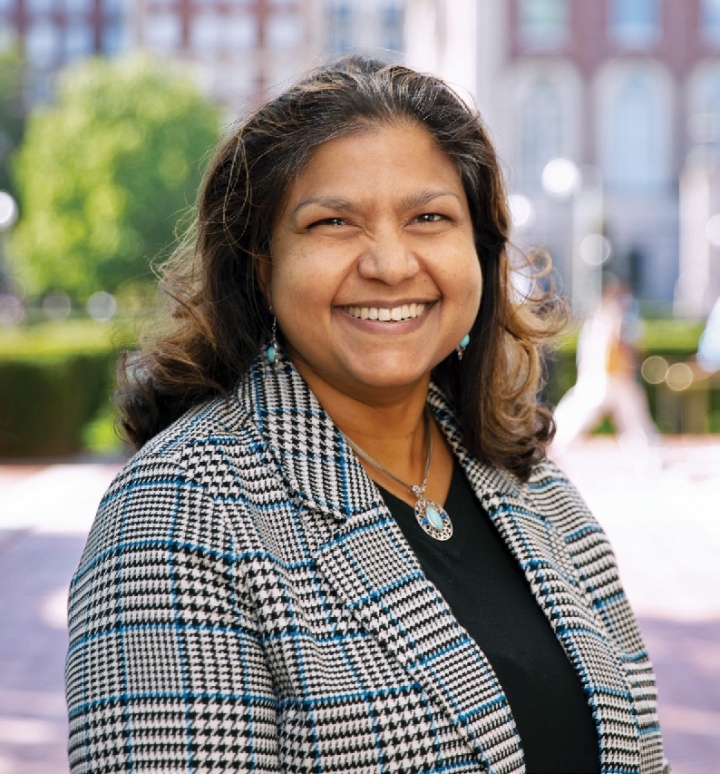
EMMA ASHER
She also held residence life and student development roles at Smith College, the University of Massachusetts Amherst, the University of Illinois at Urbana-Champaign and Michigan State University.
Now Kiem calls campus home — she can walk out her front door and be at the USL offices in Lerner Hall in five minutes. “I love that I’m living here in community with this vocation that I have,” she says. “Because this is not just a job for me; it’s also a purpose. There’s no separation — this is work, this is my personal life. It all blends together and every experience, every lesson in one area, feeds and shapes the other.”
You’ve said that co-curricular experiences were essential to your growth and development. Tell us about that.
I’m originally from Jamaica, and in Jamaica we graduate from high school very young — 15, 16 years old. I landed a tennis scholarship at a U.S. college. I’m a first-gen as well, and I was just happy to get a scholarship anywhere. I ended up at a junior college in Cochran, Ga., and a big part of my first-year experience was really that of an international student — navigating the cultural barriers that you can expect relating to that.
But I had told myself, I want to get involved in everything. There hadn’t been a lot of co-curricular opportunities in our K–12 system in Jamaica. And so I became an RA. I ran for president of our hall. And then because I was a president, I became a senator in the student government association. I was in the international club, I was playing tennis. I just immersed myself in that whole life experience outside the classroom. I wound up transferring to Florida International University, but all of that was the beginning of why I ended up in this role.
How would you describe your role?
At the heart of what the dean of USL does is create a vibrant, inclusive, fun, healthy community where all students can thrive. For me, it’s having sight lines on the entire student experience. What I mean by that is being able to see the student journey — their growth, development, transformation and success — from the moment they’re admitted to Columbia until the day they graduate. I want to make sure that the whole experience is inclusive, that students are thriving, experiencing joy, growing, transforming.
There are specific areas that I oversee and manage, and then there are areas I will do my best to influence. I oversee Multicultural Affairs, Residential Life and Student Engagement — that’s the roughly 340 clubs and organizations that we have. Oftentimes these are the spaces where students are making sense of their college experience — in clubs and organizations, in selected and elected leadership experiences, in their residential living environment and in intentional intercultural spaces. We play an extremely powerful role in student development and the formation of their undergraduate student experience. It’s not something we take for granted.
What have your priorities been this year?
I’ve been focused on four areas. The first is community and culture — Jonathon Kahn and I are in lockstep with each other. We work on ensuring that our undergraduates are navigating divisive moments in a way that keeps the community intact — in a way that can continue to build relation- ships and that keeps students informed of the dynamics around whatever issues are polarizing them.
Another priority relates to how our students take in media and social media. Do they know how to critically analyze the information they receive? Even to be critical of the books they read — knowledge production is biased in many ways. We need to consider the skills we’re giving students to discern fact from opinion.
Then there’s well-being. For students, a big part of that is a sense of belonging: “Do I feel connected at Columbia? Have I found my community? Do I have friends here? Do I have mentors?” That sense of belonging is at the core of what we do in USL. And well-being in other areas, too. Are they exploring their spirituality? Do they feel they have a pathway for what their next steps are after college? I always want to think about the environment that students are in, and how we are proactively and reactively supporting them.
Finally, how are we cultivating students to be leaders? I talk a lot about how the integration of curricular and co-curricular experiences can be truly transformative. The USL team is looking at several questions: How are we creating habits of mind and cultivating good habits and competencies when it comes to leader- ship and what leadership is? How are we defining leadership? How are we helping to cultivate courageous leaders?
I also want to say, our students are focused, dedicated and serious about their work, but part of a balanced college experience is having fun. In their individual lives and routines, we want students to be finding ways to just enjoy.
Jonathon Kahn GSAS’03
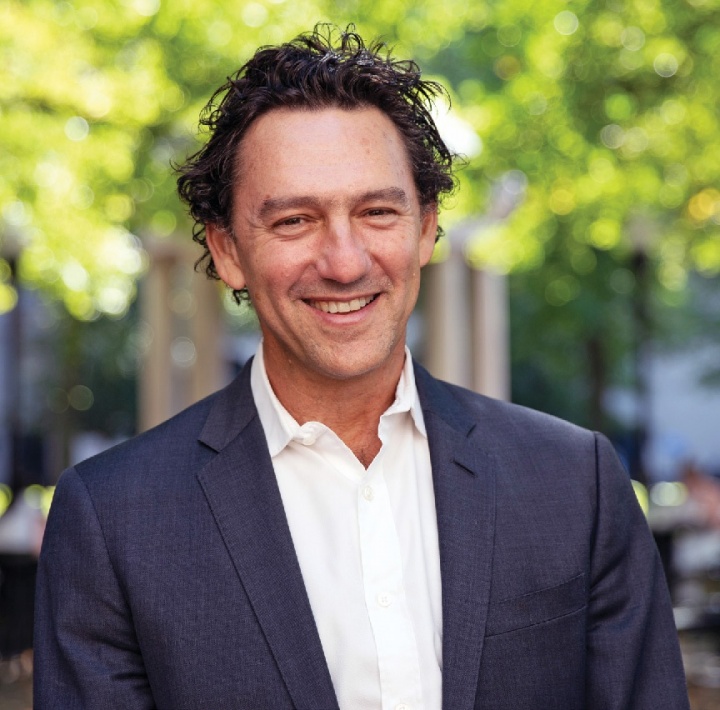
Emma Asher
Kahn went on to spend two decades as a professor of religion, Africana and American studies at Vassar; in 2024, he returned to Morningside to co-lead the Practices in Community Building Fellowship, offered through the Undergraduate Community Initiative (UCI). “Working with the students in Practices in Community Building shaped how I think about community not as something inherited, but as something built through care, disagreement and persistence,” Kahn says. “I carry these experiences with me into this new role, committed to creating spaces where dialogue can take root and trust can grow.”
You’re the first-ever Dean of Community and Culture; how would you describe your role?
My charge is to build connection between and among students, faculty and staff — so it’s a huge job. But the way that I think of it is starting at a grassroots, “bringing people together who have common interests” type of level. And so that’s at least the beginnings of this job, to provide those structures and gathering spaces.
What have your priorities been, and how have you been acting on them?
There are a couple of different buckets I’m focused on. Maybe unsurprisingly, the biggest one is developing connections with students. Getting students involved in the direction of UCI is something I’m working really hard on; getting the word out that UCI is a place for students to come and do some creating. We created a student-run storytelling workshop called “Our Stories.” It’s a space for students to gather and frame their memories, which allows them to make some sense of what they and their classmates have been through. Theater of War Productions performed in November and led a robust community discussion about artificial intelligence and higher education (see “Living and Learning With Artificial Intelligence”).
Expanding connections between students and faculty is the second biggest focus. I created a program called Fac’ to Table, in which students and faculty talk over a meal. I want to use these occasions for students to learn about the relationship between a faculty member’s personal history and what they’re doing today — like, what it is to be a college professor, and what they’re trying to accomplish. The best advice I’ve ever gotten from attending however many pedagogy workshops is to explain to students why you’re doing what you’re doing. Because if we’re not explaining ourselves, students don’t know how to orient themselves. Why are we reading this text in this way, or why are we having a conversation this way? Just telling the students the purpose helps.
And then the third focus has been deepening student-alumni engagement. We’ve started a five-part lecture series this year called “We Were Students Once Too.” It’s alumni talking about their path, purpose and profession, and their paths and purpose always begin here at the College.
What has been most exciting for you this year?
I’ve been excited about things that the students create and develop on their own — things that bubble up from our conversations, like the storytelling project, or one of my students who’s interested in making a podcast. And having UCI provides some resources and structure through which to do it.
I am the most excited when students reach out to me and say, “Hey, I would like to come and talk to you about something that I’m thinking about or that I’m feeling about campus.” Just the idea that there’s another person here on campus, in the Dean’s Office, who can represent students’ concerns, interests and passions — and I appreciate that the students are really good at holding me accountable for representing those things. I’m pretty excited by the development of relationships, where students feel comfortable coming to me and then saying, “This really is important.” Like, let’s see if we can make some change.

Published three times a year by Columbia College for alumni, students, faculty, parents and friends.
Columbia Alumni Center
622 W. 113th St., MC 4530, 6th Fl.
New York, NY 10025
212-851-7852
cct@columbia.edu

Columbia Alumni Center
622 W. 113th St., MC 4530, 4th Fl.
New York, NY 10025
212-851-7488
ccalumni@columbia.edu