Columbia College | Columbia University in the City of New York
Living and Learning With Artificial Intelligence
I
DIANE BONDAREFF
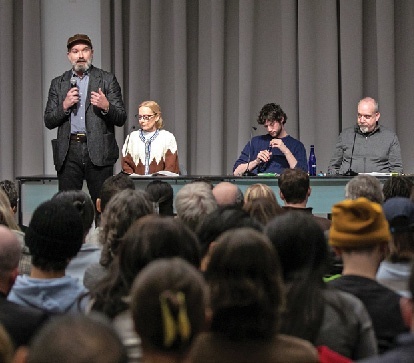
Bryan Doerries (far left) and actors from Theater of War Productions during a performance on Nov. 17.
DAVID DINI SIPA’14
It is important to hold space for all of these lenses — even as we ask ourselves how to navigate this transformative (and disruptive) technology, and account for its place in our teaching and research missions. We are engaging with AI as a classroom topic; an AI minor is coming this semester; and several departments across the Arts and Sciences are offering classes that explore AI. At the same time, we are building on efforts across the University that have sought to develop policies and guidelines that preserve teaching and learning goals, as instructors and students alike are learning with (and in some cases, resisting) generative AI. The space between responsible use and refusal is vast, and we must consider not only what will enhance or detract from our college’s education, but also how we must adapt to meet the moment, so that we continue pre- paring students to be responsible, engaged citizens of the world.
This goal of balancing tradition and innovation is familiar to us — most notably in the Core Curriculum, where the study of enduring works instills and encourages critical thinking, and provides a path for students to engage with the changing world around them. It is no surprise that the Center for the Core Curriculum is helping to lead the way in thinking about AI. In fact, the Center’s first meeting about generative AI was held in December 2022, several days after ChatGPT was made publicly available.
Since then, the Center has worked with faculty to develop guidance that is available to all Columbia instructors; experimented with assignments that use AI; and held teaching seminars, forums and other events where AI is routinely discussed. This year the College is launching an AI faculty working group to facilitate a structured series of discussions and a strategy to address AI’s implications for teaching, writing and learning outcomes.
The urgency of responsibly engaging with AI also speaks to one of our most fundamental values: academic integrity. The College is working to develop AI policies and practices that will provide students with a sense of what an informed, ethical use of this technology can look like on campus. Demands on students’ time and a sense of academic competition are two among many motivators; they remind us that in considering AI, we must also take a larger view of the culture we are creating, to help ensure that students understand the value and purpose of the education they have chosen for them- selves. Their voices, questions and ideas — and relationships with each other and their instructors — are essential to academic inquiry and to fulfilling the promise of an undergraduate education.
In this time of complex debate, it is imperative that we engage with AI in ways that align with and advance our mission: to provide students with a unique liberal arts and sciences education that prepares them for the world beyond the Gates. The College will never be a place where innovation is resisted in favor of passive adherence to tradition. We will always value critical engagement, original thinking, resourcefulness and creativity. And, in this new age of AI, we must remain cognizant of the fact that we continue to live and learn together.
With respect,

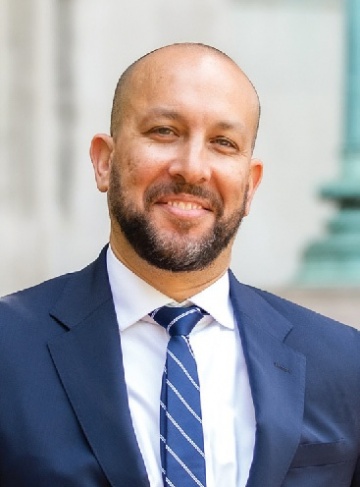
Josef Sorett
Dean of Columbia College and the Henry L. and Lucy G. Moses Professor; Vice President for Undergraduate Education; Professor of Religion and African American & African Diaspora Studies

Published three times a year by Columbia College for alumni, students, faculty, parents and friends.
Columbia Alumni Center
622 W. 113th St., MC 4530, 6th Fl.
New York, NY 10025
212-851-7852
cct@columbia.edu

Columbia Alumni Center
622 W. 113th St., MC 4530, 4th Fl.
New York, NY 10025
212-851-7488
ccalumni@columbia.edu