Columbia College | Columbia University in the City of New York
Robert A.M. Stern ’60, World-Renowned Architect, Educator and Historian
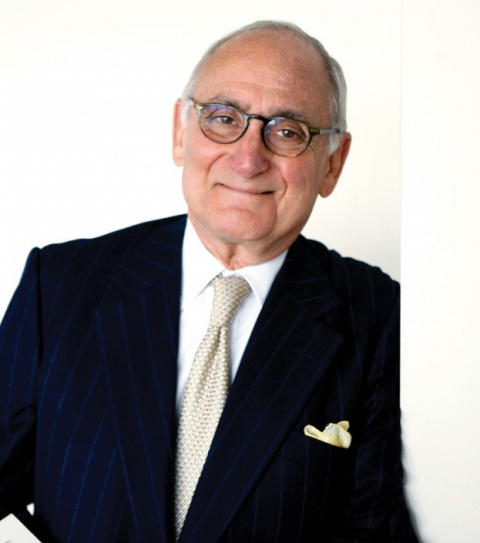
COURTESY ROBERT A.M. STERN ARCHITECTS
Throughout his long and distinguished career, Stern shaped the built environment, contributed to the education of multiple generations of architects, and raised public awareness of the importance of preservation and the role design plays in communities and in society at large.
The firm he established in 1969, Robert A.M. Stern Architects (widely known as RAMSA), assembled a distinctive and varied portfolio on four continents: soaring urban structures and exquisite country homes; major museums and libraries; courthouses; hotels; chapels; performing arts centers; planned communities; and dozens of academic buildings — at Wake Forest, Stanford, UVA, Johns Hopkins, Notre Dame, Colorado, Georgetown and many other campuses, including every Ivy school save Cornell. One of his earliest commissions was the 1977 renovation of Columbia’s Women’s Faculty Club (now Jerome Greene Annex); in 2000, Columbia opened the RAMSA-designed Broadway Hall on West 113th Street, adding welcome dormitory space.
His crowning creation — opened in 2008 and hailed as a rebirth of prewar luxury — is known only by its address, 15 Central Park West. The landmark residential building consists of two limestone-clad structures: a 19-story front on the park with the terraced setbacks of a 1920s facade, and behind it a modern 35-story tower with panoramic city views. For Stern, nearly 70 at the time, it was an artistic pinnacle, a realization of his dream to merge the past and present.
Stern was born and raised in Brooklyn’s Kensington/Windsor Terrace neighborhood and graduated from Manual Training H.S. in Park Slope. He showed a precocious interest in The New York Times Real Estate section, especially views and plans of the homes and developments that were then mushrooming in the suburbs. “I would redraw the plans,” he told CCT in 2016, “because I always knew I could do better.” Stern’s skills were soon refined enough to earn third prize in a Pratt Institute competition in which students were given five hours to design a house within certain guidelines. “I had had no training or anything,” he said. “I was thrilled beyond all measure.”
As a College first-year in 1956, Stern commuted from Brooklyn until a room opened up in Livingston (now Wallach) Hall. Although there was no undergraduate architecture program, he credited three Columbia figures with advancing him toward his life’s work: architectural historian Robert Branner, “who brought a fresh, interpretive approach to the field”; Everard Upjohn, who taught “Elements of Architecture” and inspired students “to take apart buildings and think about how they go together”; and Adolf Placzek LS’42, longtime librarian at Columbia’s Avery Architectural & Fine Arts Library.
Stern attended Yale for graduate school and earned an M.Arch in 1965. His teaching career began five years later and included time at both of his alma maters. In 1984, he was appointed the first director of Columbia’s Temple Hoyne Buell Center for the Study of American Architecture. In 1990, he became director of the M. Arch. Advanced Studio, and in 1991 was named director of the University’s Historic Preservation Program. From 1998 to 2016, Stern was the dean of the Yale School of Architecture, commuting between New Haven and Manhattan to remain hands-on at RAMSA’s practice.
Stern authored or co-authored nearly two dozen books, including a monumental five-volume study of New York City architecture since 1880; the middle volume, New York 1930: Architecture and Urbanism Between the Two World Wars (written with Thomas Mellins ’79 and Gregory Gilmartin ’81) was nominated in 1987 for the National Book Award in nonfiction. Another book, Pride of Place: Building the American Dream, was the companion volume to the eight-part PBS television series he hosted in 1986.
Stern is survived by his son, Nicholas ’90, from his marriage to Lynn Solinger (they divorced in 1977); brother, Elliot ’70; and three grandchildren.

Published three times a year by Columbia College for alumni, students, faculty, parents and friends.
Columbia Alumni Center
622 W. 113th St., MC 4530, 6th Fl.
New York, NY 10025
212-851-7852
cct@columbia.edu

Columbia Alumni Center
622 W. 113th St., MC 4530, 4th Fl.
New York, NY 10025
212-851-7488
ccalumni@columbia.edu