Columbia College | Columbia University in the City of New York
We Are the Future
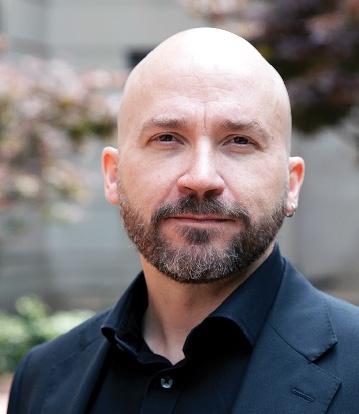
Core Curriculum director Larry Jackson
EMMA ASHER
The university’s Classroom Social Compact Committee described a culture of academic disengagement at Harvard, after conducting surveys and listening sessions involving hundreds of faculty and students.
Faculty reported that students frequently miss class, don’t do the assigned readings and ask for flexibility on deadlines.
Students admitted to prioritizing grades over learning, staying silent in class to avoid the embarrassment of giving a wrong answer and seeking out courses that are perceived to be easier. Some devote more time and energy to pre-professional clubs and activities that are believed to lead to lucrative careers than to their coursework.
The report also documented ideological echo chambers among students and fears of being ostracized for holding unpopular opinions — the concerns that prompted the Harvard committee’s formation in 2024. Some undergraduates reported taking classes and joining peer groups in which their beliefs would be confirmed rather than challenged.
What is most striking in the report is the link it draws between academic effort and the free exchange of ideas. The committee concluded that when students are not invested in learning, they are unlikely to be exposed to diverse perspectives or to find opportunities to practice disagreeing with others. Cancel culture hinders the free exchange of ideas; so, too, does academic disengagement.
While the Harvard report focuses on its own university, its findings reflect trends on campuses nationwide. It also confirms what I have long believed — that we are the future of higher education. Columbia College’s Core Curriculum offers the surest way to avoid the problems outlined by Harvard’s committee.
Consider class format. It is easy to skip large lectures without jeopardizing your grade; they are often recorded and attendance is rarely taken. Students who do show up can turn to their smartphones and laptops for entertainment whenever they lose interest in what their professor is saying.
Small seminars, like those in the Core, require students to be present and engaged. There is no hiding in the crowd and no shopping online when you are expected to shape class discussion.
Active engagement with course materials and with peers not only makes students responsible for their learning, but it also makes them accountable to one another, and fosters fellowship and mutual respect in the classroom.
Another advantage of the Core is that it is required for all College students. Distribution requirements — the dominant approach to general education in the United States — allow students to choose courses on the basis of interests, opinions or peer groups, risking the kind of ideological bubbles that the Harvard report documents. Friends and teammates do sometimes end up in the same section of a Core course, but most rosters will show a random assortment of students.
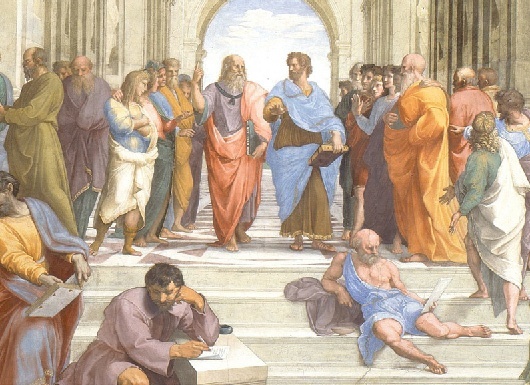
Raphael, The School of Athens (detail), 1509–1511
VATICAN MUSEUMS
The practice of interpreting these difficult works and responding to them in discussions and assignments cultivates skills, traits and habits of mind that are undoubtedly useful for any career. But because they prioritize free discovery over narrow expertise, Core courses provide spaces free from the careerism that makes students reluctant to search for undiscovered interests and talents, or to risk giving the “wrong” answer in class (which might be the one that inspires the deepest learning).
The Core’s greatest strength, however, is its enduring commitment to its values and tradition. For more than a century, the Core Curriculum has created a unifying experience for thousands of College students, alumni and faculty. Yet, the Core’s unity of purpose has never demanded uniformity of thought. It has instead created a shared intellectual framework in which disagreements can be pursued without devolving into the exclusion of opposing viewpoints that has become a mainstay in our polarized era.
A background of standards and ideas that can help us understand and respect different points of view is the vision for the modern liberal arts education that College Dean Frederick Woodbridge articulated in an alumni newsletter in November 1918. Two months later, Columbia’s faculty brought Woodbridge’s idea to life by creating the first Core course, Contemporary Civilization.
Woodbridge’s innovation transformed higher education in the 20th century, as colleges and universities throughout the country created programs based on our Core. They didn’t put an end to lecture courses or to student choice in general education, both of which have value, but they did prioritize creating a unifying experience of active, collaborative learning in small seminars, using challenging texts that model disagreement and invite diverse interpretations.
The Core was the future then. It is the future now.

Published three times a year by Columbia College for alumni, students, faculty, parents and friends.
Columbia Alumni Center
622 W. 113th St., MC 4530, 6th Fl.
New York, NY 10025
212-851-7852
cct@columbia.edu

Columbia Alumni Center
622 W. 113th St., MC 4530, 4th Fl.
New York, NY 10025
212-851-7488
ccalumni@columbia.edu