The lifelong daredevil will coach freestyle skiing at February’s Winter Olympics
Columbia College | Columbia University in the City of New York
The lifelong daredevil will coach freestyle skiing at February’s Winter Olympics
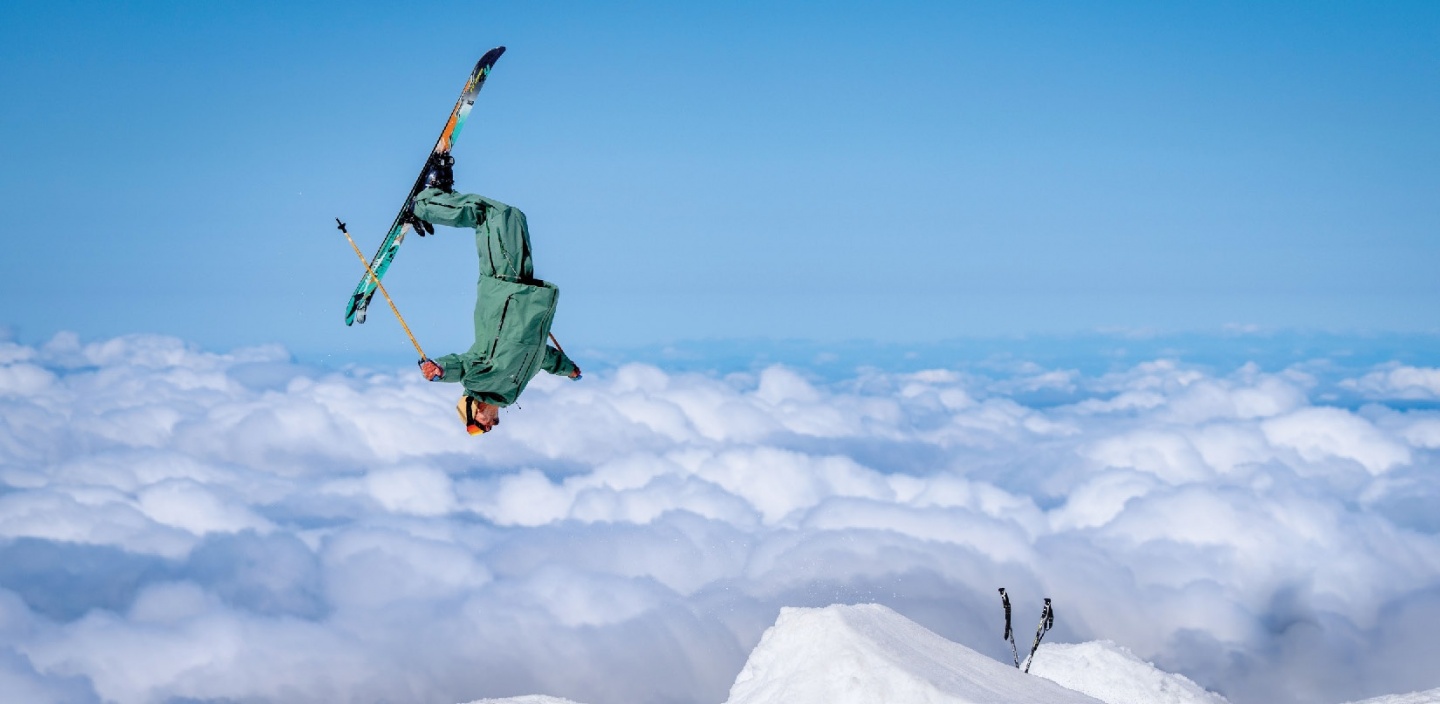
Spirito demonstrating his freestyle skiing skills last year on Mount Hood in Oregon.
PHOTOS COURTESY DEAN SPIRITO ’08
For as long as he can remember, Dean Spirito ’08 has gone his own way.
When other kids in Northern New Jersey were merely gliding down ski slopes, a pint-sized Spirito was twisting and twirling above them. When his College classmates were spiffing up their appearance, Spirito was often sporting tie-dyed T-shirts, scraggly hair and thread-bare jeans. And when they were taking their degrees to medical school, law school and Wall Street, Spirito was operating his own aquarium and backyard pond-cleaning business, getting soggy keeping koi happy.
“I think it’s just part of my nature,” the free-spirited Spirito offers. “I like to sometimes play devil’s advocate.”
So, maybe it wasn’t surprising that in 2010, after the recession took the bite out of his fish business, Spirito closed up shop, shoved his belongings into a used ’95 Subaru Legacy and high- tailed it from the Jersey suburbs to the ski slopes of Taos, N.M.
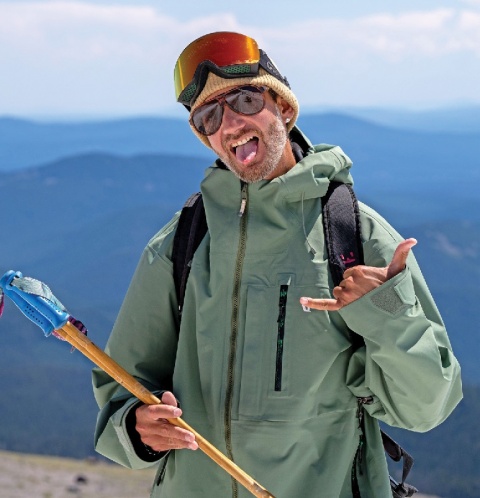
Dean Spirito ’08
As its name suggests, freestyle skiing is avant-garde. It’s expressive, rambunctious. It’s Dean Spirito-like. While renowned downhillers Mikaela Shiffrin and Lindsey Vonn will be racing down Italy’s Dolomites, both of Spirito’s athletes, American Nick Goepper and Spaniard Thibault Magnin, will look to medal by showing just how well they can show off.
Freestylers earn points with artistry and trickery — by back-flipping off rails, leaping from boxes and flying off snowbanks. “When you’re flipping and spinning through the air, you’re really testing the boundaries of physics and biomechanics. Pushing the limits of what’s possible,” says Spirito, 39, who moved from Taos to Dillon, Colo., in 2014. Both Goepper and Magnin have competed in previous Games, but for this trip they turned to Spirito to guide them.
Spirito was more than willing, having once harbored his own Olympic goals. “It was always a dream,” he admits.
High-Flying Entertainer
In addition to being a dreamer, Spirito has always been a daredevil. He started skiing at 3, and soon found his way to the terrain park where other kids were experimenting with a nascent form of freestyle skiing. It was the mid-1990s, nearly two decades before the aerial disciplines of half-pipe, slopestyle and big air skiing would become Olympic events.
“He’s the adventurer, for sure,” Louann Spirito says of her son. “He’d be going down the mountain, he’d see a little pile of snow, he’d jump over it.” She smiles at the memory. “We’d be avoiding things like that, and he’s skiing in the trees.”
When the snow melted, Spirito kept jumping and flying. Aside from skiing, he competed in gymnastics, pole vaulting and diving. “Really, anything that involved flipping and spinning,” Spirito says. “Anything that involved putting on a performance, being an entertainer.”
He had no qualms about doing reverses and somersaults into swimming pools — although sometimes those flights didn’t end well. When he was 8, he miscalculated a dive and his face smacked the board. He broke his nose and several teeth; his gashed lip required plastic surgery.
“But before you knew it,” his mom says, “he was back in the water.”
Over time, Spirito’s diving improved to the point where he brought his skills to Uris Pool; he lettered at the College all four years. But his experience in Morningside Heights went beyond the athletic — and played to his maverick style. “Columbia didn’t put me into a box,” Spirito says. “It promoted the individual, and let me say, ‘Hey, there’s a lot of different things out there.’ It let me test the waters here, there, all over the place.”
Case in point: As a political science major, a class with Professor Irwin Gertzog had Spirito researching music’s role in mobilizing the anti-war movement during Vietnam and Iraq. Although it was a bit off topic, Gertzog OK’d the project. “It gave me an opportunity to study all the ’60s rock that I liked, which was also counterculture and anti-establishment,” Spirito says. “It appealed to my senses.”
As he approached graduation, though, he recognized that any Olympic hopes he held were dimming. “The talent pool is very deep, and you have to come to grips with the reality of where you rank among your peers,” Spirito says. “It was very humbling to realize that at some point, there’s always somebody who’s going to surpass you.”
Ultimately, it’s Spirito’s coaching ability that has gotten him to the Games. With his background in freestyle skiing, he made a name for himself as an instructor and coach at Woodward Copper, a haven west of Denver for would-be adventure skiers. His relationships with Goepper and Magnin go back more than a decade. Goepper, 31, a three-time Olympian, approached Spirito in 2024, as he was transitioning from one freestyle discipline to another. He had won three Olympic medals in slopestyle, which involves navigating a course while maneuvering around different obstacles. For the upcoming Games he wanted to try half-pipe, where skiers whip off the 22-foot-high sides of a snow-covered half-cylinder into corkscrews and somersaults.
Spirito understands what a veteran medalist like Goepper can glean from him. “It’s an amazing feeling to have an athlete of that caliber reach out to you as a resource,” he says, “but a lot of it has to do with my experience and him being an older athlete. I think he values the knowledge that comes with [my] two decades in the sport.”
The Spirito-Magnin partnership runs deeper. The two have worked together on and off since 2016, when Magnin, then 16 and an up-and-coming freestyler, relocated from Europe to Colorado to train — and moved in with Spirito. “He was cooking dinner for me, driving me around and coaching me,” says Magnin, 25, who has dual citizenship in Spain and Switzerland. He eventually returned to Spain to train with the national team, but decided to rejoin Spirito in hopes of making the 2026 team. “It’s like a full-circle moment,” Magnin says. “I’ve always told him it would be a dream to go to the Olympics together.”
Alas, these Winter Olympics will be bittersweet for Spirito. Once the Games are over, he’s switching professions; he’ll begin work as a financial consultant for a wealth management firm in Golden, Colo. Though he’s been dabbling in the markets for some time, the move seems, well, counter to his counter-cultural style. But Spirito observes that as freestyle skiing has grown in popularity — going from fringe to (nearly) mainstream — it’s changed from a “pioneering” sport to a “more corporatized” one. “When you organize something at the Olympic level,” he says, “inevitably some of the freedom gets taken out of it.”
What hasn’t been lost? The urge to soar. Once or twice a year, Spirito demonstrates for others the twists and backflips that used to be part of his daily mountain routine. “I kind of pick and choose my moments because when I do these things now, the consequences at this age are a little bit higher,” he says with a chuckle.
Recently, on a mountain in Oregon, he did one backflip. It felt good, so he did another one and then another. He added a 180 and a 360.
The next day, the body ached, but not the memory.
Editor’s Note: On Jan. 27 it was announced that Thibault Magnin failed to make an International Olympic Committee qualifying mark and will not compete in the Winter Games.
Charles Butler ’85, JRN’99 is a journalism professor at the University of Oregon. He is researching a book on former Columbia football coach Lou Little.

Published three times a year by Columbia College for alumni, students, faculty, parents and friends.
Columbia Alumni Center
622 W. 113th St., MC 4530, 6th Fl.
New York, NY 10025
212-851-7852
cct@columbia.edu

Columbia Alumni Center
622 W. 113th St., MC 4530, 4th Fl.
New York, NY 10025
212-851-7488
ccalumni@columbia.edu