Over his long career as a federal judge, Nicholas G. Garaufis ’69, LAW’74 has earned respect for his principled and caring approach.
Columbia College | Columbia University in the City of New York
Over his long career as a federal judge, Nicholas G. Garaufis ’69, LAW’74 has earned respect for his principled and caring approach.
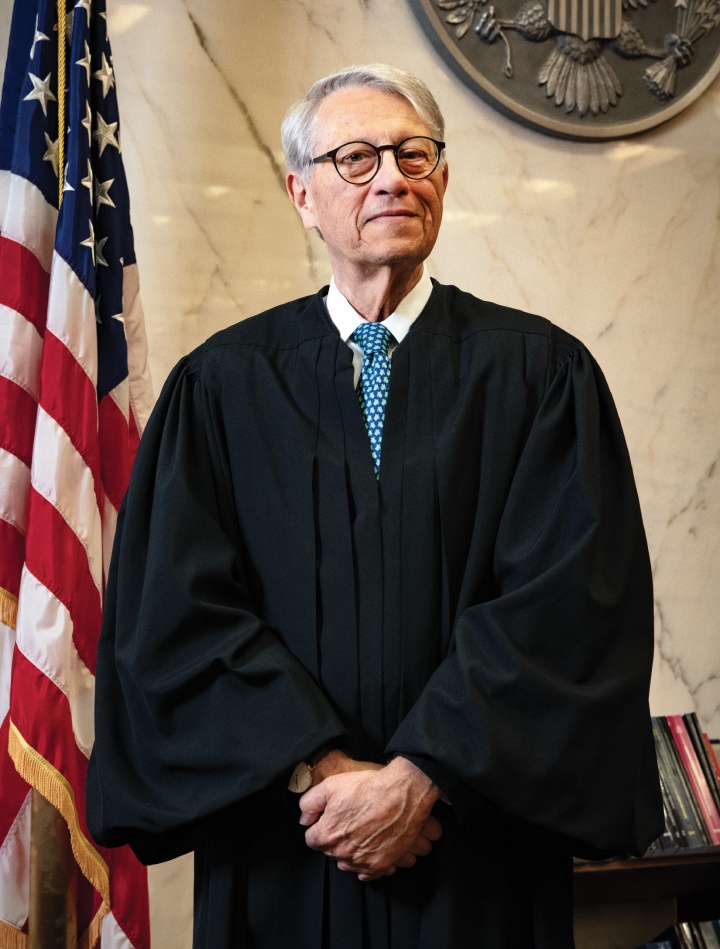
Photographs by Jörg Meyer
Garaufis has a special reason to enjoy coming to work these days: For the first time in his quarter-century as a judge, all three of his law clerks — chosen through a rigorously competitive process — are Columbia College alumni. He was unaware of this until a few months ago, when one of the trio, Ourania Yancopoulos ’16, JRN’21, LAW’23, pointed it out during a group lunch at his favorite Brooklyn Heights diner. Her fellow clerks this year are Scott Aronin ’15 and Ned Brose ’17, who attended Stanford and NYU law schools, respectively.
“It’s a stellar group,” Garaufis says. “It’s a joy to have law clerks who are so talented, so engaged and enthusiastic. We look carefully at many candidates; they’re the best of the best.”
As happy as he is to speak about his clerks, or to reflect on his long career, Garaufis is firm about withholding comment on the partisan political issues roiling the nation or on matters that might come before the court. He does, however, have something to say about governmental defiance of judicial directives.
“The judiciary doesn’t have an enforcement mechanism,” he says. “So when there is a final decision of the judiciary and remedies of appeal have been exhausted, the courts must be obeyed by the other branches of the government. Without that, we’re operating in a lawless society. That system has worked rather well for the last 250 years, and hopefully, it will keep working well for the next 250.”
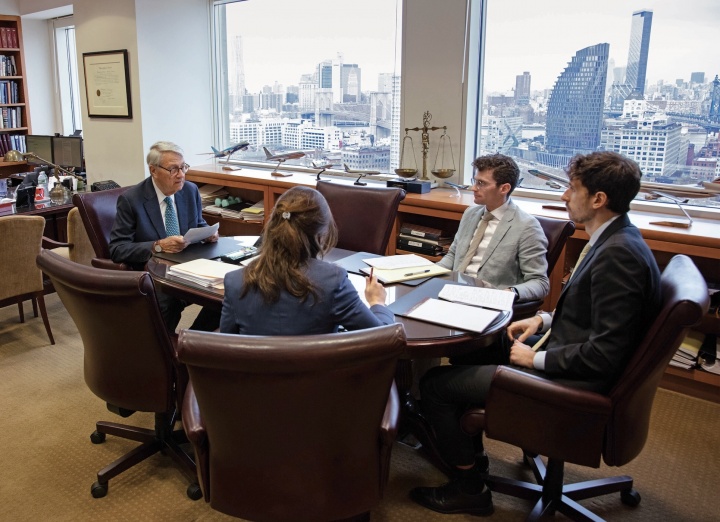
Garaufis meets with his clerks at his Downtown Brooklyn office.
The grandson of Greek immigrants, Garaufis was born in Paterson, N.J., and raised in Bayside, Queens, where he attended public schools. His father was a mechanical engineer; his mother worked in the district office of liberal Republican congressman Seymour Halpern, who co-sponsored the 1964 Civil Rights and Medicare bills in the House.
At the College, Garaufis majored in history, studying with memorable professors like James P. Shenton ’49, GSAS’54 and David Rothman ’58, who became a lifelong friend. The required Music Humanities course also had lasting effects. When his instructor, the composer Charles Dodge GSAS’66, SOA’70, noticed that Garaufis had a concert report due, Dodge showed him the New York Times music listings and said, “Just go.” So Garaufis went to Carnegie Hall for the first time and was enthralled. “I’ve had a subscription to the New York Philharmonic for 50 years,” he says.
Spectator also occupied a large chunk of his time. As a senior, he was the paper’s business manager; he later served on its alumni board for 40 years. It was at Spec that Garaufis met his first wife, Eleanor Prescott BC’68, JRN’70, who made history as the first woman to serve on the editorial board. (She later worked at Newsweek, Today and ABC News.) They were married in 1981 and had two sons, Jamie and Matthew. Prescott died in 1997.
Garaufis was admitted to the Law School as a senior but deferred enrolling for two years while he performed basic training in the Army National Guard and taught history and social studies in Bayside schools. Back on campus, he co-founded the Columbia Journal of Environmental Law, one of the first of its kind, with classmate Maria E. Garcia BC’69, LAW’74.
If judicial decisions are not obeyed by the other branches of government, Garaufis says, “We are operating in a lawless society.”
He began his legal career as a litigation associate at Chadbourne, Parke, Whiteside & Wolff, and then, in 1975, joined New York State Attorney General Louis J. Lefkowitz’s staff as an assistant attorney general. Garaufis remembers the popular Lefkowitz as a shrewd, politically deft dynamo who spoke with an old-time Lower East Side accent, kept an open-door policy and hired a cadre of brilliant women from elite law schools at a time when women were not yet welcomed by many top firms. Garaufis is grateful to have worked in their midst. “They became my mentors,” he says.
Four years later, Garaufis went into private practice in Queens, and, in 1986, was named counsel to Queens Borough President Claire Shulman, a position he held for nine years. It was a further education in the rough-and-tumble of local politics. “I had to work with people in the community, people from other governmental offices, with businesspeople,” he says.
With both LaGuardia and Kennedy airports situated in Queens, Garaufis necessarily had extensive dealings with the FAA, the airlines and governing agencies. This background proved pivotal in 1989 when he negotiated a temporary flight path at LaGuardia that would avoid disrupting the nearby U.S. Open tennis tournament for two weeks each year. His experiences with New York aviation, in turn, helped lead to his appointment in 1995 as chief counsel of the FAA, where he supervised a staff of 200 lawyers.
Garaufis was involved in the inter-agency reviews of several catastrophic plane crashes, including the explosion of TWA Flight 800 off the South Shore of Long Island in 1996. After ValuJet Flight 592 went down in the Florida Everglades the same year — the result of improperly stored oxygen canisters — he led the implementation of stringent new air safety regulations. Some carriers resisted the guidelines because of the added expense they mandated; one impressive exception, Garaufis says, was a nascent airline, originally named NewAir, which wholeheartedly embraced the tighter standards and consulted regularly with the chief counsel about achieving full compliance. That airline, renamed JetBlue, has not experienced a fatal accident since it began operation in 2000.
Garaufis left the FAA, also in 2000, when he entered the judiciary. The transition gained him more than a robe and gavel. He first met Betsy Seidman, a civically active nonprofit consultant, in 1999, when he was interviewed by Moynihan’s judicial selection committee, on which she was serving. They were married in 2002. “That’s Nick for you,” Supreme Court Justice Sonia Sotomayor remarked at the unveiling of Garaufis’ official portrait in 2014, when he attained senior status on the court. “He’s the only guy I know who could walk into a job interview and walk away with both the job and a wife.”
The Eastern District of New York is one of the largest federal jurisdictions in the United States, covering Brooklyn, Queens, Staten Island and Long Island’s Nassau and Suffolk counties. The outcomes of many of Garaufis’ cases there have had wide repercussions.
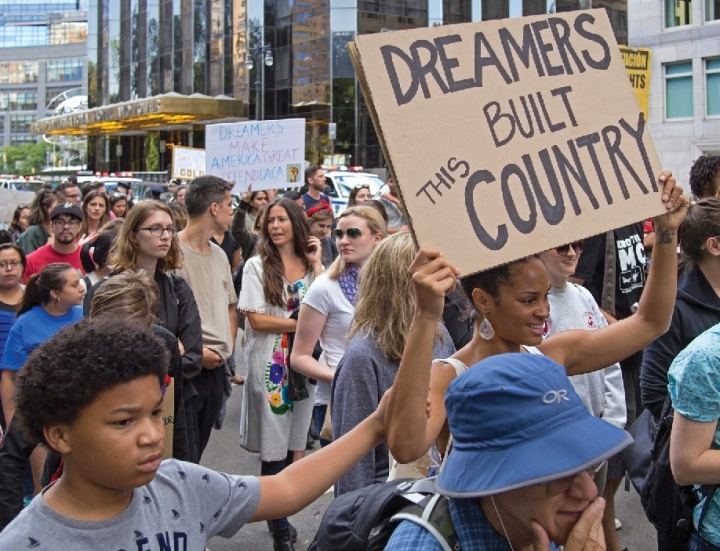
In 2018, Garaufis issued a nationwide preliminary injunction halting the Department of Homeland Security’s proposed crippling of the DACA program for more than a half-million children of undocumented immigrants.
RHODODENDRITES / WIKIMEDIA
Another headline-making case under Garaufis’ purview also concluded this past fall, when the U.S. Court of Appeals for the Second Circuit upheld the earlier conviction and sentencing of Keith Raniere, the cult leader of NXIVM, a purported self-help group for women, on charges that included sex trafficking, racketeering, wire fraud and forced labor. Raniere faces 120 years behind bars.
Gentle and considerate in private, Garaufis can be stern when called for in court. Stanley Zareff, a New York acting coach and consultant who attended the NXIVM trial, remembers Garaufis silently staring down an out-of-line defense attorney for “what seemed like 20 minutes” in a hushed courtroom, until the man finally apologized. “He absolutely is a brilliant communicator because he owns the room,” Zareff says. “And he knows when to relax things a bit with humor, too.”
One of the judge’s own favorite cases centered on a 12-year-old boy’s guitar that had been shakily autographed by George Harrison shortly before the former Beatle died of cancer in 2001.
Harrison’s wife, Olivia, had brought her ailing husband from Switzerland to the U.S. to pursue last-hope experimental treatment with Dr. Gilbert Lederman, a radiation oncologist at Staten Island University Hospital. One day Lederman brought his kids to meet Harrison and have him sign his son’s guitar. Had a doctor bullied a dying celebrity into creating a priceless piece of memorabilia, or had a grateful patient gladly consented to please a young fan? That was the question at the heart of the $10 million lawsuit the Harrison estate slapped on Lederman and the hospital in 2004. The whole affair made for juicy tabloid fodder; the doctor was widely reviled and his son was harassed by reporters and schoolmates alike.
The case went on for two weeks without either side budging on a settlement, when Garaufis decided he had heard enough. “There are many, many people out there who loved George Harrison and wouldn’t want to see this devolve into a circus of litigation,” he said.
He issued an ultimatum: Either the parties settle by 3:00 p.m. the next day, a Friday, or he would summon all parties to appear in New York — coming from London, Hawaii and elsewhere — to resolve it with the judge himself on Monday. The pressure tactic worked. At 2:30 Friday afternoon, they reached agreement: The lawsuit would be dropped, no money would be exchanged and the guitar in question would be “disposed of privately.”
“The only request I made is that I be allowed to indicate that Harrison’s family appreciated that Dr. Lederman’s son was an admirer,” Garaufis says. “I felt that he was a victim of this whole unpleasantness.” Garaufis then shared a more personal thought. “George Harrison’s music,” he said, “spoke to the heart and soul of my generation.”
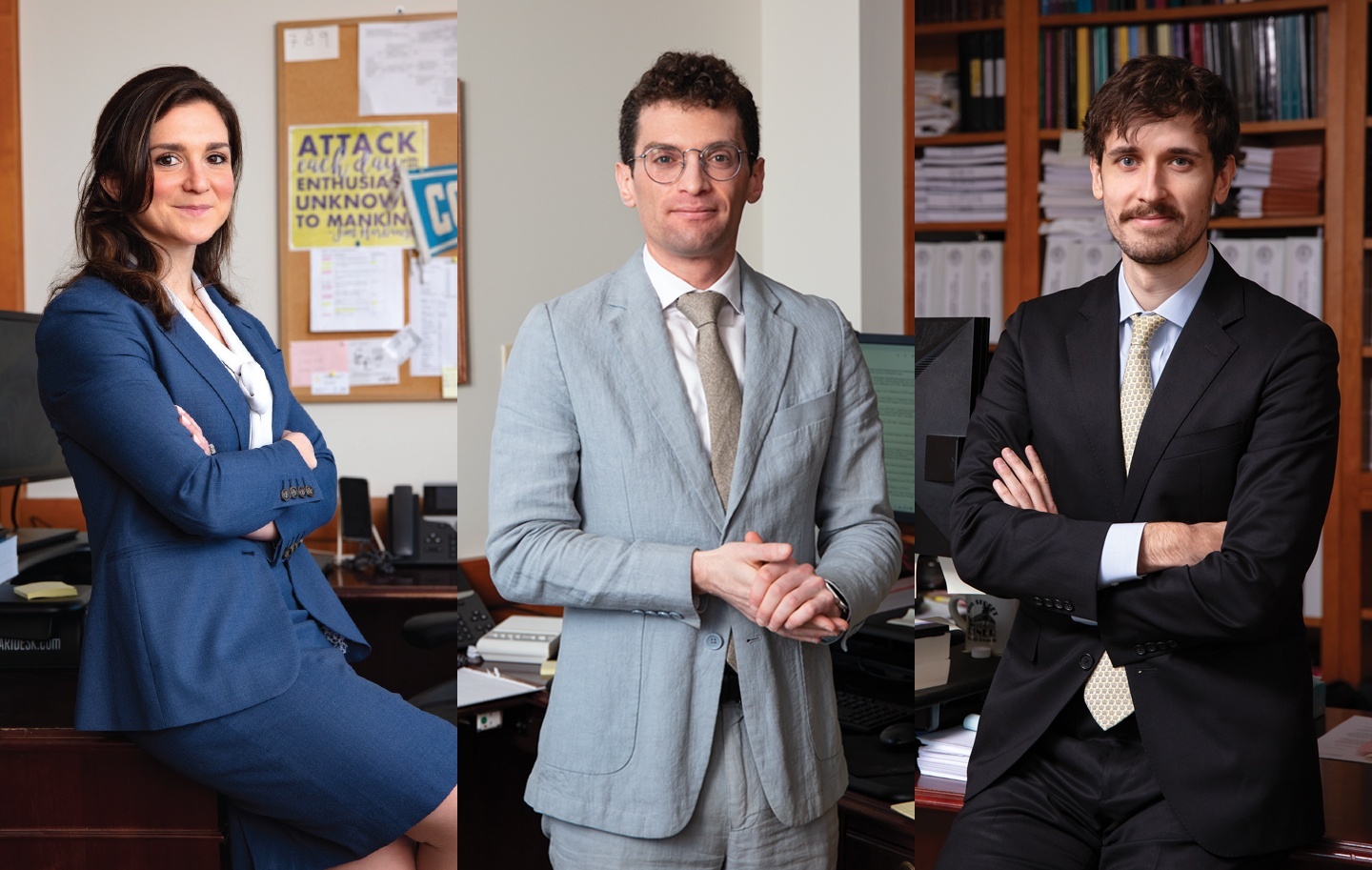
Left to right: Ourania Yancopoulos ’16, JRN’21, LAW’23; Scott Aronin ’15; Ned Brose ’17
Working with Garaufis has been a powerful learning experience for the law clerks. “Judge is not somebody who just looks at the law and the outcome of a case in the abstract,” says Yancopoulos. “He truly, truly cares about people and is thinking about how the law and his opinions are going to impact them.” She points to a case she attended the previous week, where she was moved by his holistic concern for a man being sentenced for robbery.
“He was someone who’s had a really tough go of it and got caught up in the criminal justice system. He faced a possible term of imprisonment,” she says. “Judge sentenced this man to time served. In doing so, he remarked on everything that the man had been through and had overcome since this particular criminal action began. Judge also spoke directly to the mother, who was in the courtroom. He said she has a responsibility to make sure that he keeps going down the right path and keeps making the right decisions.”
Brose and Aronin concur. “Judge shows a lot of humanity,” Brose says. “He’s often wry and sometimes humorous from the bench, but I think he approaches all cases with a lot of thoughtfulness and compassion, while trying to serve the interest of justice.”
“He really cares about getting it right in every way, managing his courtroom, caring about his clerks,” says Aronin. “It’s been like watching a master class. I consider myself very grateful to have the chance to learn under him.”
A lifetime of learning informs Garaufis’ ability to serve as such a strong example of the judicial calling.
“We are the sum total of our experiences,” he says. “We come into the judiciary having had careers as lawyers, in public service, in private business. We use our morality, our education and our common sense to address issues that come before us. We make an effort to set aside any biases that we may have developed over time.
“I think everything you do in life should sensitize you to the needs and the problems of other people. In most jobs, this is an important consideration at least some of the time. If you’re engaged in the work of the judiciary, it’s all the time.”
Former CCT editor Jamie Katz ’72, BUS’80 is now a contributing editor to the magazine. His most recent piece was an Online Exclusive about Ben Rosenblum ’16, “A Jazzman at Heart.”

Published three times a year by Columbia College for alumni, students, faculty, parents and friends.
Columbia Alumni Center
622 W. 113th St., MC 4530, 6th Fl.
New York, NY 10025
212-851-7852
cct@columbia.edu

Columbia Alumni Center
622 W. 113th St., MC 4530, 4th Fl.
New York, NY 10025
212-851-7488
ccalumni@columbia.edu